

One year ago, I left The Atlantic, where I’d worked happily for nearly 17 years, to launch this Substack. This week, my newsletter turns one. So, I wanted to use its first birthday to reflect on the state of the business, what I’ve learned about writing a newsletter on this platform, and where I’m trying to grow in the next year.
The best place to begin is with gratitude. I was infinitely fortunate to be hired by The Atlantic when I was 22. I made a great living there, and I was well-read by the magazine’s millions of readers. So I was worried that I would be sacrificing income or reach in exchange for a certain taste of freedom. But Substack has been a wonderful home, and you have been sensational and generous readers. Thank you, thank you, thank you. I’m going to share total subscriber numbers below, rather than specify my current annualized run rate. But it is enough to say that my ARR surpassed my Atlantic salary after about five months, and has continued to grow. With direct access to a subscription audience, my average per-article readership in 2026 now rivals or surpasses any year I can recollect at the magazine. None of this would be possible without you. So, thanks again.
If you’ve been thinking about becoming a subscriber, or buying a subscription for someone as a gift, I have a special offer for you. For the next week, you can get 35% off a subscription to this newsletter to read:
AI analysis on the case for and against a bubble; AI’s effect on medicine, the rise and fall of tokenmaxxing in 2026, and interviews with frontier lab executives
Economic analysis on labor market mysteries and the risk of stagflation
Essays of social criticism on how young people are becoming “monks in the casino”, why the story of media is that “everything is television”, why the story of health and individualism today is the rise of the “enhanced self,” and the dangers of “zombie flow” in our leisure time
My reflections on fatherhood and the modern family
To read all this and more, please subscribe here:

How the business is doing
After one year, the newsletter has nearly 110,000 subscribers, with a paid-subscriber conversion rate around 5.5 percent. This is what the last year’s total subscriber growth looks like.
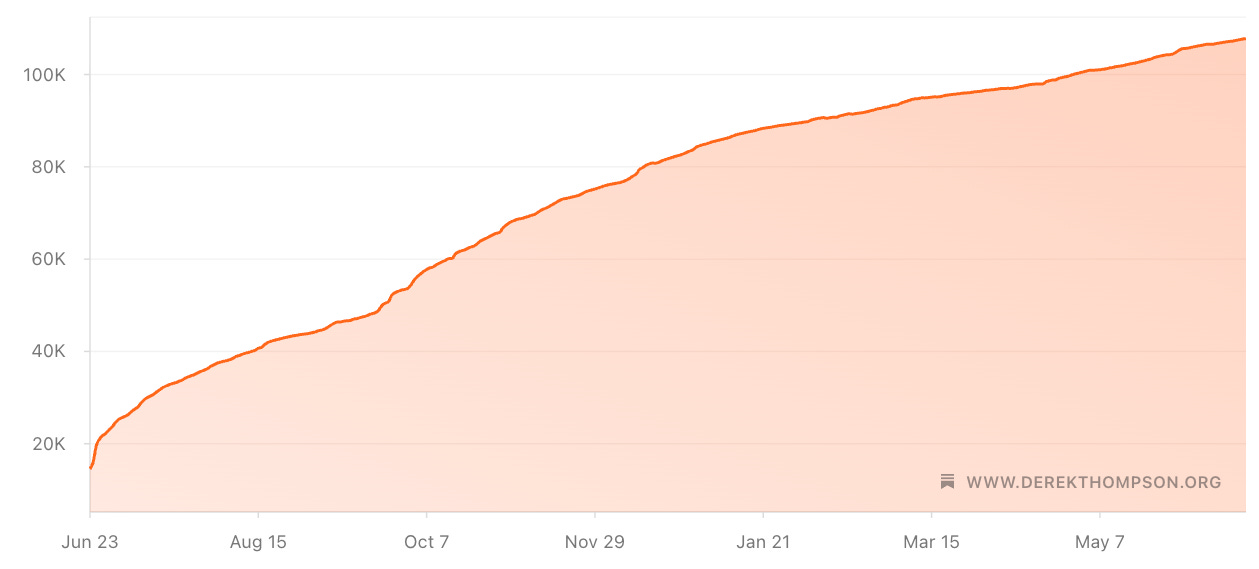
It’s a bit odd that the subscriber line looks this smooth, because the experience of running the newsletter is a limbic roller coaster, with dopamine corkscrews followed by cortisol flips. I guess you could squint and see some life lesson here—that, despite the turbulent, hour-to-hour emotional experience of being alive, the exercise of looking back on longer stretches of our lives often reveals a smoother narrative arc, and many worries that once felt existential fade so completely that it’s impossible to even remember the things that once tortured us. In any case, yeah, the growth line looks steady and the newsletter currently adds about 1,000 new subscribers every week.
The most-read articles of the last year
I’ve written 13 articles with more than 150,000 views. Somewhat to my surprise, my most popular article was a digest of screenshots I’d taken on my phone of papers, charts, and book passages throughout the year. The resulting compendium, The 25 Most Interesting Ideas of 2025, still receives thousands of views a day and is on track to be my first article to surpass 400,000 views on the newsletter. (The fourth biggest article from the last year is a similar roundup.)
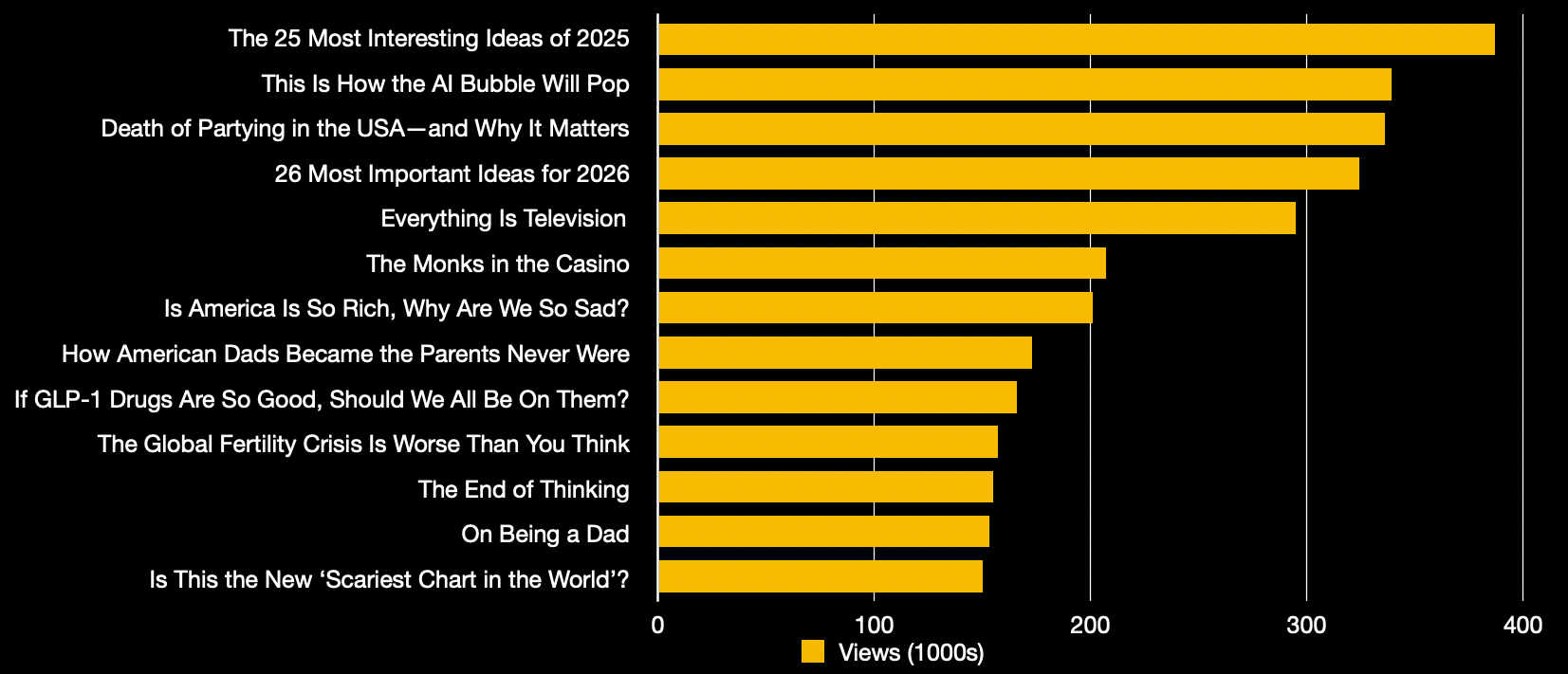
The rest of the 150k Club is, I’m pleased to say, all over the place: the macroeconomics of AI, the promise of GLP-1s, the death of partying, the mystery of declining happiness in America, and finally my favorite big-swing essays on media (Everything Is Television), young men (The Monks in the Casino), and fatherhood (On Being a Dad).
Some lessons on writing for Substack
Results scale with effort. I wish I could tell you that I’ve discovered a cheat code to writing articles that get lots of people to read and sign up for my newsletter. I have not discovered a cheat code, and I promise to tell you if I do. Instead, what I’ve found—and this is either mildly depressing, or supremely gratifying, or both—is that my most popular articles tend to be stories that I fall in love with and spend dozens of hours reporting and writing and editing. The stories that I work on the longest are the stories that get the highest open rates, the most shares, the most comments, the most retweets on Twitter, and the most new subscribers. The stories that I bang out in a few hours because I feel itchy about not having published in a while? Well, they typically go nowhere.
Beware bleh (or: Don’t publish something until you can’t wait to share it.) Some writing is awesome. Some writing is slop. And between the zenith of awesome and the valley of slop, there is a vast landscape of bleh. Bleh is not bad. It’s fine. But its fineness makes it worse and far more dangerous than bad writing. When a piece of writing is going to be bad, you probably know it, so you abandon it early and don’t publish it. But even the best newspapers, magazines, and newsletters publish plenty of bleh, and it’s a waste of time for everyone. It’s a waste of time for the writer, who could be working on something more awesome. And it’s a waste of time for the audience, which could be reading something better. In my haste to publish something every week, I have occasionally allowed bleh to finagle its way onto this platform, and for that, I apologize. Over the last few months, I’ve tried to adhere to a new rule: I don’t publish something until I can’t wait to share it. If I’m not burning with anticipation about tweeting out an article on Tuesday morning, I shouldn’t pretend to be done with it on Monday. I should report more, think more, and write more, until l’ve surpassed the bleh threshold and completed something that I want to shout about to the world.
Dimes for analysis, dollars for information, Benjamins for AI. While I’m extremely proud of my Atlantic-style essays, I’ve learned that paid subscriptions on Substack don’t just scale with effort. They also scale with deep factual reporting and the ability to unearth information that might be useful to investors or anybody who follows markets. The articles that have converted the most paid subscribers tend to be in the realm of economics, finance, and technology, and they tend to be quite technical (i.e., here’s what BLS data says about the labor market for young people) rather than broadly analytical (i.e., theories about why young people are lonely). It’s also clear that artificial intelligence over-performs for paid subscribers, but not necessarily for all subscribers. The four articles that have driven the most paid subscriptions in the past year were all about AI—three were about the macroeconomic case for AI being a bubble (or not) and the fourth was about whether AI was responsible for the declining hiring rate since 2022 (it’s not).
A longer leash for the weird and personal. When I joined Substack, I did my best to study writers like me to learn how their work differed from the sort of magazine-style essays that I had spent the previous decade-point-five working on. I determined that the biggest difference I saw was that, while heavily edited Atlantic features were often polished and edited by many hands to produce a (in the best cases) smooth argument or narrative, the Substack essays were less smooth. Many of them had a sort of spiky exuberance. You could imagine the sweaty hands that typed the essay on a MacBook keyboard with some three-week-old spaghetti sauce crusted on the DELETE key. They had personality and verve and weirdness and, yes, flaws. Spiky exuberance sometimes looks like an absolute mess. But it’s a mess with character. When I started this newsletter, a close friend who is successful on this platform told me: “Remember that people aren’t paying for you to sound like a version of the New York Times op-eds that they’re already paying for. They’re paying for an individual. Sound like an individual.” I’m grateful that some of my most successful pieces, in particular my writing on fatherhood, have been personal, and admittedly strange, but extremely popular. Weird seems to scale on Substack.
Two final questions
How many Plain English transcripts do you want? My other big job is that I host the Plain English podcast. In the last few months, I’ve started to run several edited and annotated transcripts of my podcast as newsletters. Some of them have done very well. Two of the ten biggest articles in the newsletter’s history were podcast transcripts. But I want to get a sense of what subscribers want from me. How many Plain English transcripts do you want? Fill out the poll below or tell me in the comments.
What would make you more likely to subscribe? If you care to say, I want to know how I can make this newsletter more valuable to you. What are you waiting for? What do you want? Email me at derekthompson@substack.com.
Thanks, again
Really, this has been a dream year. Thank you for reading.