


I. The Ring
In December 2024, I received an Oura ring for the holidays. I thought I would hate it.
I’d had a messy relationship with other “wearable” technology designed to monitor my physical activity, or lack thereof. Years earlier, during a period of elevated stress and miserable sleep quality, I’d owned a different fitness device that wouldn’t stop sending me panicked notifications about my insomnia. Sleep was hard enough without the harsh judgment of one’s jewelry, I thought. I threw the thing in the trash.
But the ring I liked. One of the first things I learned was how alcohol affected my sleep. When I had a glass of wine after 8 p.m., my resting heart rate shot up, and my heart rate variability plummeted. This would lower my “Readiness” score, which is prominently featured on the smartphone app. But when I had the same glass while cooking dinner around 5:30 p.m., the wine had no effect on my Readiness number. Like so many elderly Millennials, I am the sort of person who cannot see a prominently labeled scoreboard without devoting myself to climbing it. So, without ever figuring out what heart-rate variability actually meant, I ditched the late-night drinks. (Mostly.)
The demise of the nightcap wasn’t the only way the ring changed my life. More profoundly, it altered my relationship to activity. Before a walk, after a workout, or even after a nap, I would check in with the app to see my Readiness, Activity, and Sleep scores. Each day was now compared with—even set in competition against—the previous day or the previous week. The ring pulled me into a feedback loop with a biometric technology that turned my body into a game board through which I could win or lose points.
The philosopher C. Thi Nguyen, who writes about the philosophy of games and metrics, has said that the modern world’s blizzard of numbers can obscure our wise yet murky questions about life and replace them with easy and legible goals. For example, someone might become a journalist to uncover important truths but then devote each week’s labor to maximizing page views; or she might get into philosophy to think about the deepest life questions but devote her life to maximizing her h-index. “Metrics are useful because they compress information,” Nguyen told me. “They are dangerous, because they compress information.”
At its best, the ring makes me fitter, happier, and, sure, even more productive. I walk more, lift more, sleep more, and drink less. You will be hard-pressed to find a physician who thinks there’s anything amiss in the previous sentence.
But the same doctor might not see how the obsession with winning the measurable games of health can encroach on the less measurable games of life. The best way to sleep more is to see fewer friends in the evening. The best way to lift more during the week is to eliminate social lunches to protect my midday gym time. To become a measurably enhanced self often means eliminating my less quantifiable sources of meaning and happiness.
The ring improved my life. But its form of self-improvement often pulls me away from other people. This left me with a nagging question. At what point is it unhealthy for me—for anyone, for all of us—to be this obsessed with health?
II. The Enhanced Self
Clearly, I am not the only American who is reconsidering his relationship with alcohol. The share of people who drink hit an all-time low last year, according to Gallup, whose data go back to 1939. Total beer consumption recently reached a 21st-century low, and wine vineyards are reportedly “in crisis.” While many social changes happen slowly, the attitude shift against alcohol has been quite sudden. The share of Americans who say moderate drinking (defined as one or two drinks a day) is “bad for health” doubled in just the last 10 years. Two-thirds of Americans under 35 now tell Gallup that alcohol is harmful in any quantity.
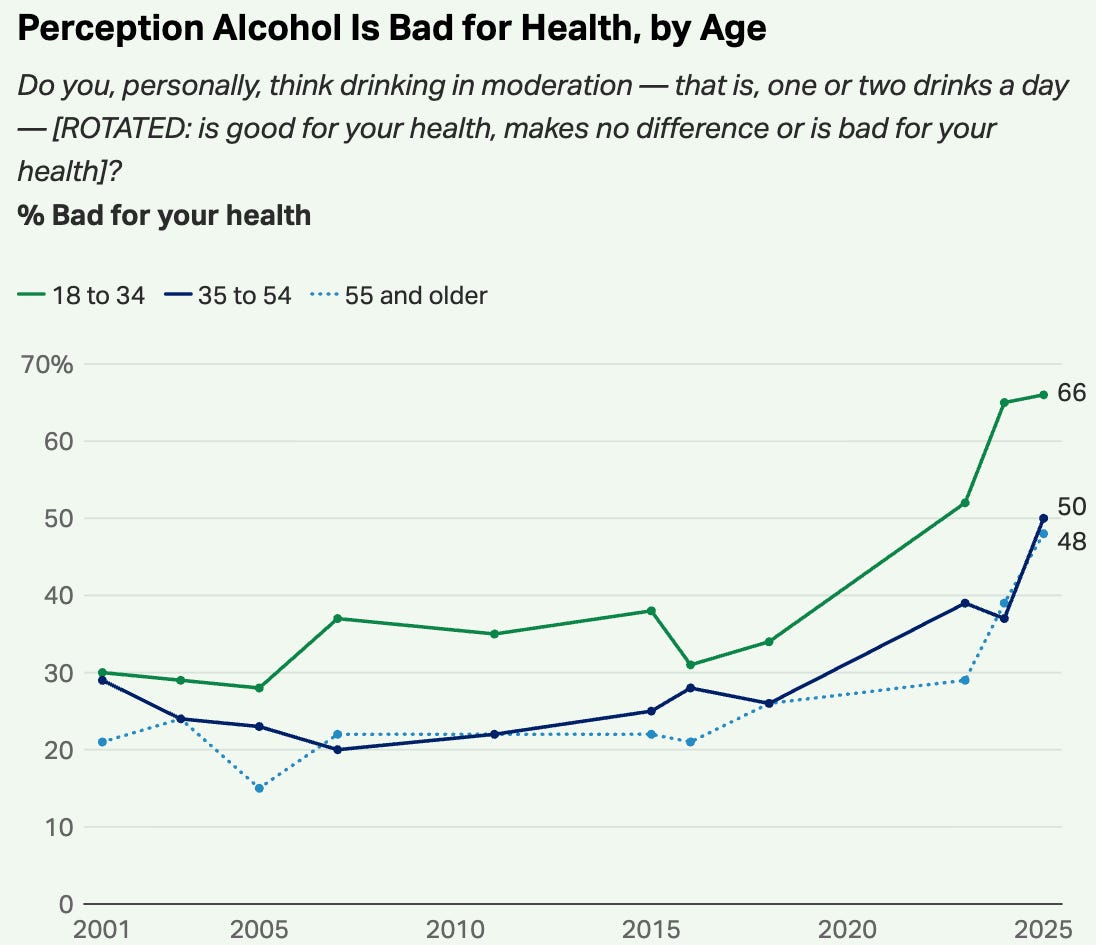
The decline of drinking is one part of a larger cultural phenomenon, a hydra-headed megatrend whose tentacles reach out to touch everything from science and medicine to technology and entertainment, reshaping the way that Americans think about themselves, their time, their friendships, and their future. It is the rise of the Enhanced Self.
The Enhanced Self is the evolution of medicine, technology, and consumer culture from an emphasis on curing illness to an obsession with optimizing normal, healthy life. We see this with the rise of GLP-1s, the explosion in biohacking with peptides (injectables that affect inflammation and gut health and are also the “P” in GLP), and the continued growth of supplements. More Americans are using therapies not only to cure what is wrong with them but also to improve what is not wrong with them. At the layer of leisure, the tendrils of the Enhanced Self touch the white-hot rise of fitness in American life. A record 77 million Americans belonged to a gym or studio in 2024, up 20 percent since before the pandemic. Running clubs on the fitness app Strava nearly quadrupled in 2025 alone. If you don’t believe the industry data, perhaps you’ll believe the federal government: according to the American Time Use Survey, Americans today exercise and play sports more than at any period on record.
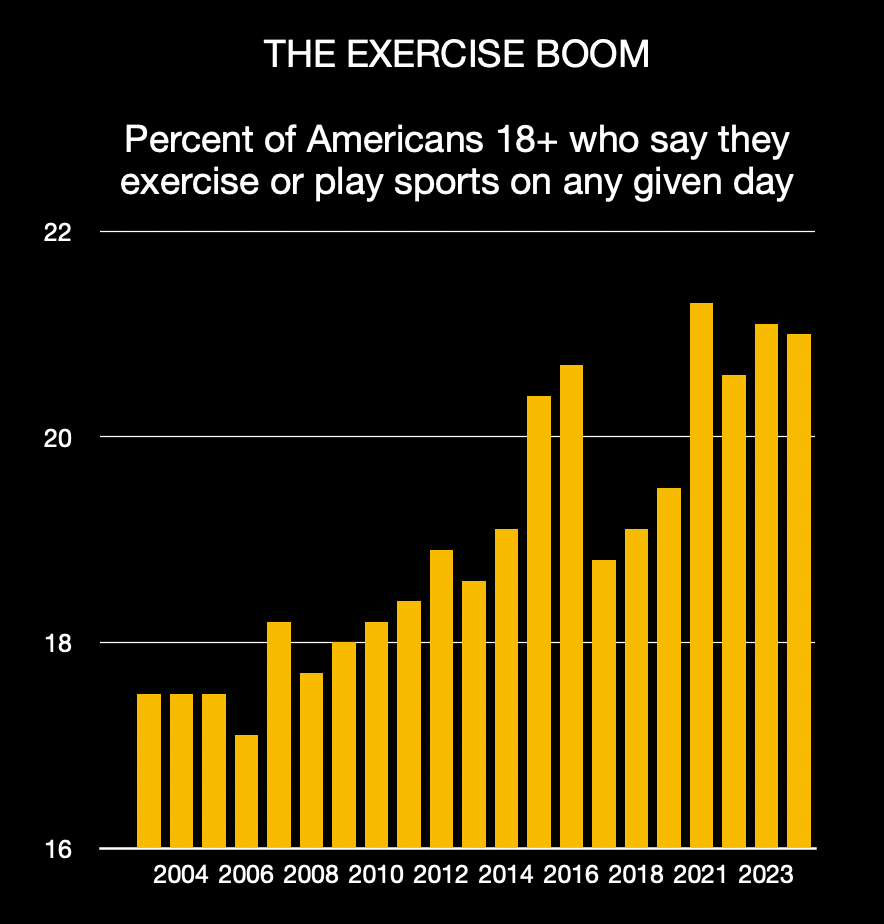
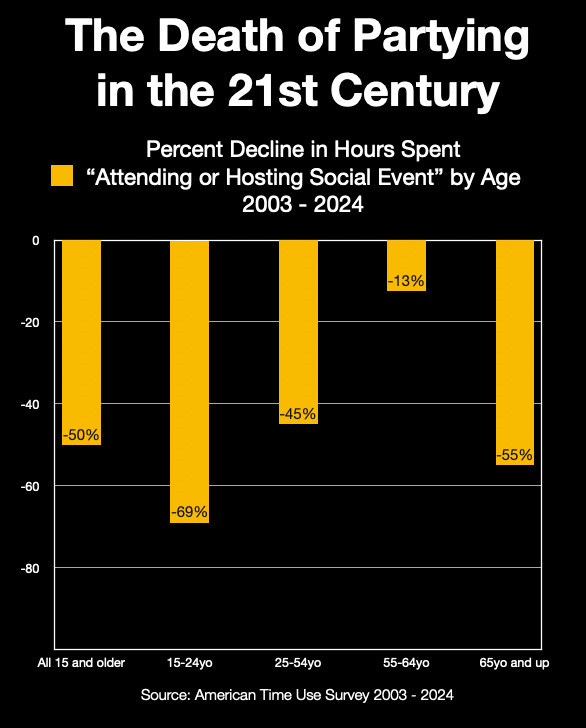
At the layer of biology, the Enhanced Self incorporates the belief that the human body is akin to a single-issue hardware device, whose owner should obsessively seek to extend its operating life beyond its scheduled date of obsolescence through relentless work and eagle-eyed neuroticism. At the layer of sociology, the Enhanced Self is inseparable from the decline of socialization, which I have previously called the anti-social century. While running clubs and morning workouts are booming—and I am positive that these are highly social events for at least some of their participants—nightclubs are closing and parties are withering. Young Americans spend about 35 percent less time socializing and 70 percent less time attending or hosting parties than they did at the beginning of the century.
America’s self-improvement tradition is practically as old as the country. Benjamin Franklin tracked thirteen virtues on a daily scorecard. Sylvester Graham preached dietary reform in the 1830s. The instinct to improve the body, and to moralize that improvement, is anciently American.
These earlier iterations of self-improvement drew their power from religion, community, or characterological projects to promote civic virtue. Temperance, for example, was not just about individual health; it was a social movement to improve the culture, to rescue women and children from alcoholic husbands, and to build a better republic. (That it failed in myriad ways is not to deny that some of its goals were virtuous.) The Muscular Christianity movement of the 19th century paired New Testament virtues with an ethic of manly strength in a way that wouldn’t be so out of step with modern MAGA and MAHA machismo.
But the age of the Enhanced Self is different, not only because many of its elements are distinctly of the 2020s—including peptide shots, social media, and biometric scanners—but also because it does not particularly seek to build anything outside of the self. For all its sins, the temperance movement was focused on national change. But the typical adherent to the Enhanced Self—say, a 50-year-old with a peptide stack and a Whoop—is not trying to improve the country. He’s just trying to improve his score.
The history of alcohol abstention offers another way to see how the Enhanced Self is a truly modern phenomenon. For a long time, abstinence was associated with religion or personal histories, such as addiction recovery or pregnancy. But in the new health culture, abstinence is not about faith or addiction; it is about bodily perfection. On health podcasts and videos, influencers and science communicators talk about alcohol’s association with sleep scores, skin clarity, energy levels, cardiometabolic biometrics, and executive function. The explosive growth of non-alcoholic breweries like Athletic Brewing offers commercial proof in a secular age that the decline of drinking has little to do with faith. Modern sobriety, for better or worse, is not about addiction, but enhancement; not about our body politic, but about our bodies—period.
III. The Three Pillars of the Enhanced Self
The Enhanced Self is defined by three distinct tendencies. None of these ideas are entirely new in the 2020s, but the combination of science, technology, and social media has afforded them special power.
1. OPTIMIZATION AS THE NEW VIRTUE: Many drugs and devices initially invented to cure the sick become instruments to greatly enhance the healthy.
In his book Outlive, which serves as a kind of Bible of self-enhancement, the scientist and podcaster Peter Attia divides the history of medicine into three phases. Medicine 1.0 was the prescientific era of doctors trying and mostly failing to treat disease. Medicine 2.0 is the modern approach, in which doctors cure illness with the full apparatus of science, including randomized drug trials. Medicine 3.0, Attia argues, goes further: it stops chronic illness before it takes hold, through personalized, data-driven preventative care.
This is the medical logic of the Enhanced Self, in which drugs and devices built to cure the sick become instruments to enhance the healthy. GLP-1s designed for diabetics now quiet food noise in millions of people who simply want to eat less. Continuous glucose monitors, originally designed for diabetics, have found a growing market among healthy people who want to know how an afternoon’s potato chip changes their blood sugar. Stacked on top, you have biohacking with off-label peptides1, experimentation with supplements, and hormone therapies, including replacement therapy. Prescriptions for TRT rose from 7.3 million in 2019 to more than 11 million in 2024, a 50 percent increase in five years, with an even steeper rise among men aged 35 to 44.2
Put it together—peptides, supplements, and hormone therapy, connected through the web of biometric data made available by fitness trackers—and today’s self-enhancers are armed with a portfolio of pharmacological and technological tools, allowing them to treat their bodies like improvable machines.
2. FITNESS AS THE NEW CLASS MARKER: We used to compare ourselves based on money. But fitness trackers and biomarkers create a parallel class system that makes us feel superior to, or inferior to, everybody else.
A generation ago, high-status Americans bragged about how little they slept, as a proxy for their work ethic. Today, the even-richer elite brag about how much they sleep, as a testament to their ability to outrun mortality. They toy with sleep stacks of magnesium and melatonin. They try mouth tape, white-noise-cancellation devices, and multithousand-dollar cooling mattresses. I have witnessed adults comparing deep-sleep percentages the way their younger selves once compared GPAs and SAT scores.
If you squint, it looks like health is becoming the new status marker and, perhaps, the ultimate status signal. For centuries, people compared themselves to others based on income, in part because money is standardized, measurable, and visible. If you earn $1,000,000 a year, and I earn $50,000 a year, then we both know where we stand relative to the other in purchasing power. Fitness comparison, by contrast, was more difficult, except in obvious cases of diagnosis (i.e., a neighbor who has cancer) and physical appearance (i.e., an extremely thin or heavy person in the office). But as fitness biomarkers and peptide stacks become part of upper-class conversation, people can more easily rank themselves against others, turning health into a comparative status marker.
Every cultural movement mints a new class of celebrity, and the Enhanced Self is no exception. Attia turned longevity medicine into a mainstream preoccupation. Andrew Huberman built a podcast empire on the premise that every behavior, from morning sunlight exposure to cold-water dips, could be neurochemically optimized. Bryan Johnson became the human embodiment of the movement’s extremes, spending millions of dollars a year submitting his body to hundreds of interventions in a war against aging.
What these figures sell, beyond supplements and programs, is the feeling of superiority along with an insider’s vocabulary: VO₂ max, grip strength, Zone 2 cardio, DEXA scans. These terms have migrated from exercise physiology textbooks into dinner-party conversation, giving ordinary people—or disproportionately affluent people—benchmarks for comparing themselves to others, as they think about their bodies as systems to be monitored and compared.
Once we see bodies as measurable and improvable systems over which we exert a certain amount of control, it is only a small step toward thinking of personal health as an enterprise that requires an almost managerial approach—that is, as yet another job.
3. HEALTH AS THE ULTIMATE JOB: More people are treating health maintenance as a kind of professional occupation, one that makes them behave like the chief executive of their own body.
The historian Alfred Chandler argued in The Visible Hand that the telegraph and the railroad moved information so fast that companies needed a new kind of person to handle it. They were called “managers,” and thus was managerial capitalism born.
Something similar is happening in modern health. The eruption of biometric data from wearable devices, along with the genetic and diagnostic tests that forecast our futures3, produces a flood of information that demands a managerial response. I find it almost impossible to look at my Oura ring without comparing this week’s heart rate and exercise data to last week’s. When I read one day’s numbers (huh, that exercise score looks awful), I feel obligated to adjust my behavior (I should schedule a walk). As more people manage this deluge of information flow, they will face the same problem as 19th century chain stores, and they will begin to think of their anatomical output as a product to be managed. Slowly and then quickly, many of them will come to see themselves as akin to chief executives of their own bodies.4
As strange as this might sound, I think the Self Executive will become an identifiable figure in the next few years. By this I mean: More people will talk about their health, their fitness, and their life extension procedures as if they were a job, a career, or a calling. In the process, they will somewhat invert the historical role of leisure in modern life. In the traditional arrangement, people go to the office, where they focus on being productive, and then go home and relax. But today, fitness and health fixations are colonizing leisure at the same time that our wearable devices gather, sort, and grade the data that our bodies produce. Over time, this trains people to approach their downtime with the very same productivity mindset that they were supposed to leave at the office. In short, the Enhanced Self turns personal health into a second job, one in which the individual serves as both the executive and the firm.
IV. Enhanced Selfishness
In one respect, the age of the Enhanced Self is a triumph. The fruits of this movement will include fitter people, with less disease, who live longer lives. This is not an achievement of mere accounting. It will mean millions of moms and dads who live to dance at their kids’ weddings. It will mean more friendships and partnerships that last into the 90s and beyond. It will mean children who know their grandparents by their touch and their smell and not just by their photographs.
As sure as I am that all health is good, I am skeptical that the Enhanced Self is a purely positive trend. The pursuit of health can go too far, and it can come at the expense of others. The three pillars of the Enhanced Self include optimization, class comparison, and running one’s body like a corporation. These are all individualist endeavors. Many of them are inherently solitary.
Many people have told me that the fitness boom is a direct response to declining social connection. For some, gyms and workout classes serve as the 21st century’s answer to shuttered union halls and molding bowling alleys. They are the new spaces where people, young and old, can go to seek out a social life, to talk to people, to attend events, and to become a member of a community.
But it is no coincidence that the age of the Enhanced Self is also an age of aloneness. Young people, who are seeing the highest increases in exercise time, also say they have fewer friends than any cohort ever; that they spend more time alone than any generation on record; and that they are more anxious and depressed than previous groups. Generation Z has the lowest levels of interpersonal trust of any group ever polled, the author and researcher Ryan Burge reported. “The velocity of their decline in trust already far exceeds any previous generation,” he wrote.
Our bodies want us to be social, even when we act like secular monks. Research by Sandra Weintraub of Northwestern University has found that “super-agers” (individuals over 80 with the cognitive function of people decades younger) shared little in common except for an unusually robust history of friendship and other social connections. A 2025 analysis of 500,000 participants in the UK Biobank reported that living with a partner and frequently visiting family had roughly the same relationship with longevity as exercise.
Our health is our own. It is one of those things that we cannot share with other people. And so, while the pursuit of health does not have to cleave us away from others, the project of delaying mortality is often a solitary undertaking.
V. Coda (Death)
Sometimes, I wonder what the Enhanced Self is all about. Surely, its emergence in American life has something to do with a traumatic pandemic winding down, the rise of the MAHA movement, and the migration of Nietzschean tech executives toward the center stage of internet culture, just as GLP-1s and new fitness trackers made certain kinds of self-improvement reachable for millions. Altogether, I think these forces have, like disconnected weather systems moving into a shared area, created a cyclone of a social phenomenon.
But deeper forces may be at work. In a sensationoal essay, the psychologist Adam Mastroianni notes that over the past few decades, high schoolers have steadily drunk less, smoked less, and fought less. In the same period, serial killers have all but vanished, blockbusters have grown less original, design has grown less distinctive, and cars have gone monochrome. Mastroianni ties these together with a theory he calls “the decline of deviance.” As people get richer and the world gets safer, deviance falls, because “life is worth more now.” When people think that they might live to be 100, the strategy for every life-game is the same: play it safe.
The novelist Karl Ove Knausgård once wrote that an irony of the modern world is that we are obsessed with cultural representations of death and yet terrified of the real thing. In movies and TV shows and podcasts and news, people are constantly dying; dead bodies are the hydrocarbons that power every modern plot. But no amount of represented death can prepare us for the thing itself. When bodies die in real life, we rush to hide them. In the hospital, they are filed away in subterranean basements, at the far end of long hallways that branch out like root systems, where no visitor can accidentally stumble upon them. Enraptured by death’s fiction, we are also terrified of its reality.
At bottom, enhancement culture is a disposition toward death—thinking about death, calculating distance from death, worshipping death like some Aztec priest offering sacrifices to appease the angry sun god. Bryan Johnson’s wellness company, book, and company-and-book-inspired Netflix documentary are not called “Live Better” or even “Live Forever.” It’s called “Don’t Die.” The moment-by-moment obsession with death may extend our lives. But when we cannot stop practicing this lifespan arithmetic—how much time will this drink cost me? how much time will that supplement buy me?—many of us will slip out of the thick appreciation of the here and now and approach life with all the verve of a lonely risk-assessment officer at a life insurance firm.
The fact that the Enhanced Self is often anti-social and the fact that it’s profoundly about death are not two different claims but rather two reflections of the same idea. Our fear of death motivates an all-consuming neuroticism about outrunning mortality, even when the price we pay is putting health optimization above everything else, including other people.
Last week, wrecked from travel, I saw a friend whom I hadn’t seen in months for drinks in Washington, D.C., on a Thursday. We had many things to celebrate—birthdays, babies—and oh how we celebrated. We stayed up too late. I drank too much. My head hit the pillow several hours after bedtime, and when I woke up, the mezcal left a dull ache behind my left eye. Turning toward my nightstand, I saw my Oura ring, which I’d taken off before slipping into bed. Data from the previous night’s sub-optimal sleep, like light particles within a black hole, would never reach the outside world. Thank god for that. I put the ring back on my finger, and I walked downstairs to make coffee. I don’t remember when the hangover ended. Was it one minute, one hour, a day? It doesn’t matter. What matters is that I saw my friend. He saw me, too. In more ways than one, we lived.
From the New York Times: “Imports of hormone and peptide compounds from China roughly doubled to $328 million in the first three quarters of 2025, from $164 million in the same period of 2024. This includes demand for GLPs, melanotan II, and other peptides from compounding pharmacies and gray-market suppliers.”
The same optimization instinct, applied to appearance, is reshaping the cosmetics industry. According to the American Society of Plastic Surgeons, nearly 10 million neuromodulator injections, mostly Botox, were performed in the United States in 2024 alone. From 2000 to 2020, the number of annual Botox injections increased by roughly 459 percent. As more young women embrace “preventative Botox,” the procedure’s demographic is getting younger each year, thus mimicking at the industry level the effect that Botox hopes to have on the human face.
Your reaction to the previous two sentences will depend on your attitude toward capitalism, your enthusiasm for running a business, and your experience with managers. I am not asking anybody to see this trend as purely good or bad. Biometric managerialism simply is happening, period.
The contrarian part here is that a culture can get healthier on paper while becoming thinner in spirit.
That’s what’s resonating. The problem isn’t fitness, sobriety, or wanting to live longer. The problem is when health stops being in service of life and starts becoming a second job that quietly crowds out friendship, spontaneity, and joy.
Feels to me like the real warning. A higher score isn’t always a better life.
It is of course possible to be active socially and still prioritize health/minimize alcohol. I'm 64 so perhaps have a different point of view since most of my friends are also drinking far less. As well, group fitness classes have a social element.