

The late psychologist Mihaly Csikszentmihalyi was troubled by a paradox of progress. People alive today have more sophisticated machines, medicines, and systems for organizing the world. So why haven’t these advances made us happier? “The gods of the Greeks were like helpless children compared to humankind today and the powers we now wield,” he wrote. And yet “we do not understand what happiness is any better than Aristotle did, and as for learning how to attain that blessed condition, one could argue that we have made no progress at all.”
So, Csikszentmihalyi set out to bring progress to the field of happiness research. Starting in the 1960s and continuing for decades, he interviewed thousands of people about what defined the “optimal” experiences. He recorded interviews with just about every profession and walk of life—from men and women, young and old, “Navajo shepherds, farmers in the Italian Alps, and workers on the assembly line in Chicago.” He heared in these diverse testimonies a kind of singular melody—a description of how, in the best parts of life, a feeling of self, time, and anxiety melt away in the face of deep immersion in an activity. He named this phenomenon “flow.”
Today you might hear self-help gurus talk about flow so constantly that the monosyllable has become a cliché without a clear definition. Csikszentmihalyi summed it up this way:
The best moments usually occur when a person’s body or mind is stretched to its limits in a voluntary effort to accomplish something difficult and worthwhile.
That’s pretty good. But of all the passages in his 1990 book Flow, I think this one comes closest to capturing the nearly spiritual quality that he was trying to convey:
The optimal state of inner experience is one in which there is order in consciousness. This happens when psychic energy—or attention—is invested in realistic goals, and when skills match the opportunities for action. The pursuit of a goal brings order in awareness because a person must concentrate attention on the task at hand and momentarily forget everything else. These periods of struggling to overcome challenges are what people find to be the most enjoyable times of their lives
Flow suggests a waterway—something liquidly effortless, an unimpeded stream. But the wisdom of Csikszentmihalyi was to recognize that well-being is no lazy river. It is neither ease nor effortlessness that leads to the highest happiness. It is something close to their opposite. It is immersion in an activity that is hard, but just hard enough; it is the discovery of comfort at the outer realm of difficulty. Life feels best, not when it is smoothed with frictionlessness, but when it is filled with achievable challenges.
FLOW AND FAMILIARITY IN CULTURE
I found Flow when I was writing my first book Hit Makers, in which I was trying to understand the psychology of popularity in culture. I was curious why some things—movies, songs, TV shows, art, and even political figures—become so popular while similar ideas and products fail to find an audience. To boil that book down to a very long sentence, my thesis was what I called “the law of familiar surprises”: Most of the time, audiences want to discover new things, but they are deeply enamored by familiar things, and so the critical challenge for most cultural producers is to make something that is optimally new; familiar but not too familiar; seemingly surprising but quietly traditional; a window to a new world that paradoxically shows you home.1
I was thrilled by Flow because its conclusion seemed in harmony with my own. The similarities between Flow is an achievable challenge and Popularity is a familiar surprise seemed to suggest a Goldilocks zone in human experience2.
In the years since Hit Makers was published in 2017, I’ve watched these two ideas—familiarity and flow—evolve, interact, and merge in strange ways. Familiarity, for its part, has overtaken pop culture, and I would not say that this has been an altogether positive development. Hollywood’s hit machine notoriously specializes in sequels, adaptations, and reboots—or, it might be just as accurate to say that movie-going audiences have, in an age of abundant content, reserved their small handful of annual tickets for familiar IP that they trust to entertain them. Even HBO, once prized for its bounty of original content, has caught the bug. Today, its most popular series include several Games of Thrones spinoffs, a Stephen King prequel, a video game adaptation, and, emperor of all familiarities, a Harry Potter reboot.
![OC] How sequels took over Hollywood : r/dataisbeautiful](https://substackcdn.com/image/fetch/$s_!BFJv!,f_auto,q_auto:good,fl_progressive:steep/https%3A%2F%2Fsubstack-post-media.s3.amazonaws.com%2Fpublic%2Fimages%2Ff507359a-0c39-4389-9930-6e6a1149f336_1268x744.png "OC] How sequels took over Hollywood : r/dataisbeautiful")
Beyond film and TV, it’s the same story in video games (see headlines such as: “Why the Gaming Industry’s Reliance on Sequels Is Killing Innovation”) and music. As The Atlantic’s Spencer Kornhaber reported, every year, a higher percentage of the albums streamed online is “catalog music,” meaning it is at least 18 months old. The triumph of familiarity in pop culture has itself become an overly familiar phenomenon. Everybody knows that everybody else knows that this is happening.

But something else is happening that deserves our attention—something that is simultaneously obvious and also almost too obvious in a way that makes it hard to see clearly. On our phones, the principle of familiarity is merging with flow to produce a new kind of high-tech passivity that resembles the experience of flow without fulfilling the meaning of it.
THE RISE OF ZOMBIE FLOW
The algorithmic newsfeed—from TikTok to Reels—is carefully engineered to organize compulsive short-term videos around the user’s revealed interests, for the purpose of maximizing the display of advertising squares. Scrolling has a funny way of immobilizing its user, numbing their mind, and producing a kind of disembodied timelessness.
The information systems researcher Shishi Wu coined an interesting term for the effect of short-form video platforms: “Passive Flow.” In her 2024 dissertation at the University of Massachusetts Boston, Wu wanted to understand why so many young users spend more time on social media platforms than they intend to. “This phenomenon cannot be fully explained by addiction or self-control failure,” she wrote. Instead, Wu proposed the theory of passive flow, which has three features. First, users engage without clear goals. The platform mindlessly pulls forward their attention, and they rarely pause to reflect on why they’re doing what they’re doing. Second, they lose self-awareness. They notice their body less, and disconnect with the world around them. Third, they experience “time transformation”—that is, they don’t just spend more time than they intended on the site, but also they lose track of time entirely.
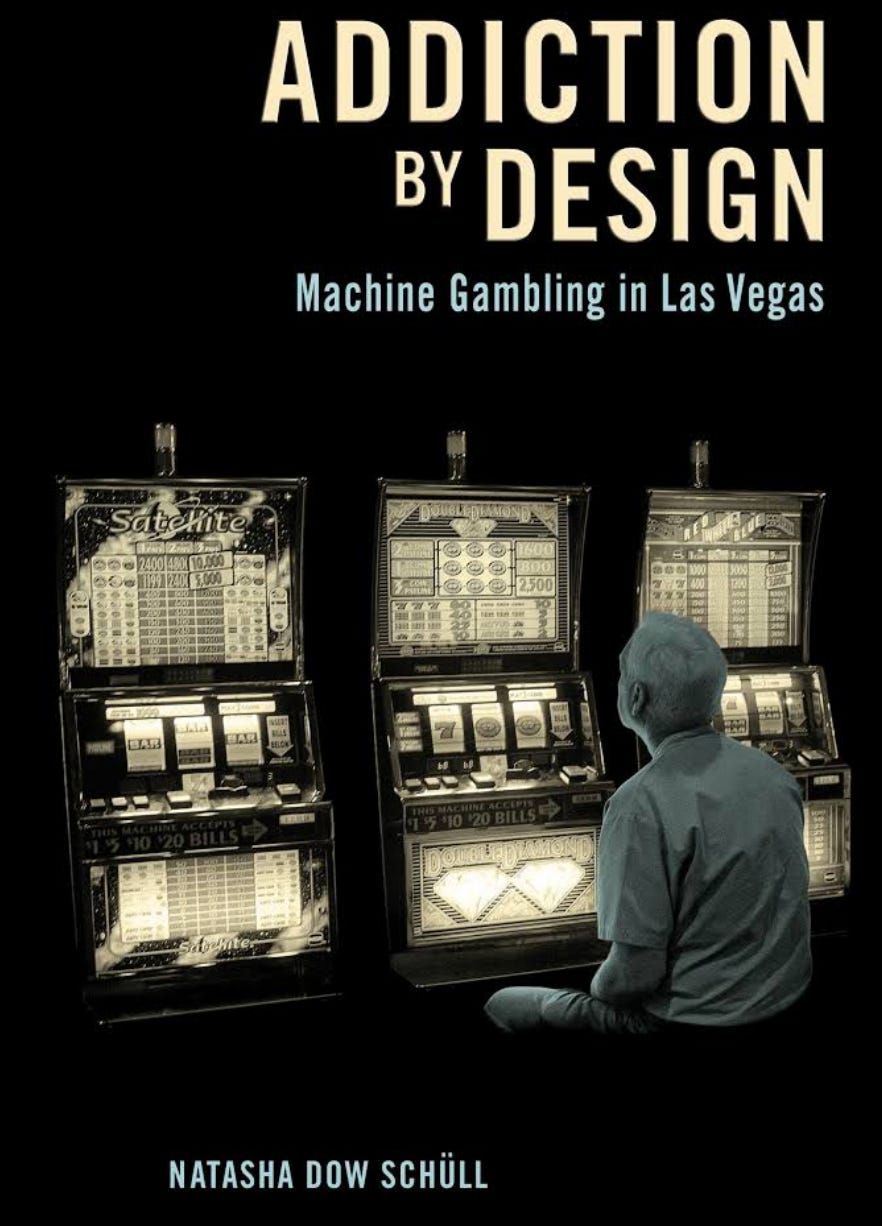
“Csikszentmihalyi didn’t say that flow needs to be pointed towards something great,” the author Brad Stulberg told me on my podcast Plain English. “You can experience flow when you’re falling in love or when you’re writing a book. But you can also experience flow scrolling on Twitter, gambling at a slot machine.” In fact, the anthropologist Natasha Dow Schüll, who studied Las Vegas casinos, found that gambling addiction is less about winning money than about achieving a “trancelike state” at the machines where the body’s sense of material reality melts away.
The psychologist Paul Bloom coined yet another term to describe the experience of being in the sort of weightless state of scrolling that you later come to regret: “shitty flow.” In shitty flow, time feels like it’s melting away, but upon reflection, it’s melting away from the direction that you want to live. “During these experiences, you may feel relief or calm and undergo some hallmarks of flow, such as losing a sense of time and perhaps even losing a sense of yourself,” Stulberg wrote in the new book The Way of Excellence. “But when you come out of them, you are left with the sobering reality that your time could have been better spent.”
The philosopher C. Thi Nguyen once told me that games can have both a goal and a purpose. The goal of a game is a win; the purpose of a game is to have fun. In toxic games, the goals overwhelm the purpose. You can win a game by mastering its rules, but also feel miserable by failing to see that there is a larger game of well-being whose rules you have broken in order to feel like a winner.
I’ve come to believe that something similar has happened in pop culture. Entertainment and tech companies have gotten smarter about putting consumers into bastardized flow states that leaves people feeling drained and sad rather than challenged and enlarged as selves. Modern leisure recapitulates the goal of flow while evacuating the purpose, which Csikszentmihalyi summarized as “to make life more rich, intense, and meaningful.” Algorithmic flow is flow without achievement, flow without challenge, flow without even volition. What Wu calls “passive flow” and Bloom calls “shitty flow” deserves a harsher and more specific label. To be lost in the lazy river of algorithmic media is to be lost the current of life without a mind. Zombie flow.
THE RIGHT KIND OF HARD
To talk about zombie flow as a failure of will—just put the phone down; just go outside—is to fixate on individual behavior. But one thing Csikszentmihalyi understood much better than the modern gurus who quote him is that individuals often rely on external structures to encourage them to seek out activities that make life more rich, intense, and meaningful. Without endorsing any particular theology, he respected world religions for giving people a sense of higher purpose that organized their lives. He also surveyed global cultures to understand how groups engineered healthy feedback loops in the absence of a specific belief in god.
Drawing from the Canadian ethnographer Richard Kool, he described the Shushwap tribes of British Columbia. Their habitat was rich in salmon, elk, and edible plants. But the tribal elders developed an unusual practice for encouraging their people to avoid the passive laziness that might be caused by this easy abundance of food.
The elders said, at times the world became too predictable and the challenge began to go out of life. Without challenge, life had no meaning. So the elders, in their wisdom, would decide that the entire village should move, those moves occurring every 25 to 30 years. The entire population would move to a different part of the Shushwap land and there, they found challenge. There were new streams to figure out, new game trails to learn, new areas where the balsamroot would be plentiful. Now life would regain its meaning and be worth living. Everyone would feel rejuvenated and healthy.
The British Columbian natives understood the difference between goals and purposes. The goal of life may be the achievement of ease. But the purpose of life is the overcoming of difficulty.
To end where we began: “If we’re so smart, why aren’t we happier?” Csikszentmihalyi asked. Zombie flow is a perfect answer. It is progress without pleasure. It offers the sensation of optimal experience while scooping out its meaning. The Shushwap had moral elders whose authority derived from their obligation to the community’s flourishing. Our entertainment elders specialize in the opposite aim, to remove every friction and keep us floating in the lazy river of the scroll. It is everybody’s job these days to bring the fish to the village. There is no one left whose job it is to move the village.
Ten years ago, when I stumbled on Csikszentmihalyi, I was convinced that the great challenge of living was the ability to get into flow. These days, I wonder if a crucial skill to maintaining sanity and self-awareness is rather the ability to get out of zombie flow. “Without challenge, life had no meaning,” Csikszentmihalyi wrote. The elders knew it, too. Life is supposed to be the right kind of hard.
Star Wars Episode IV, to pick just one example, was a wacky world-building exercise that combined classically western and eastern elements, but it was also literally the most basic story in human history—a purposefully executed, beat-for-beat, hero’s journey that George Lucas has said he modeled on the mythological research of Joseph Campbell.
Smushing our conclusions together, I suppose could imagine a kind of synthesis that pointed the way forward for anybody working in culture: Popular products combine elements of novelty (which present a spiky challenge for audiences) and familiarity (which gives the mind a bit of a break, smoothing the cognitive rollercoaster) to produce experiences whose balance of surprise and understanding so absorb our attention that it causes people to lose their sense of self and time.
This concept really makes sense to me. As a tiny example, I just got back from a vacation overseas when I was almost entirely offline and had a great time, even just sitting on a bus or train while people watching. It wasn’t some trip of a lifetime, I was mostly free-riding on my husband’s business trip. But just being present in a less familiar place, focusing only figuring out what to do, how to get the most out of that activity, and how to get from one place to another felt like a brain/attention spa.
Derek I feel like you got right up to the edge of making the point around AI and work but never jumped in. IMO the scariest thing about AI is how it threatens to make work frictionless or obviate the need to do hard work at all, thereby making everything feel rather pointless.