


Why has the number of births declined everywhere, all at once?
This was the subject of last week’s Plain English episode and a new blockbuster report from the Financial Times’s John Burn-Murdoch. In fact it feels like just about everybody has been taking a crack at this question recently.
Some blame it on technology. One week ago, my feed was flooded with a viral video of Connor Leahy, an AI researcher, speaking about the sterilizing effects of modern technology. Among his friends, “no one’s having kids,” said Leahy, who was 30 at the time. “Do you know how hard you need to abuse a mammal to make them not have children?” If you asked Leahy what the explanation was, “my answer is technology,” he said. “My answer is social media. My answer is AI.”


Others blame a kind of 21st century weltschmerz—a world sadness about the state of the world and our uncertain future in it. A long essay in the New York Times by Anna Louie Sussman, entitled “Why So Few Babies? We Might Have Overlooked the Biggest Reason of All,” an excerpt from her forthcoming book Inconceivable, argued that we have “overlooked” the pervasive sense of existential uncertainty among young adults. Between climate change, rising housing costs, political instability, AI, inflation chaos, doomscrolling, and declining social trust, today’s generation is too anxious about the future to make the irreversible commitment of having a child.
So who is right? Is this about phones and technology, or is it a reflection of modern anxiety about the world? Or, perhaps, both?
I always like to begin my analysis of the subject here: Any complete and responsible explanation of this phenomenon cannot begin in the 21st century and should never pretend that this is some tragedy brought about by exclusively terrible things. Birthrates have been declining in developed countries for a long time, as child mortality has declined; as women’s education has increased; as female labor force participation has soared; as modern contraception has proliferated; and as modern notions of feminism have empowered women to take more control over their bodies and their economic futures. And birthrates have continued to decline around, or even accelerated in their downturn in developed countries, as smartphone usage has surged; as housing prices of increased; as time spent at home on the Internet has grown; and as socialization and coupling have declined.
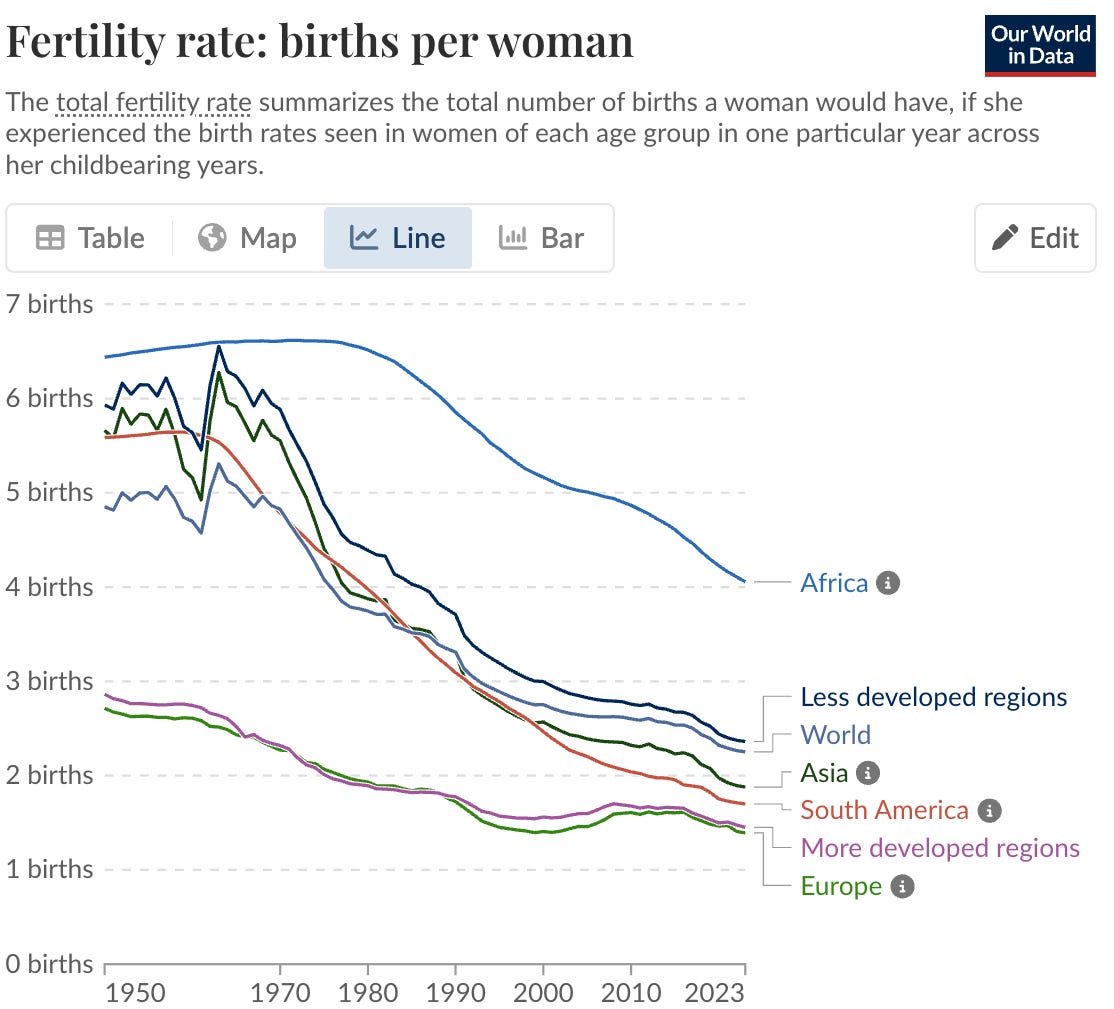
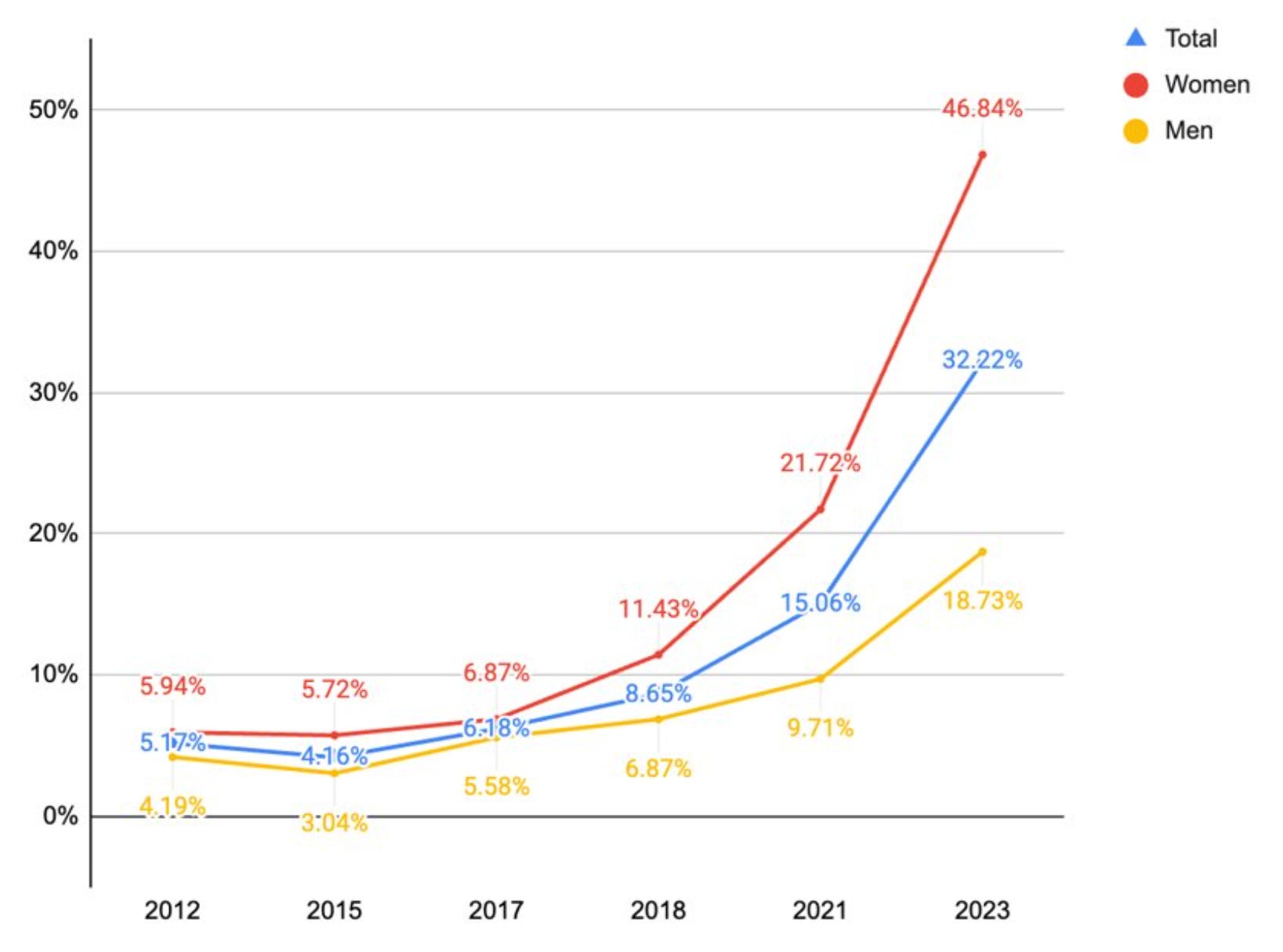
The decline is accelerating faster than almost anybody predicted. As Burn-Murdoch reported, UN demographers predicted that there would be 350,000 births in South Korea in 2023; the real figure came in at 230,000—a whopping 50 percent miss. The total fertility rate has fallen below the replacement level of 2.1 births per woman in almost every country in North America, South America, Europe, and Southern and Eastern Asia. It’s falling swiftly in most African countries. And birthrates might be set to crash in China. In the 2026 paper “The Rise of Zero Fertility Desire in China,” a Brown University researcher reported that according to the China General Social Survey, the share of young women with “no desire for children” increased from approximately 5 percent in 2012 to 47 percent in 2023.
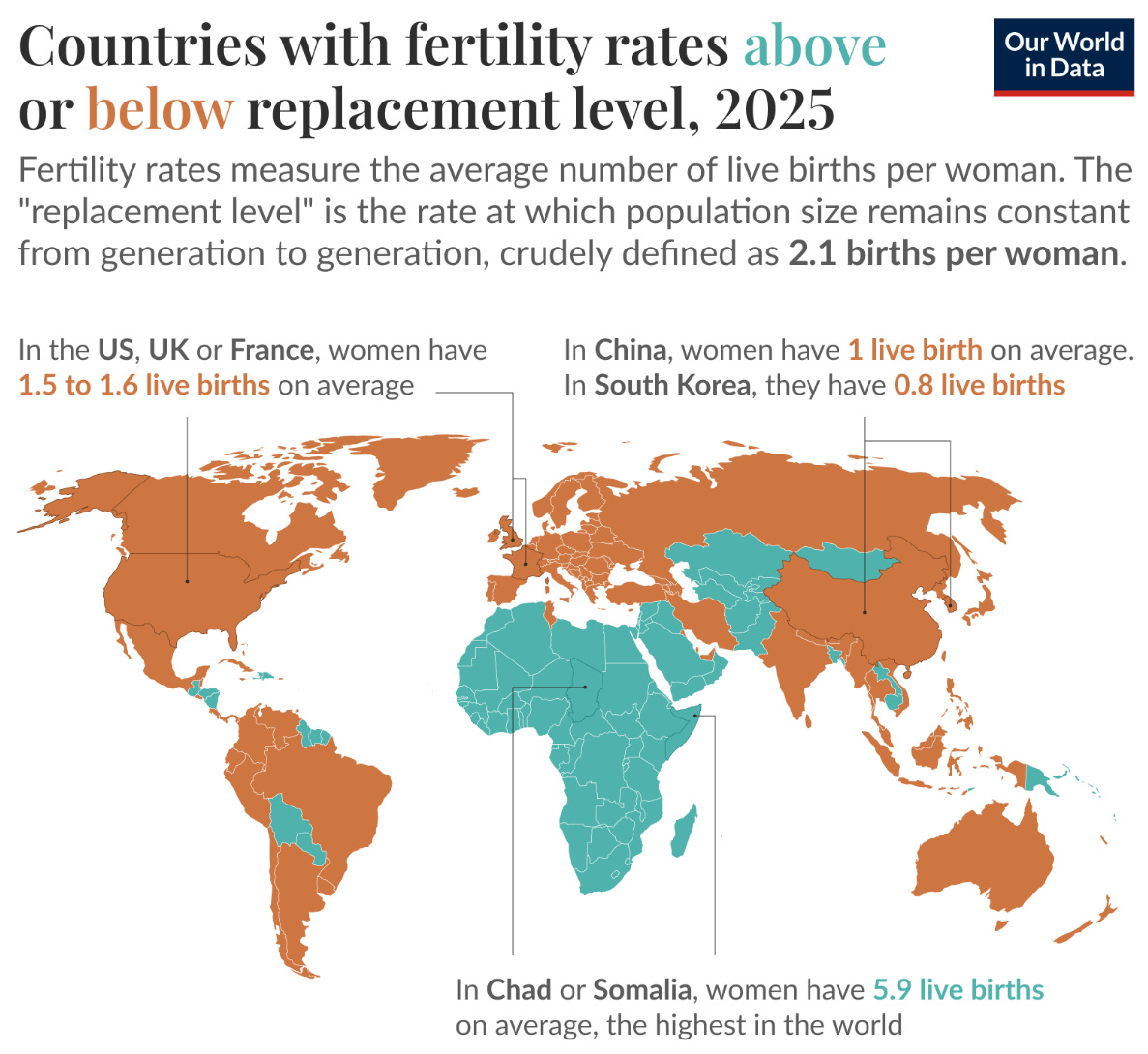
The epicenters of the baby bust will surprise many people. Europe has a higher fertility rate than Thailand. Tokyo has a higher fertility than Mexico City, Bogotá, or Santiago. China may already a lower fertility rate than Japan.
“Only two things are important right now in life: fertility and deep learning,” the University of Pennsylvania economist Jesús Fernández-Villaverde said at the conclusion of a recent lecture. “Everything else is noise. Once you start thinking about these, it’s hard to start thinking about anything else.”
In today’s interview, Fernández-Villaverde explains:
Demographics 101: Defining total fertility rate, replacement rate, and momentum
Why the world has probably already passed “peak child”
Why 2023 was the first year in human history that the global fertility rate likely fell below the replacement rate
Why the question “why is the birthrate declining?” is so hard to answer quickly
Why most people underrate the long-term effects of low birthrates on world affairs
The compounding effects of sub-replacement level fertility: “If Thailand keeps its current fertility rate of 0.8 for the next 200 years without immigration, its population will decline from 63 million to 2 million.”
WHY DOES FERTILITY MATTER, AT ALL?
Derek Thompson: Why is fertility important?
Fernández-Villaverde: Because demographics is destiny. The number of children born today will determine how our society will look in 30 to 40 years. The year 2023 was a unique year in the history of humanity, because it’s the first time our total fertility rate as a planet fell below replacement rate. That has never happened before in 200,000 years. That means the world population will peak in another 30 years or so if the trend continues. Some things will be good, some will not be so good.
Thompson: Tell me what replacement level means and what total fertility rate means.
Fernández-Villaverde: Let’s start with replacement, which is the easiest. Imagine you have a population of one million people. How many children need to be born for that population to be constant at one million in the long run? It turns out that for every woman in that population, you need 2.1 kids.
Why 2.1 and not 2.0? Two reasons. First, there are a little more boys born than girls, around 105 boys for every 100 girls, if you don’t do anything like selective abortions. Second, not all girls who are born will move on to become mothers themselves. They will die of accidents or other reasons before they enter their fertile ages. So you need every woman to have 2.1 kids on average to keep population constant. That’s the replacement rate.
The total fertility rate is an estimate of how many children women will have in a given population. When we look at the U.S. right now, the fertility rate is around 1.57. That means the average American woman is having 1.57 kids. Because the replacement rate is 2.1, a way to think about it is that we have a shortfall of slightly over 0.5 kids. There is a subtlety I want the audience to understand. The total fertility rate is an estimate. It’s slightly different from what we call completed fertility. Completed fertility is when I go back to women who are already 50 years old and see how many kids they actually had. The problem with completed fertility, which is what we really care about in the very long run, is that by definition it takes decades before we can compute it. So if we are going to make any forecast about the future, we cannot rely on completed fertility.
Thompson: In your Miami speech, you said “peak child” might already be behind us. I want you to explain what that means and why, if peak child is already behind us, the global population isn’t already falling.
Fernández-Villaverde: Let me start with the second and come back to the first. In demography there is something called momentum.
Momentum means the population will keep growing for 15 to 30 years after you fall below the replacement rate. Let me give a simple example. Imagine you have a spouse and only one kid. You are below replacement rate, but you are two. You have two parents, your spouse has two parents. You are not replacing yourselves, but your parents have not died yet. The fact that you have one kid still increases the population. The problem is when your parents die, we have not replaced them.
During the 1980s and 1990s, a lot of women were born on the planet. They had their kids in the 2010s, and that’s why the population is still growing. The grandparents of these girls have not died yet. What will happen is that when these grandparents, the generation born in the 1950s and 1960s, start dying, that’s when the population goes down. The analogy I love to use: think about a gigantic oil tanker. When you start changing the direction of the oil tanker, it has so much momentum that it takes time before it turns, but it is already cooked in. The number of children on the planet has been going down since around 2012. It’s just that their grandparents have not died yet.
And then the first point: yes, as a planet we are below replacement rate. We are not producing enough kids to keep the population constant. There are countries like the U.S. and Western Europe for which we have very good data. There are countries in Sub-Saharan Africa where the data is not so good. So all of this is done with some degree of uncertainty. I’m pretty sure it was 2023, but it may be the case that in 10 years, where we have slightly better data, it may have been 2022 or 2024. The big picture doesn’t change if it is one year up or another. Everything we observe is that fertility on the planet is continuing to go down very fast. In 2024, fertility was below 2023, and in 2025 it was below 2024. My educated forecast is that we are going to continue seeing this drop in fertility for the next 20 to 30 years, nearly for sure.
Thompson: Given your educated estimate, what is the decade when the global population will start its structural decline?
Fernández-Villaverde: At this moment, I would say 2055. In 2055, the world population will start going down.
WHO WAS WRONG?
Thompson: If you go back to the 1960s and 1970s, it was common for public intellectuals to predict the global population would rise and rise until the environment buckled and we suffered ecological disaster and widespread famine that wiped out billions of human souls. That has not happened. Global fertility has declined significantly. It’s falling faster than practically anybody predicted, certainly folks like Paul Ehrlich, author of the infamous book The Population Bomb. Why do you think these so-called experts were both so confident and so wrong?

Fernández-Villaverde: The wording of your question already tells you a lot about the answer, because you used the word “public intellectual.” You didn’t use the word “demographers.”
I’m a professor at Penn, and we have—sorry to brag—what I think is one of the best demographics groups in the world. Had you gone to our population study center in 1968 or 1969 and asked professional demographers what they thought about Ehrlich’s book, they would have probably said, “Eh!” Ehrlich, who was not a demographer, was very good at tapping into a lot of the anxieties people had at the time. I reread the book two years ago, and what surprised me is that all this vocabulary we have introduced is not to be found there. He never wants to define carefully what replacement rate is. He never wants to define carefully what total fertility rate is. He uses the term “birth rate.” The birth rate is the number of children born per 1,000 population. Birth rates are seriously affected by the momentum effects I mentioned before. I would argue the book was not very good at the time, and what a lot of the public intellectuals were saying was not really what the best demographers were saying.
Thompson: I want to push back. It’s not that I want to defend Ehrlich, but rather I want to be clear that your research also seems to disagree strongly with expert demographers today. You’ve said that you think the United Nations is over-estimating the total fertility rate of many countries. Why are today’s experts wrong?
Fernández-Villaverde: You need to understand that the incentives you have when you are putting numbers on the table at a university and at a public policy institution are very different. I’m a professor. Short of me saying something absolutely outrageous and hateful, my dean is not going to complain. My dean is only going to say, “If you think this is what the data says, I’m happy with you.”
But when you’re at a public policy institution, you have to follow an institutional framework, and you need to stick with the party line. The Population Division of the United Nations was created because there was a serious concern that we were having a population bomb. It is true, and I want to hedge a little bit what I was saying about Ehrlich, that fertility was very high in the 1950s and 1960s. What demographers were saying then, which Ehrlich did not, is that fertility was likely to start going down, that it was not such an abysmal thing as Ehrlich was saying.
It’s very difficult for an institution that has spent 60 years saying we had a population bomb to wake up and say, “There is no population bomb.” It’s costly in terms of institutional prestige. It’s costly in terms of communication. It’s costly in terms of even the people working there, who were very committed to a narrative. If you actually look at the UN’s projections, they have been dialing down a lot of their statements about population over the last decade.
In fact, the UN has three scenarios: low fertility, middle fertility, high fertility. My scenario and their low fertility scenario are on top of each other. It’s not that I’m very far away from the UN. We are already fighting about the second decimal. The problem is that these things, even at the second decimal, accumulate over half a century.
WHY IS THIS HAPPENING IN SO MANY DIFFERENT COUNTRIES AT THE SAME TIME?
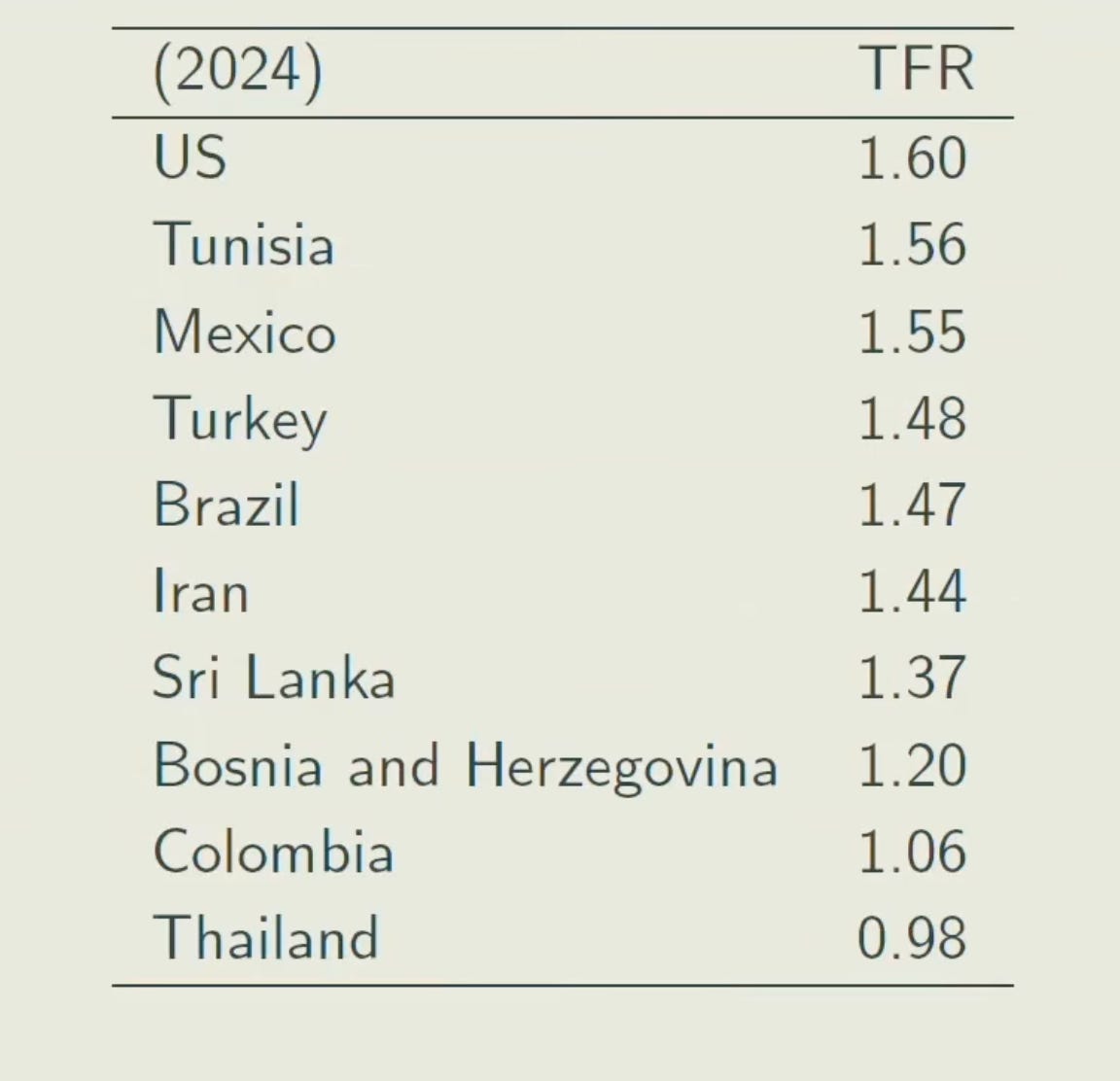
Thompson: I think a lot of people believe falling fertility is mostly a rich country phenomenon. But you point out that’s a misconception. Total fertility rate is lower than the U.S. in Mexico, Brazil, Colombia, and Thailand. If we want to understand why this is happening at a global level, and global synchronized phenomena like this are rare, where do we begin?
Fernández-Villaverde: There are several hypotheses on the table, and I’m going to list them in what I think is their relative importance.
First, there’s been a huge change in social norms worldwide. This probably has a lot to do with social media and cell phones. People watch a TV show about how people live in California or New York, and they say, “Why not something like that for me?” TV changed a little bit of social norms, but Internet, TikTok, X is really a completely different ballgame. In particular, this has mattered a lot in countries where there is not a lot of gender balance in social norms. If you’re in a country like South Korea, or in many Latin American countries, where household work allocation is very unequal, suddenly a lot of younger women are looking at the world and saying, “Why am I going to be working for my husband 24 hours a day?” Social media has really changed that perception.
Second, we have moved to an economy that is much more service-based. Service-based economies, even in India and Africa, mean people don’t work in factories that much anymore, or even in agriculture. They work in shops, they work in offices. Those are jobs much easier for women to have because they don’t depend on physical strength. In Mexico, Brazil, or Colombia, if you are a woman 22 or 23 years old with a decent job in the service sector, and a guy comes to you and tells you, “If we get married, I’m going to be the macho in the home, ruling everything, you are going to work for me all the time, and we are going to have three kids,” you tell the guy, “No.”
Third is what I have called the educational arms race. It used to be the case that a high school degree was the pathway to middle-class life. Those times are gone. Now sometimes not even a college degree is enough for a middle-class life. You need a master’s degree or some postgraduate education. People are staying much longer in school. They are marrying or forming partnerships much later in life. When they are thinking about their kids, they understand they will need to maintain their kids and educate their kids for many, many years. This is particularly true in Asia, in China, Korea, and Japan, where [there is pressure for] your kid to excel in high school and college. Those are the countries with the lowest fertility rates.
The last is housing. In many countries, not in all, housing is at historical heights in relative price. That also limits the ability of families to have more children.
Thompson: Let me summarize what I’m hearing and offer my own framework.
You’re saying that media—phones, the internet, television—have globalized Western values and in particular globalized Western feminism, which has empowered women to determine their own fertility. The ability, the freedom, and the power of women to determine their own fertility has, in country after country, pulled total fertility rate from seven, six, five to around two or one. That’s happened around the world. You also brought in economics: moving from an agrarian to a manufacturing to a services economy might have its own natural effect on lowering total fertility rate, and the cost of housing might also move total fertility rate at the margins.
Two other issues I want to put on the table. First, contraception. Second, socialization rates in the West and throughout East Asia have gone down. People socialize less, they couple up less.
When you put all of this together, having kids has gone from being a necessity or a predestination to a choice. Once having children feels like a social or cultural choice, that rules in other questions such as “can we afford more children?” People were having seven, eight kids when it was difficult for them to afford a house, when they had no money, when food and clothing and home costs were their entire budget, and there was no money left over for pet care and spa days. They were still having seven or eight kids. When economic and cultural norms required high fertility rates, having children wasn’t a choice in the first place. Now it is. In America, you can get married and not have children and still basically live a completely normal economic and social and cultural life.
So I wonder how you feel about this cultural argument that a series of technological and economic and social changes essentially flipped a switch where having children used to be a necessity and a predestination, and now it is a choice.
Fernández-Villaverde: At the very basic level, I fully agree. My PhD dissertation in 2001 was basically an exploration of this mechanism. That’s why I already forecasted back in 2001 that fertility was going to drop a lot. But if you stopped the Jesús of 2001 and told him Colombia’s fertility was 2.8 or 3 then, and asked me where I thought Colombia’s fertility would be in 2026, given all these mechanisms, I would have probably said 1.8, 1.7.
What the Jesús of 2001 would have been enormously surprised by is that it’s not 1.8 or 1.7. It’s 1.1.
Let me put it this way. A fertility of 1.9 basically means most people are having two kids, which is your idea of the perfect suburban family: a boy and a girl, a nice house, and a few people who don’t have kids. A total fertility rate of 1 is really a situation where many, many women only have one kid, and a lot of women have zero. That’s what has surprised me, that we have not gone from seven to two. We have gone down much, much further.
You were mentioning contraception. The US was around 1.9 in 2000. There was lots of contraception in the US in 2000. And in 2000, the U.S. was already a service-based economy. It was already a world where women were empowered, maybe not as much as today, but not very different from today. So why have we gone from the 1.9 of 2000 to the 1.57 of today? That is the mystery.
Thompson: I like that. I haven’t quite thought about it that way: there’s one set of explanations that can explain why total fertility rate in a country might go from five to two, but you might need a separate set of explanations that explain why fertility would go from two, roughly replacement level, to one, a situation where the population is halving itself every few decades.
THE MOST SURPRISING STATISTIC
Thompson: Where is the most surprising fertility collapse in the world?
Fernández-Villaverde: Latin America. If you ask which is the main continent right now undergoing an amazing demographic revolution in terms of fertility collapse that is not covered in the mainstream media, it’s Latin America.
Let me give my favorite example: Guatemala. I love Guatemala. I have many good friends from Guatemala. But Guatemala was not really a shining example of development in Central America. Around 2006 or 2007, I’m quoting from memory, Guatemala had a fertility rate of 3.9, basically the fertility rate of a Sub-Saharan African country. Last year, it was probably around 1.9, 1.8. The fact that in 20 years Guatemala has cut in half its total fertility rate is mind-blowing. At the current speed, Guatemala will have a lower fertility rate than non-Hispanic whites in five years.
Let me give another statistic, now coming to the U.S. The fertility rate of African Americans fell in 2024 below the fertility rate of non-Hispanic whites for the first time since the creation of the Republic. The fertility rate of African Americans was always quite higher, stayed high for quite a long time, and then started going down. The fertility rate of non-Hispanic whites also went down, but the fertility rate of African Americans went down much faster. At some moment in the first quarter of 2024, the lines crossed. If you are asking which are the groups with the lowest fertility rates in the US, my answer would be African Americans, which is completely different from what a lot of the discourse is. Who is having kids in the US? Rich white suburban families. Who is not having kids in the US? Poor African American urban families.
These are the fundamental changes that are hard to explain with a naive, “We went from agriculture where in my farm I needed seven kids to living in a city where I only have two.” That explanation is perfectly fine. That’s what my dissertation was about. Why suddenly in Colombia and Guatemala, in Chile, in Bolivia, in Brazil, have people decided to stop having kids so quickly?
The second region in the world where fertility is collapsing incredibly fast is North Africa and the Middle East. Morocco is already below replacement rate. Tunisia is very low. Egypt is falling incredibly fast. All across the Middle East, fertility is falling very, very fast. Those are the countries that will not come to mind. But coming back to the beginning of the answer, Latin America is really the poster child of, “I don’t have a very good explanation for this.”
HOW FERTILITY SHAPES THE FUTURE
Thompson: I want to move on to implications. Before I do, I want to say clearly that when we discuss the reasons for declining fertility around the world, we listed a set of reasons that combined negative motivators, like affordability and lack of housing, with things I think are objectively good. More education for women is good. More freedom for women is good. I’m very pro-contraception. I’m very pro-access to contraception. So the reasons for the decline of fertility are a mix of, I think, quite clearly good things and arguably bad things. Similarly, the implications of the decline of fertility combine both upsides and downsides. Let’s talk about the upsides first.
Fernández-Villaverde: First and foremost, we can ease the pressure on natural resources. In a world where population doesn’t grow or where population starts going down, we will consume less energy, or the growth of energy consumption will be smaller. We don’t need to build that many highways. We don’t need to build that many new dams. We don’t need to extract that many minerals. That’s good for the environment.
Second, it will help us redesign a lot of cities across the world. Cities, especially in emerging economies, grew very fast from the 1960s to today, and the result is not very pretty. You may go to a Latin American city and it has a pretty colonial center, which is where tourists go and take photographs and take a TikTok video. But when you go to the places where the average person lives, they are not great. If we have much lower population pressure, we don’t need to build as fast as we did in the 1960s and 1970s. I’m originally from Madrid in Spain. A lot of the residential neighborhoods in Madrid are ugly. People don’t see those when they come to visit Madrid, but they are really ugly, because in the 1960s and 1970s when population was growing very fast, you had to build these horrible high-rises just to put people under a roof. We are not going to need those ugly high-rises. We can demolish them. We can redesign our cities, have much more livable cities, medium density, places that are much more pleasant to live.
And then, if people are not having kids because they don’t think it’s in their best interest, who am I to complain? I’m an economist, and economists tend to have, by default, a slightly libertarian view of life. If this is what you want to do, that’s what you want to do.
Thompson: What are the downsides?
Fernández-Villaverde: We need to adapt, and adaptation can be costly. The obvious thing that comes to mind is Social Security. Everything related to retirement benefits, Social Security payments, the equivalent of Medicare and similar health programs for the elderly across the world, that’s going to impose a tremendous amount of cost on the planet. But also you are going to start being forced to close primary schools. The school district here in Philadelphia, where I live, was just forced to announce a couple of weeks ago that they are closing a lot of primary schools because there are no kids. That’s a serious disruption for a lot of local communities. Many parts of Philadelphia do not have such a nice environment as they could have, and the local school not only plays the role of an educational institution. It also plays the role of a social club. You use the gym for a lot of social events. Now that the school is closed, you are not going to have the gym to do social events. That causes a lot of disruption. You will be forced to close hospitals. You will be forced to close a lot of other public services.
Finally, if fertility really stays at 1 or 1.1 for a long time, I don’t think we appreciate how big a change this is. Now I’m going to make a crazy forecast, and I want everyone to understand this is a crazy forecast. Let’s suppose Thailand keeps its current fertility rate of 0.8 for 200 years. Thailand right now has 63 million people. At the end of 200 years, it will be around two million people.
Thompson: Sorry, two million?
Fernández-Villaverde: Two million. How do you wind down a society of 63 million people into two million? When population starts falling a lot, countries may do crazy subsidies for having kids, things can change. Maybe the people who are still having kids tend to have more kids and they grow as a share of the population. All those things can happen. I’m just highlighting that these things compound over time. You are going from a society that has 63 million people to a society that has two million. It means you need to close 98% of the hospitals of the country. It means you need to close 98% of the schools of the country.
Thompson: What’s the population of Philadelphia?
Fernández-Villaverde: Philadelphia is around one and a half million right now, maybe a little less.
Thompson: One and a half million is not so different from two million. You’re talking about the nation of Thailand having a population in 200 years that’s a little larger than the city of Philadelphia. It’s not even possible for me to comprehend.
Fernández-Villaverde: Exactly. People have the idea this is going to be about closing some hospitals. No, this is not about closing some hospitals. This is about closing 98% of the hospitals.
Thompson: Or it is about closing hospitals in the next five years. But you’re saying this is a phenomenon that’s like a tectonic plate.
Fernández-Villaverde: Exactly.
Thompson: It’s going to keep moving. History is going to play out on top of that tectonic plate. And if it doesn’t stop moving for 100, 200 years, you have a situation where Thailand becomes Philadelphia.
I want to keep pulling on this thread because this conversation reminds me of a conversation I had with my friend Rob Meyer, who’s the editor-in-chief of Heatmap. We were talking about climate change. He said, “Derek, the problem with climate change, the most interesting problem of climate change, the most significant problem of climate change, is not the fact that temperature goes up. It’s the second and third-order effects. Temperatures going up increase the likelihood of famines. A famine in Syria creates a population flow into the Mediterranean. That creates a refugee crisis at the borders of European countries. That creates an immigration influx into Germany under Angela Merkel. That creates a populist backlash across Central Europe.”
After just four easy steps, and this is not a hypothetical, this happened 10 or 15 years ago, a phenomenon that sounds like it’s about carbon dioxide in the atmosphere is actually about the rise of populism in Europe. Taking that as inspiration, I wonder whether there are other knock-on effects that you and other demographers thinking in the span of decades and centuries worry about. One quick example to me would be a lot of modern liberalism is built on the presumption of positive-sum interactions. But a positive-sum philosophy requires growth. In a world without growth, my earning more income is not positive-sum. I’m taking income from somebody else because it’s a zero-sum environment. A world where population is declining and productivity is not increasing is a world where GDP growth on a year-to-year basis is something like zero to negative 0.5%. You’re talking about a permanent stagnation or recession. That’s a world of zero-sum growth, and that’s a world where a lot of values I consider positive liberalism are no longer feasible because in some cases they might not be true. So without necessarily endorsing that particular fear, what do you see as some of the more interesting or scary second-order effects?
Fernández-Villaverde: Let me give an example that is a very close analog. Let me take Spain because I know it very well. We have had very low fertility for a long time. That means our Social Security payments have ballooned, which means the younger population needs to pay a tremendous amount of taxes to sustain that elder population. People are not happy about it. People are saying, “I’m happy to pay 25% of my income in taxes to pay for Social Security, but I’m not happy to pay 50%.” It’s not that I want to pay zero, but I don’t want to work half of my day just to pay taxes. In Spain right now, there are two conservative parties. Europe is slightly different from the US because we have proportional representation, while the US has first past the vote. In political systems with proportional representation, political change happens by the appearance of new parties. We have a mainstream Conservative Party, which would be the Republican Party of the Mitt Romneys, George Bush father, your country-club Republican, who likes to talk about lowering taxes and breaking investment. And there is a radical right-wing party, and this radical right-wing party is, among other things, about these redistribution issues you are mentioning.
Look at all the electorate in Spain that votes right, and divide it between those under 50 and those above 50. Those under 50, the radical party is the larger party by a very long margin. Those above 50, the country-golf-club Conservative is the dominant party. It’s not just a little difference. If you go for those under 25, no one under 25 is voting for the mainstream Conservative Party, and no one over 65 is voting for the radical right-wing party. The demographic change and the pressure this has put on the Spanish government budget basically means the way right-wing votes in Spain have allocated has changed drastically, and that has completely changed the policy of Spain among tons of things.
Thompson: It also seems to me that the politics of immigration become a significant and unavoidable part of sustaining the welfare state, because what do you need to sustain a welfare state? You need taxable income. Where does the income come from? It comes from people. And if you’re running out of people, you need to import people, and that’s called immigration. But in my experience as someone who lives thousands of miles away from Europe, it seems to me like practically every country that allows immigrants to become a certain share of their population almost always has a populist backlash. I’m not rooting for that outcome. It’s just what I often see.
It means you’re stuck in this almost like a Chinese finger trap, where you need to increase taxable income on the one hand, but doing so in a low-fertility environment can only require either slashing Social Security or adding immigrants. But adding immigrants increases populism. Slashing Social Security creates another backlash. So you find yourself in an environment where there is no long-term popular solution to your political problems. That’s what I see as an outsider.
Fernández-Villaverde: Exactly. When I talk about these problems, someone always raises their hand and says, “Yeah, we will just bring in a few immigrants and that will fix the problem.” Let’s go back to the example of Japan. Japan right now is around 98% ethnically Japanese. If we wanted to keep the population of Japan constant in 200 years through immigration, in 200 years Japan will be 5% Japanese and 95% non-Japanese. This is not about bringing in a few immigrants. This is about changing your country. That country will not be Japan. You may say, “I’m perfectly fine. I’m not attached to the idea of Japan in the abstract.” But I can see a lot of Japanese say, “This is not about being a xenophobe. This is not about being anti-immigrant. This is about not having a country anymore.”
Let me give a concrete example. In Spain, in addition to Spanish, we have regional languages like Catalan. The problem is Catalonia is getting a lot of immigrants. The immigrants are not Catalan speakers. Their kids may learn Catalan in school, but they don’t speak Catalan. Given the current level of immigration, Catalan, I have forecast, is doomed as a language. It will not exist. Some people will always speak it in a small village in the mountains, but as a working language of day-to-day life, Catalan is doomed. You see it in all the statistics. Look at people under 25, look at people under 30, very clearly the language is dying. If you’re a native Catalan speaker, this is existential. So this is not about being anti-immigrant because I’m a nasty guy. This is not about being racist. This is just about saying, “Don’t I have a right to my language to still exist?” I’m an immigrant myself, so it’s not that I’m against immigration. But like everything, it needs to be within a reasonable degree.
Thompson: You’re making what seems to be an almost mathematical point. A population that does not replace itself with fertility will either die off or find itself replaced by people born in another country. There’s no other way for the math to work out. This is why over the centuries, low fertility becomes not just a numbers problem, not just an economic problem, not just a welfare-state taxation problem, but a political problem and a cultural problem.
You said only two things that matter in the world. We’ve spent 99% of this episode on one of them, fertility. The other one is deep learning, AI. If Korea’s total fertility rate is 1.0 or below in the 2020s, 2030s, and 2040s, its population is going to be shrinking fast by the 2050s and 2060s. But AI also benefits from this principle of scale. This technology that in 2022 often failed to do basic arithmetic is now identifying cybersecurity vulnerabilities better than the best coders in the world. How do these trends intersect?
Fernández-Villaverde: They intersect to some degree, but not as much as sometimes people think. Let me tell you where you are absolutely right. If thanks to artificial intelligence and robotics, a lot of jobs can be done by computers and robots, and that generates a lot of economic growth and that helps us to pay for Social Security, that will make the transition much easier. I’m a bit of a techno-optimist in that sense, and I’m glad this is happening. I think it’s going to give us more degrees of freedom to adapt our society.
But coming back to my point before, this is just not about GDP. My wife and I love to go to a small village in England to spend some time on vacation. It’s a lovely English village. They recently closed the local pub because of population decline. The problem is the local pub in an English village is not just the place you go for a beer. It’s the place where you meet your neighbors. It’s the social gathering place of the village. How are you going to substitute that with artificial intelligence?
That’s what worries me. A lot of the things that make us human are not about being able to produce a lot of widgets with robots. It’s about our social interactions. Thinking again about Thailand, if we are going to be two and a half million, we pretty much need to abandon most of the country and make it empty, because to run things like hospitals you need scale. So we are going to abandon 90% of the country and leave it to the wild side. Artificial intelligence is not going to be able to do much about that. Those are the challenges I don’t think people quite appreciate. I’m a techno-optimist. I love artificial intelligence. I do a lot of artificial intelligence in my own work. But we need to be careful about what it can and cannot deliver in terms of fertility.
Why not ask women? Like just survey women directly why they aren't getting married and having kids...it's crazy how every article I see is just men hypothesizing instead of asking the source.
Many women will give you the same response - they cannot find men with similar levels of education attainment and income potential to partner with. Now that women have access to education, capital, and contraception, they control their own fertility. They'd rather not partner than partner with men who do not view them as equals. Those middle-class suburban couples who are actually having kids? Poll the men on their views of women and how they split parenting responsibilities and I think you'd find the recipe to success...
Until men view women as equals, this crisis will continue!
The examples of Japan and Catalan are somewhat alarming to me. "This is not about bringing in a few immigrants. This is about changing your country. That country will not be Japan." This seems to uncritically accept an argument that a country is comprised not of a shared culture or shared ideology but of a shared ethnicity. "Japan" is a varied set of cultural norms and contradictions spanning language, art, architecture, history, religion, social norms, foods, traditions, ways of being - there is no reason why any white or brown or whatever person couldn't be part of "Japan" unless Japan is ONLY an ethnic category. It seems bad to hear someone way "this is about not having a country anymore" and defend them as being totally reasonable and not racist or anti-immigrant.
The example of Catalan as a language dying in the following paragraph is also interesting - "if you're a native Catalan speaker, this is existential" no its not. You can still speak Catalan, you can teach your kids Catalan, you can start an after-school program where everyone speaks Catalan if you think its an important part of the culture you want to preserve. Immigrants don't threaten that. No one is "killing" Catalan (at least, not that I know of - maybe Spain has programs akin to the way the US deliberately tried to destroy our indigenous languages and cultures. In which case, I'd say that's a problem that has little to do with birth rates). It feels like the guest is defending a lot of mundanely racist attitudes while handwaving with a "I'm not against immigration, it's not about being anti-immigrant".
I just thought it was interesting that I read all of that, feeling increasingly that the guest was blithely making a lot of unproven and (imo) harmful and hidden assertions, and Thompson's first reply is "You're making what seems to be an almost mathematical point."
Much of the piece is about culture, it feels like its trying to prove that falling fertility rates leads to a destruction of culture. The economic side is perhaps easier to defend (if you assume that the basic logic of our economy is unchangeable, which I think is a bad assumption but always seems to be the case in pieces about birth rates). I don't think the goal of the piece was to convince me that falling birth rates are bad per se (moreso trying to convince me that the fall is bigger than I think) but not only did it *not* convince me that falling birth rates are bad, it convinced me further that people who are very worried about "birth rates" are also worried about a lot of things I'd consider to be goofy racism (and goofy anti-feminism, too, but this piece addresses those "concerns" just fine).