


1. What’s behind the socialist groundswell in the Democratic Party?
Well, for starters: dissatisfaction with establishment Democrats’ inability to keep Trump from power, cost-of-living struggles, economic disappointment, and antipathy toward corporations and capitalism in an age of rising wealth inequality. In July, Nate Silver published an analysis of the demographic “sweet spot” of the democratic socialist movement. His diagnosis: downwardly mobile (i.e., middle- to low-income) and highly educated.
But the DSA’s own surveys show that we need to add another variable: age.
In 2013, the median age of respondents to surveys by the Democratic Socialists of America was 68. By the first year of the Trump administration, it was 33. After accounting for just 7 percent of DSA members in 2013, Americans born after 1980 surged to 73 percent by the early 2020s. American socialists are extremely Millennial-ish.
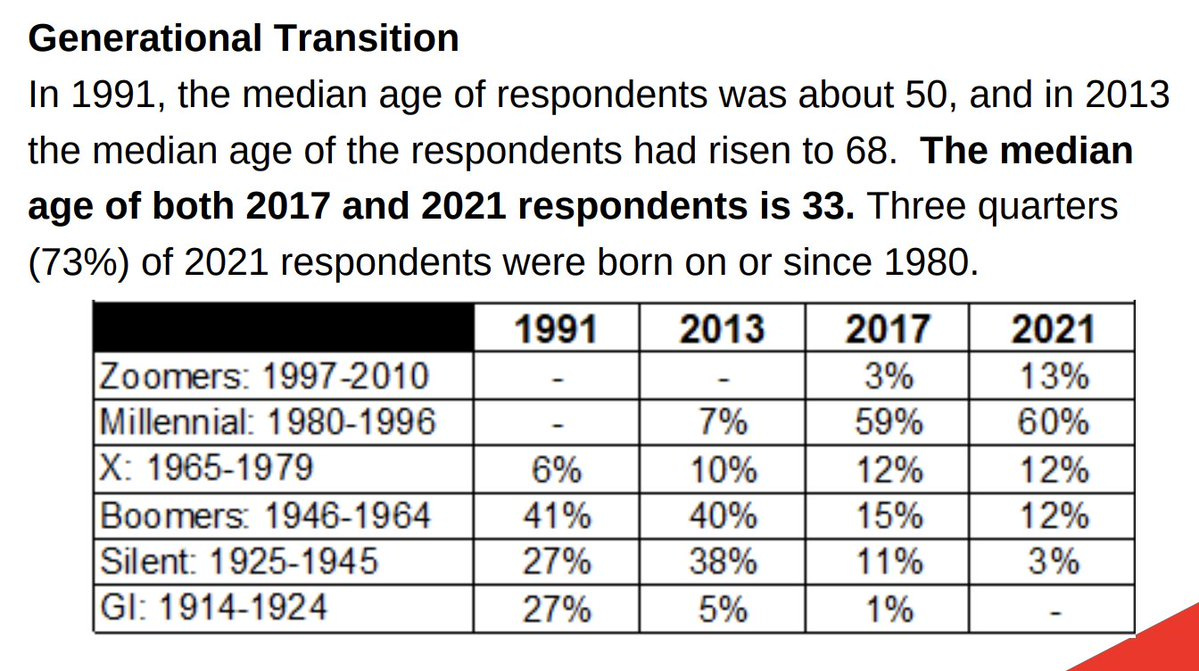
The Great Recession made self-described socialists out of a lot of Millennials who loaded up on credentials and graduated with debt into a disappointing economy. While this cohort had no political power in 2009, they’re now in their 30s and 40s and make up a much bigger part of the electorate, especially in and around major cities. If you knew nothing else about politics except that “people who graduated from college in the decade after 2007 seemed quite fond of socialism,” you would automatically expect a socialist wave within the Democratic Party in the decade to follow, as this generation’s propensity to vote increased relative to the rest of the electorate.
The New Yorker writer Jay Caspian Kang adds another dimension to the age analysis. He distinguishes between the Subaru Socialist class—“college-educated millennials in their thirties and early forties who earn a somewhat steady income but not what they expected”—and the Great Disappointed, his term for younger, twenty-something voters who, coming over age during the pandemic, practice a more “polarized, hard-line moralizing” political style, typified by a strict litmus test on Gaza.
One interesting feature of the socialist groundswell is that it remains very much a college thing. Zohran Mamdani beat Andrew Cuomo by 24 points among college voters in the NYC Democratic primary but lost non-college voters by 22 points. In one recent poll, Abdul El-Sayed led Haley Stevens by 7 points among college grads while trailing by 22 points among non-college voters. Before his campaign’s implosion, Graham Platner led Susan Collins by 37 points among Maine college voters in New York Times polling, but was down 23 points among non-college voters. For now, the left-populist revolution is not solving the Democratic Party’s core 21st-century problem, which is the erosion of support among non-college, low-information voters sometimes euphemistically referred to as the “working class.” Instead, the socialists are creating a kind of left-wing party-within-the-party, which might accentuate the benefits and costs of Democrats overperformance among college grads rather than fix the problem.
2. What technology is changing the world faster: AI or GLP-1s?
Like nitrogen, AI seems ubiquitous and invisible at the same time. AI-related spending dominates private investment. Data-center construction is powering the construction sector. Large language models have transformed coding and solved advanced math problems. But when one zooms out to analyze the big macroeconomic indicators, where’s the AI effect? GDP growth is low and steady. Productivity growth is lukewarm-to-warm. Unemployment seems unremarkable and low. Despite the fearsome potential of the most powerful models, there have not been any public reports of broadly debilitating hacks of government or civilian infrastructure.
Compare AI’s record with that of the other major technological development of the 2020s: GLP-1 drugs. These drugs are already reducing obesity (and inflammation, and maybe cancer and dementia), which will likely extend average life spans. A study of GLP-1 data in Denmark found that the drugs are reducing long-term sick leave by 17 percent. A 2025 study from Cornell University found that households with at least one GLP-1 user reduced their grocery spending by 5 percent and shifted spending away from chips (10 percent decline) and toward yogurt and fresh fruit. Spending on salty snacks and alcohol is projected to plummet in the next decade, a trend to which GLP-1s are contributing.
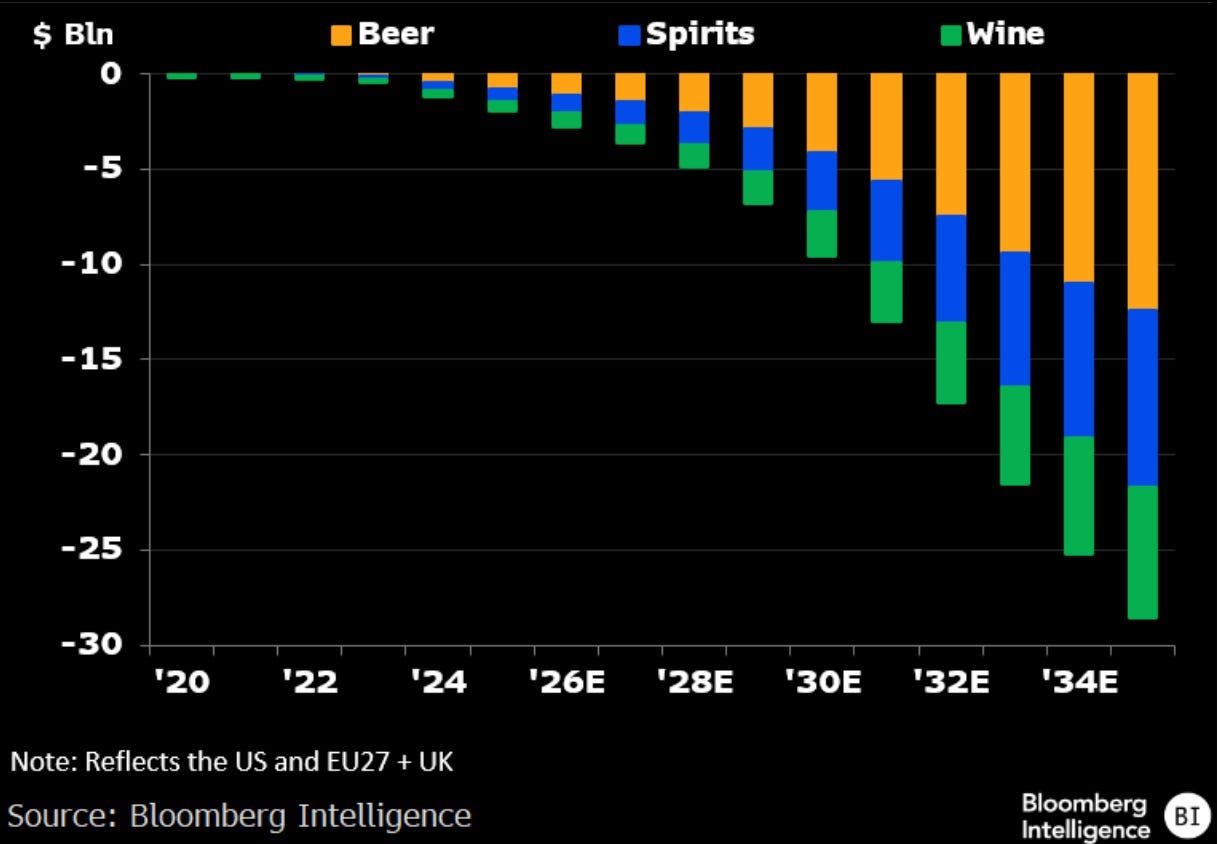
For now, I think the GLP-1 vs. AI debate is a fun tossup. I’d probably lean AI, for reasons spelled out in the next few questions …
3. Why did science fiction (mostly) fail to predict AI writing?
Here are some of the most famous science fiction predictions about AI: It will give us robot workers (The Jetsons, Asimov’s Robot series); it will destroy jobs (Player Piano, among many others); it will try to wipe out humanity (Terminator, The Matrix); it will make whatever we want (Star Trek); it will drive our cars and rocket ships … with rather uneven results (2001: A Space Odyssey); and it will be our friend and lover … with rather uneven results (Her, Westworld, Blade Runner).
Far rarer, however, are predictions that AI will write so much material that it will displace the human-made books. In 1984, Orwell’s Party builds a “versificator” to compose basic music and poetry for the masses, but it’s a relatively minor part of the plot. Today, however, AI doesn’t just write every other LinkedIn personal essay and high-school history paper. It writes a majority of new books.
A recent study found that between 2023 and 2026, the number of books with any sales grew by a factor of 19, far outpacing the growth in sales. Books with “substantial AI text” are making more money with every passing year, while authors who don’t write with AI are earning less per book in almost every genre, with fantasy as the major exception.
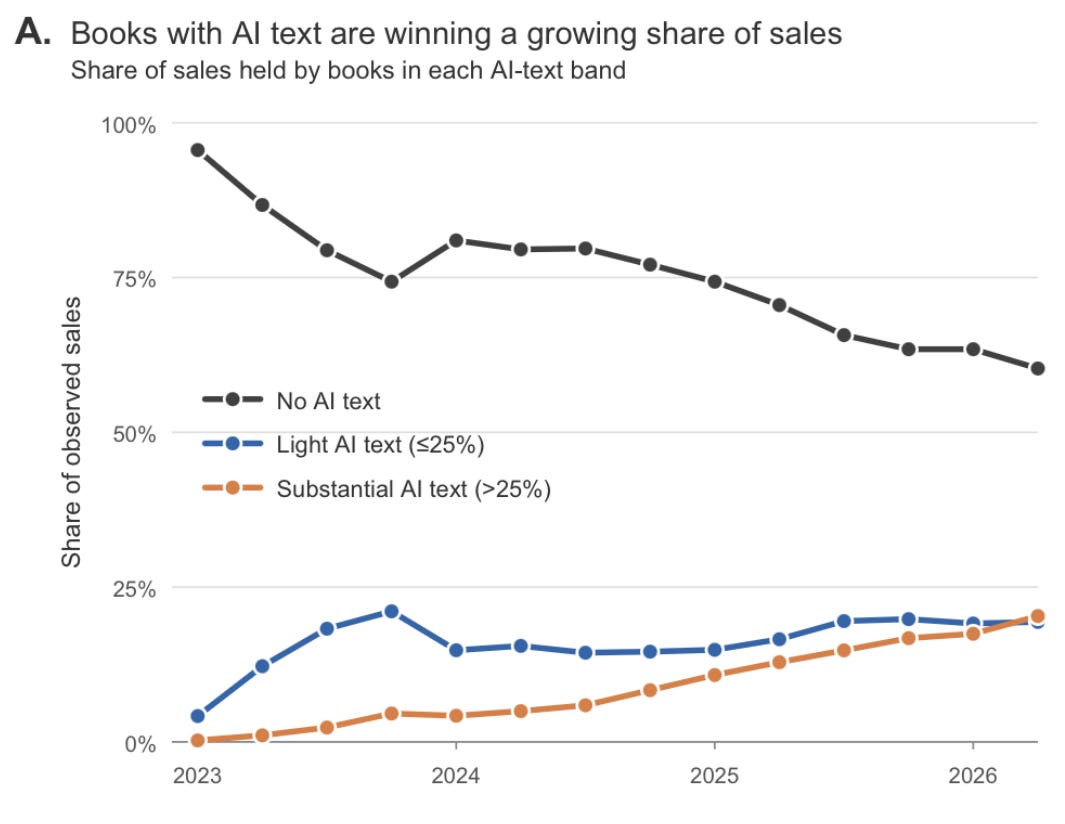
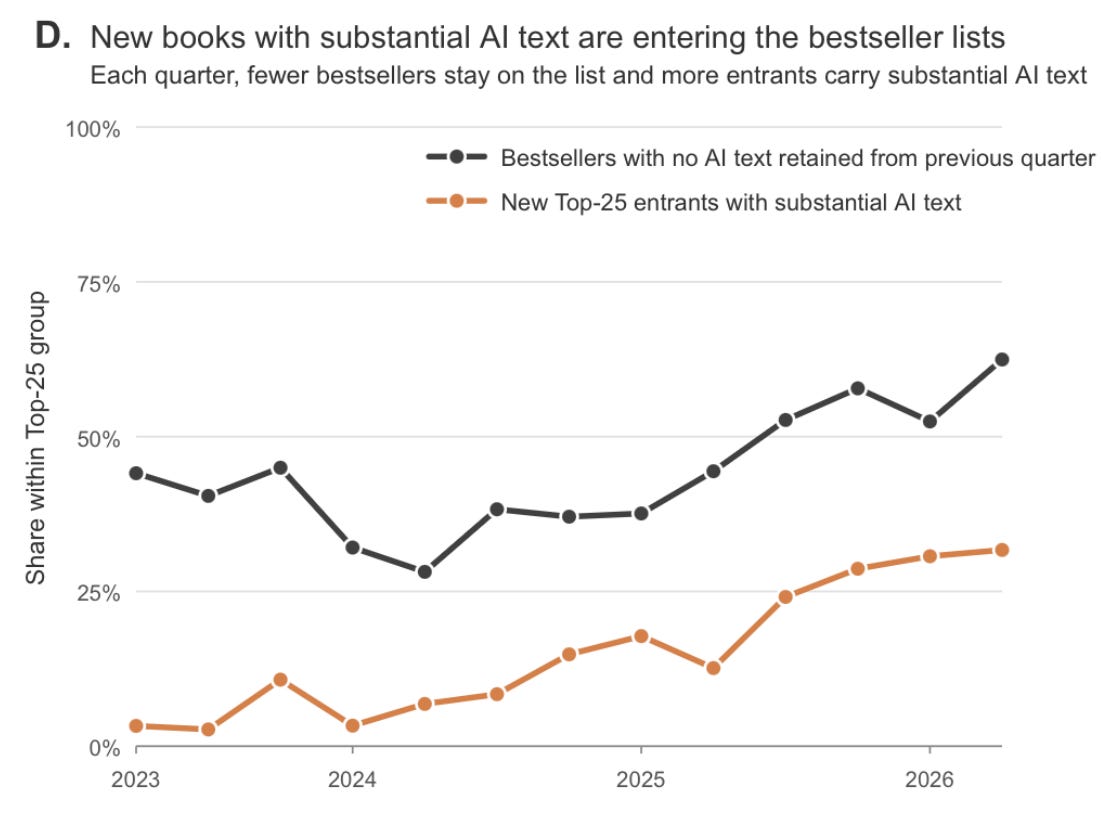
It seems like, after decades of futurist writers anticipating the effect of AI on society, most of them failed to anticipate the effect that it would have on their own industry. Why? One explanation is that this is about the meat and potatoes of plot and storytelling. It’s interesting to cast AI as a lover, enemy, friend, or recalcitrant navigation system. It’s not so fun to write a story about AI writing for itself all day long. But another explanation is that technology is just inherently surprising to both science fiction writers and technologists. After all, OpenAI released ChatGPT without expecting that it would reshape their company and the entire global AI race. They failed to anticipate the future, too.
4. What will be a bigger business by the end of 2026: Anthropic, OpenAI, or all of Elon Musk’s publicly traded companies combined?
Anthropic’s annualized run-rate revenue is reportedly around $80 billion. That is, if you multiplied its last month’s revenue by 12, you’d get $80 billion. The podcaster Dwarkesh Patel, who knows many folks inside the company, estimates that the company’s ARR could exceed $100 billion by the end of the year. OpenAI reportedly isn’t far behind.
Given continued demand for AI, especially in coding and future cybersecurity services, both of these companies could earn substantially more than $100 billion in the next fiscal year, rivaling companies such as Comcast ($125B in revenue), Bank of America ($116B), and Target ($106B).
But I think there’s a more provocative way to frame the revenue growth of the frontier labs. The richest man in the world, often hailed by corporate executives the greatest businessperson of our age, is Elon Musk. Last year, his companies made $94B (Tesla), $18B (SpaceX), and $3B (X)—collectively, $115 billion. Even with significant revenue growth from Tesla and SpaceX in the next year, it’s not out of the question that Anthropic or OpenAI—which barely had any revenue before 2023—could equal or surpass the revenue of all of Musk’s public companies some time in the next 12 to 24 months. Let that sink in.
5. Will we look back at 2026 as a breaking point in Hollywood history, from the Age of Iger to Age of Nolan?
Matt Belloni, Hollywood reporter at Puck and host of The Town podcast, writes: “I’d rather have the next commercial movie from the five biggest directors (Nolan, Cameron, Coogler, Gerwig, Villeneuve) than the next installment of almost any piece of well-worn I.P. Wouldn’t you?”
I love this provocation from Matt, and I think it’s worth unpacking what it says about the state of Hollywood and what it means for the future of the movie business.
The first two decades of the 21th century were dominated by what you could think of as the Bob Iger Hit Formula. It went like this: (1) Buy familiar IP; (2) establish a franchise; (3) extend the franchise; (4) repeat. It really worked. For years, practically every film in the top 10 had a sequel number in the title. But the BIHF is faltering. Despite the smash hits of Spider-Man and Super Mario, remakes and sequels of Moana, Star Wars, Minions, and Supergirl have all disappointed in the last few months.
On the other hand, every Christopher Nolan movie these days is a billion-dollar event, and last year’s Sinners was a box-office and awards monster. The fact that this is coinciding with the Obsession/Backrooms phenomenon is notable, too. Superhero fatigue, along with the decline of the Chinese box office, has ever so slightly nudged Hollywood toward making stranger and more original bets, and audiences are rewarding the effort.
The optimistic gloss on the Iger-Nolan shift in Hollywood would be that I, a person who never read comic books, am much more interested in seeing movies that were greenlit because of the ingenuity of the director or the script, rather than the mathematical inevitability that “We did Ant-Man 2” = “We’re doing Ant-Man 3.” (It’s cool that this shift is happening during a relatively buoyant year for ticket sales, but movie ticket sales are still more than 20 percent below their pre-pandemic levels.)
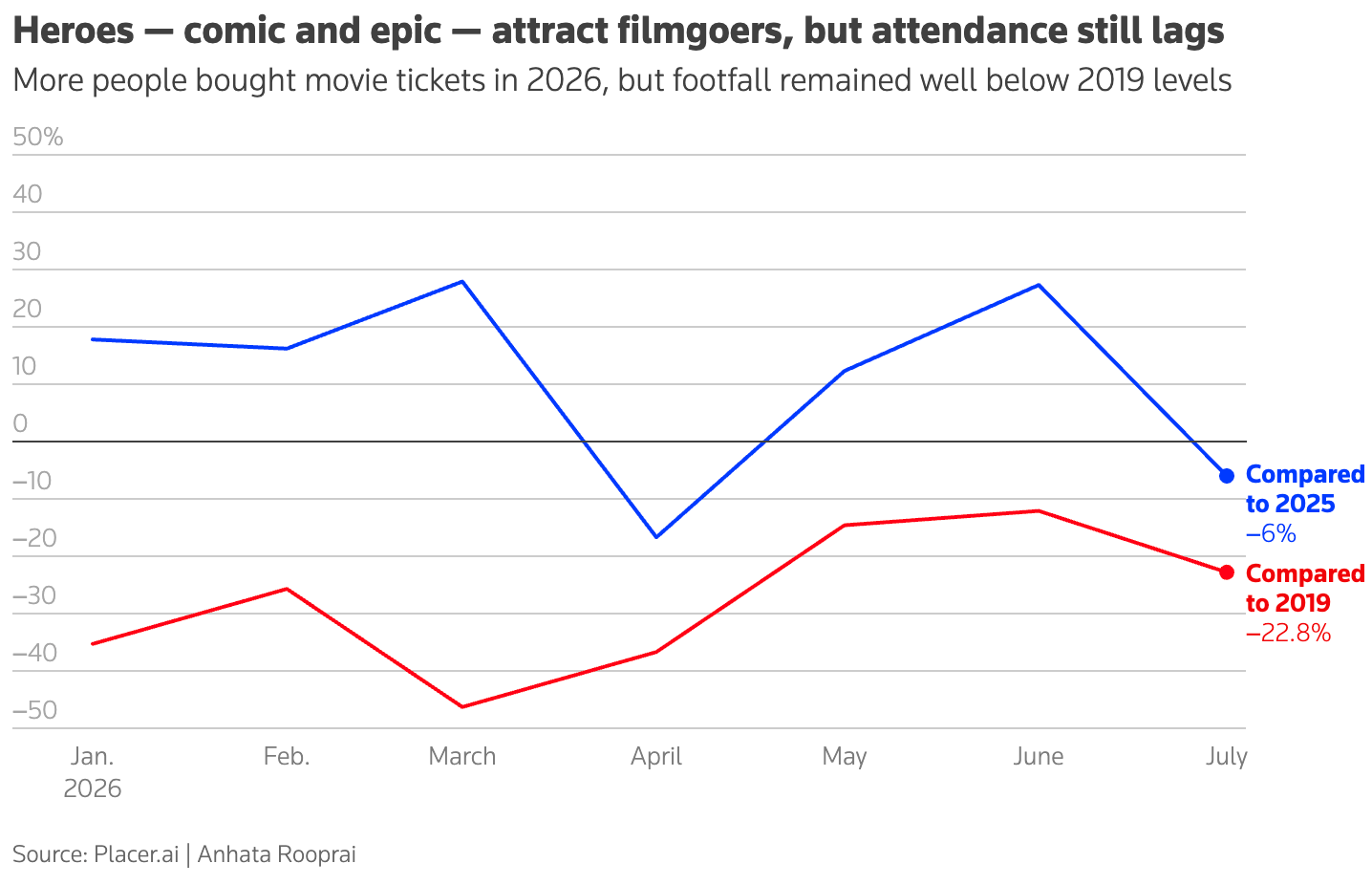
The long-term risk for Hollywood is that an age of original blockbusters raises the bar for success. If you owned the Marvel or Minions franchise in the 2010s, you had a relatively high floor for the next Marvel or Minions movie, bc you knew a certain number of people would turn up even if the Rotten Tomatoes score was negative-10. But starting from scratch every time means finding ten Obsessions in ten straight years. Good luck.
Bottom line: The Iger-Nolan vibe shift in Hollywood is great for people who like original big swings and blockbusters that also try to win Academy Awards. But, despite an amazing 2026 for the “Revenge of Movie Theaters” narrative, it’s sobering to remember that sui generis hits are rare, and directors like Christopher Nolan and Ryan Coogler are even rarer than familiar IP.
6. Are balding, chubby guys with erectile dysfunction going to live forever?
Well, no. Probably not. But they might live longer than a lot of Bay Area health neurotics experimenting with off-label peptides and experimental hormone therapies.
Say you’re a big guy with a receding hairline and a waning libido. You log into a telehealth site, like Ro, to fix what ails you. You get Propecia for your hair situation, GLP-1s for your weight situation, and Viagra and Cialis for your other situation. What arrives in the mail several weeks later is not quite the elixir of eternal life. But in the last few years, all of these drugs have demonstrated surprisingly beneficial side effects:
GLP-1s: As many people now know, these drugs seem to reduce not only weight but also the risk of heart attack, arthritis, migraines, and, potentially, several forms of cancer
Viagra: On July 31, the National Cancer Institute announced the results of early research suggesting that sildenafil, the drug compound typically known as Viagra, might stop the spread of cancer by increasing levels of a molecule, cGMP, that disrupts the ability of cancer cells to make cholesterol.
Cialis: Last year, a systematic review of tadalafil (Cialis) and related drugs known as PDE5 inhibitors found that low daily doses can improve vascular health, or blood flow, especially in patients with cardiovascular risk factors.
Propecia: A large randomized trial involving more than 18,000 men over the age of 55 found that participants taking 5 mg of finasteride (Propecia) saw a 25 percent reduction in diagnoses of mostly low-grade prostate-cancer.
Put it all together, and a GLP-1-finasteride-tadalafil protocol seems weirdly beneficial. In all seriousness, I am definitely not suggesting that otherwise healthy people start microdosing ED pills. The most consequential point here is that many drugs, both approved and unapproved, have surprising side effects that often go unrecognized for years or decades. It would be wise to find ways to unleash LLM technology to discover surprising benefits lurking in discarded clinical trial results.
7. Why is it so hard to stop comparing ourselves to other people?
One of my favorite conversations on Plain English in the last few months was my talk with the University of Chicago philosopher Agnes Callard about her grand theory of the uni-context. For the purposes of the following paragraphs, I would define the uni-context as the ethical and value-based consequences of telecommunications technology making everybody feel as though they live in the same universal room together. Callard predicts that the uni-context nudges people to focus on negativity over positivity and identity over character, because in both cases, the former is more context-independent. (That is, I am a white guy in every context, but I am only jealous or patient in certain contexts, so my identity as a man is more context-independent than my character.)
I was particularly struck my Callard’s observations about comparison and envy. She asks us to imagine two schools in separate school districts. One day, the districts are redrawn, and the schools are in put in the same district. Suddenly, they are in competition. Parents now compare the schools as if they exist in one evaluative field. Over time, the schools might become more similar, or they might specialize to become more different. Either way, they change as they become part of the same evaluative field.
It is such a simple story. And I think it’s a stunning metaphor for life online. On TikTok, Instagram, and X, we see people just like us. They are happier or sadder, richer or poorer, funnier or crazier. They are small faces on a screen, just as we are. Life online seems to place us in the same evaluative field as thousands of strangers who are often more successful than us along some dimension, which makes it impossible to avoid comparing ourselves to them, or feeling a bit jealous of their success, or feeling quite righteous when we learn of their downfall. Jealousy and schadenfreude are more ancient than broadband technology. But there really is something about living in a universal room with everybody that makes it harder to live without that infamous thief of joy known as comparison.
More of life feels like a competition, because the uni-context encourages strangers to imagine themselves in competition, even if they will never meet.
8. Why do we feel so much guilt?
Several critics have accused Christopher Nolan’s Odyssey of being inappropriately modern, or even woke, by replacing Odysseus’s Homeric values (glory from strength) with Christian values (guilt from victory). While much of the discourse has been extremely stupid, I’ve enjoyed thinking about the way that values have changed over the centuries, and how the Bronze Age Greeks told stories to honor values that now seem archaic to our modern sensibilities. The philosopher Friedrich Nietzsche argued that Ancient Greek culture used to value brute strength for its own sake, while it was Judeo-Christianity that inverted the relationship between strength and goodness and encouraged the strong to feel guilt and pity for the weak. Nietzsche revered Homer’s Odysseus much more than he respected a contemporary Christian priest.
But how would you actually prove anything like Nietzsche’s contention that values change over the millennia? One new study used large language models to trace of how Western values have changed in the last 2,000 years, based on the frequency of themes and words across 23,000 books. The researchers found that, while some values rise and fall over the millennia, “indulgence”— defined as freedom from rigid social control and a preference for fun and gratification against restraint and asceticism—is higher than ever, having basically increased steadily since the 1500s.
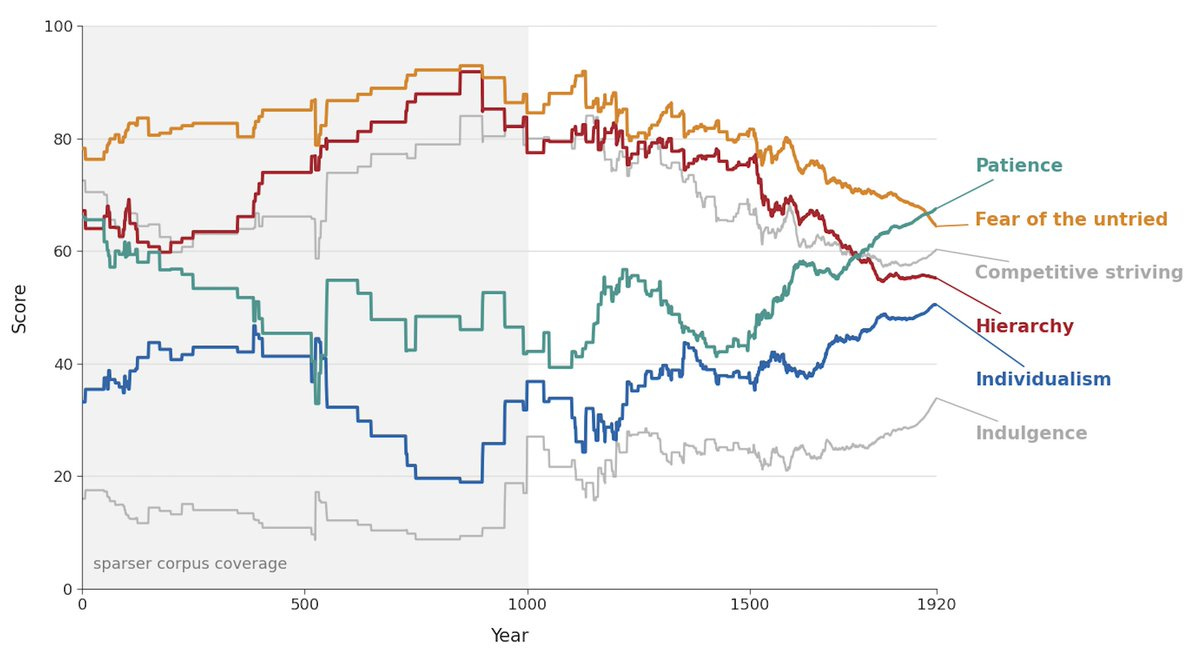
The chart stops in 1920. But one conclusion is that “it’s virtuous to make myself happy” might be a more popular notion today than any period in recorded history. Combined with Nietzsche’s observation, I think you could argue that moderns are both more selfish and more guilt-stricken than our ancestors. We have more thoughts about our thoughts and more feelings about our feelings. We are ever more inside our heads, with our indulgent instinct to self-soothe stuck in constant dialogue with a sibling instinct to judge ourselves for indulgences.
9. If every age of American life gets the drug it deserves, what does it say about us that cannabis is the drug of the 2020s?
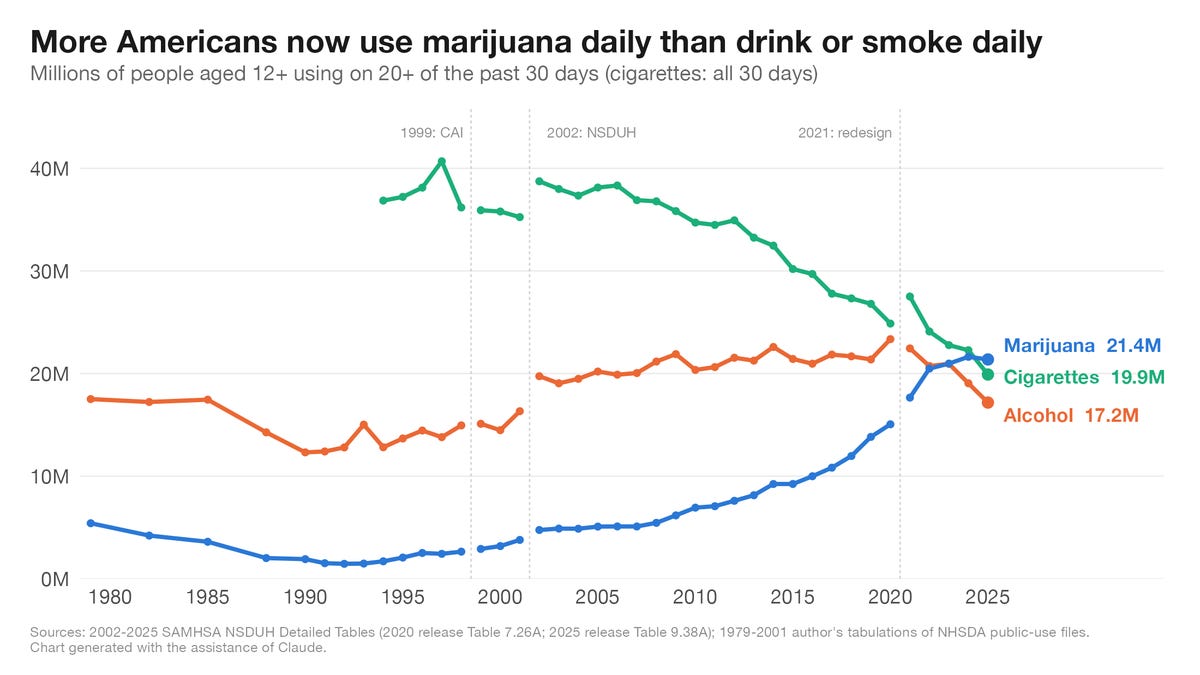
Data compiled by Charles Fain Lehman finds that, for the first time ever, daily cannabis users outnumber daily users of cigarettes or alcohol. The reasons why America seems to be switching from booze to weed was the subject of this week’s podcast episode.
The big idea of the podcast is that every age of American life gets the drug it deserves. Social mid-century America was throwing cocktail parties and handing out cigarettes, while ignoring the health risks of excessive use of alcohol and tobacco. Naturally, it was an age of socialization and often unscrupulous growth. The 2020s are seeing the rise of marijuana, which, for all its pleasures, is more more likely to be used in isolation and whose users often claim (or tell themselves) that it is a therapeutic.
According to Kasey Creswell, a psychologist at Carnegie Mellon, most alcohol is consumed socially. In one study, 720 drinkers were put in groups of strangers and given a cranberry vodka cocktail or a cranberry flavored placebo. Researchers concluded that alcohol “enhanced individual and group-level behaviors” associated with positive affect. People drinking around each other smiled more and felt more bonding.
Cannabis, by contrast, is more likely to be used in isolation, or among smaller groups of friends who are all getting high together. If alcohol is a drug for bonding with near strangers, cannabis seems more suited for deepening one’s experience with people (or, for me, movies) that we’ve already selected. It is the perfect drug for an age of individual indulgence, and it is notable to me that the drug of the moment is one often used for curating a carefully selected experience of interiority rather than giving ourselves over to the uncertainty of strangers.
A weekend’s worth of questions to think about now 👍
Regarding: "The philosopher Friedrich Nietzsche argued that Ancient Greek culture used to value brute strength for its own sake, while it was Judeo-Christianity that inverted the relationship between strength and goodness and encouraged the strong to feel guilt and pity for the weak."
I have often thought that narcissism and psychopathy exist in the human population because natural selection favored them at low rates in the population. If your tribe is competing with a neighboring tribe, having one psychopathic person on your team, happy to do terrible violence to the other tribe, is better than if you are all squeamish normies.
By extension, just as many of our leaders today are disordered narcissists (or worse), I think that many leaders of the past and deep past likely were as well.
So no surprise, when the idea of God came along, he/she looked like the leaders of yore. The God of the Torah and the Greek gods certainly read as capricious at best and disordered at worst.
Christianity flipped this, and imagined a God that was NOT disordered! And promised the normies (i.e. the 'meek') that they too could get ahead, and even inherit the earth.