


Why are so many Americans not getting married—or not even dating, in the first place?
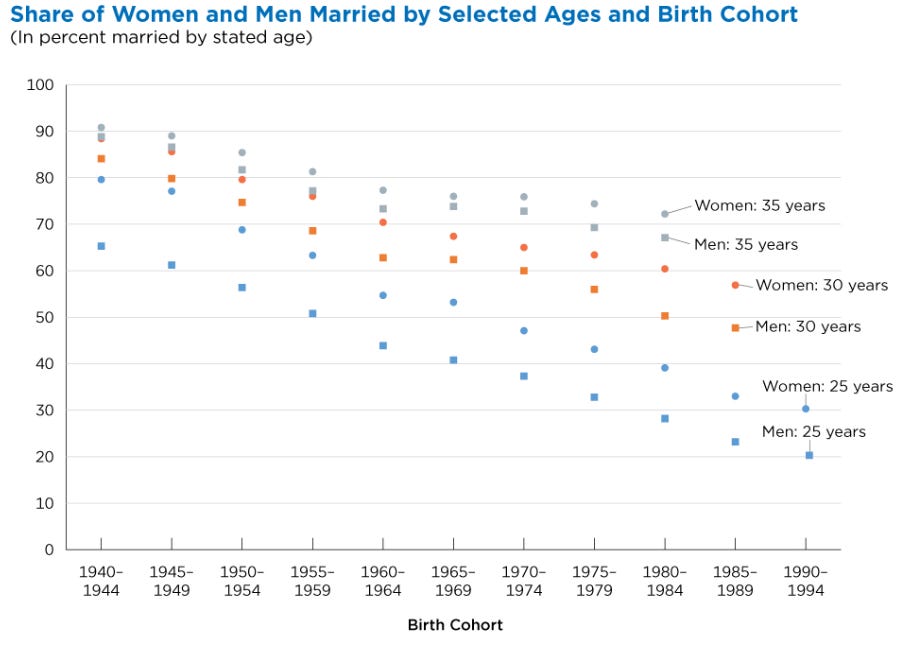
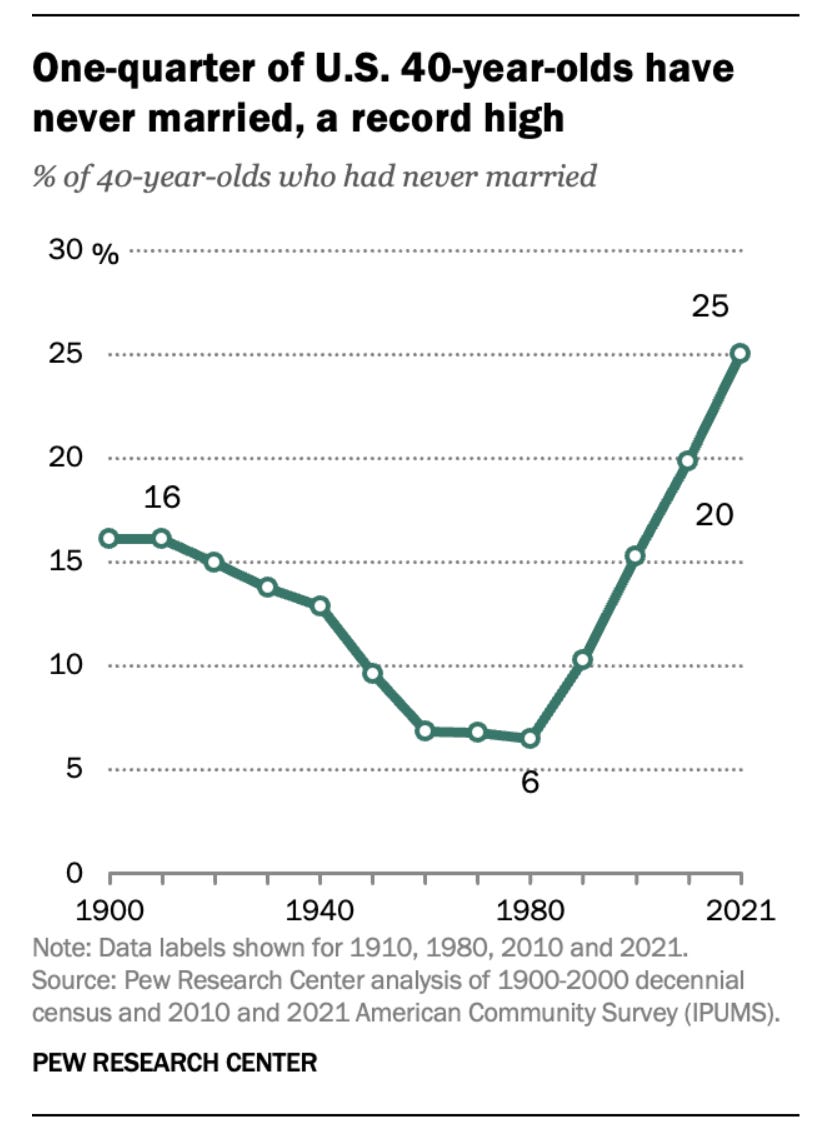
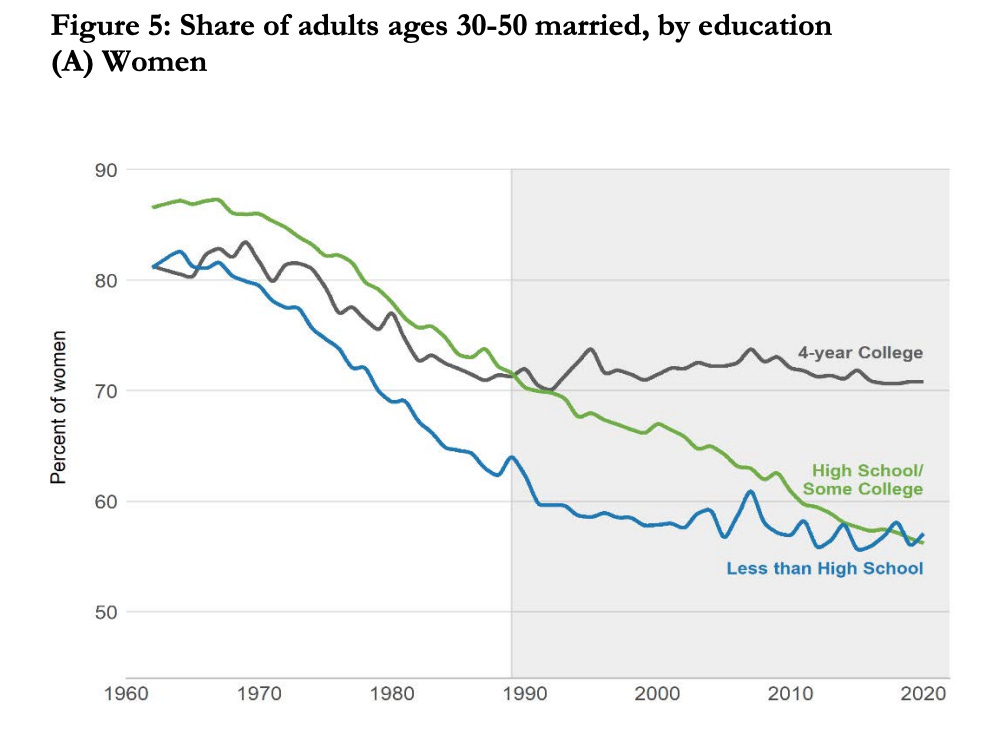
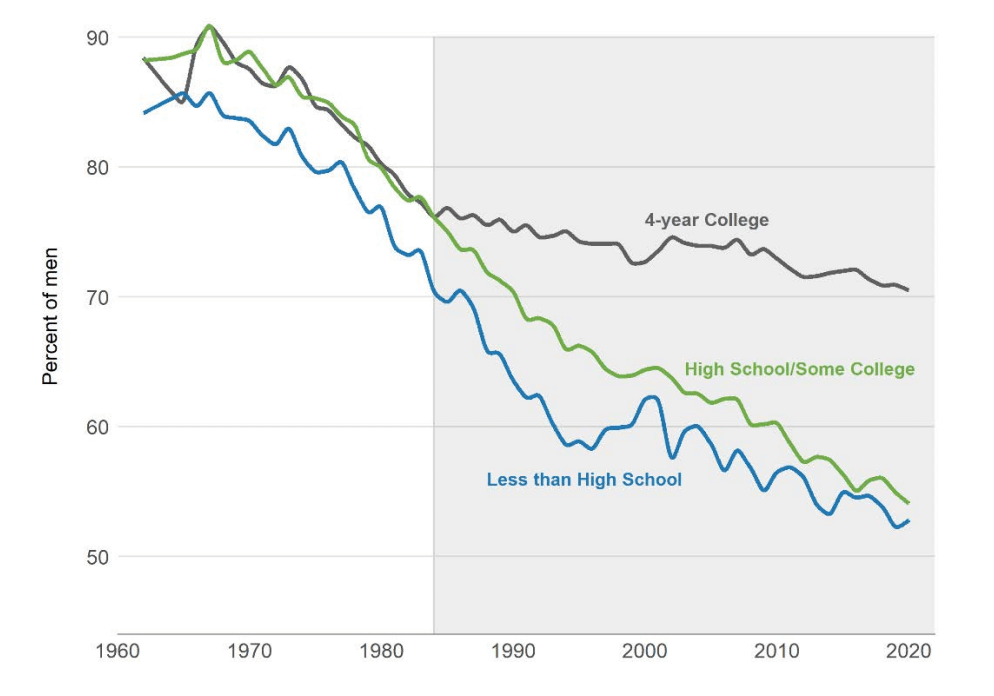
The share of 40-year-olds who have never been hitched has quadrupled since 1980, as Americans get married later, or not at all.
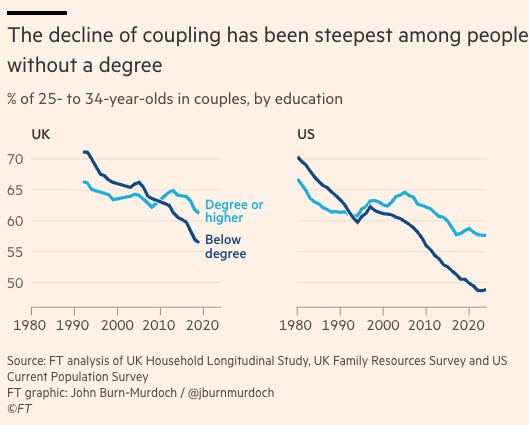
It’s not just marriage that’s declining but rather all forms of cohabitation. An analysis by John Burn-Murdoch found that “coupling” has declined steadily in both the UK and the U.S., especially for those without a college degree. The declining popularity of dating apps suggests that these trends are likely to continue.
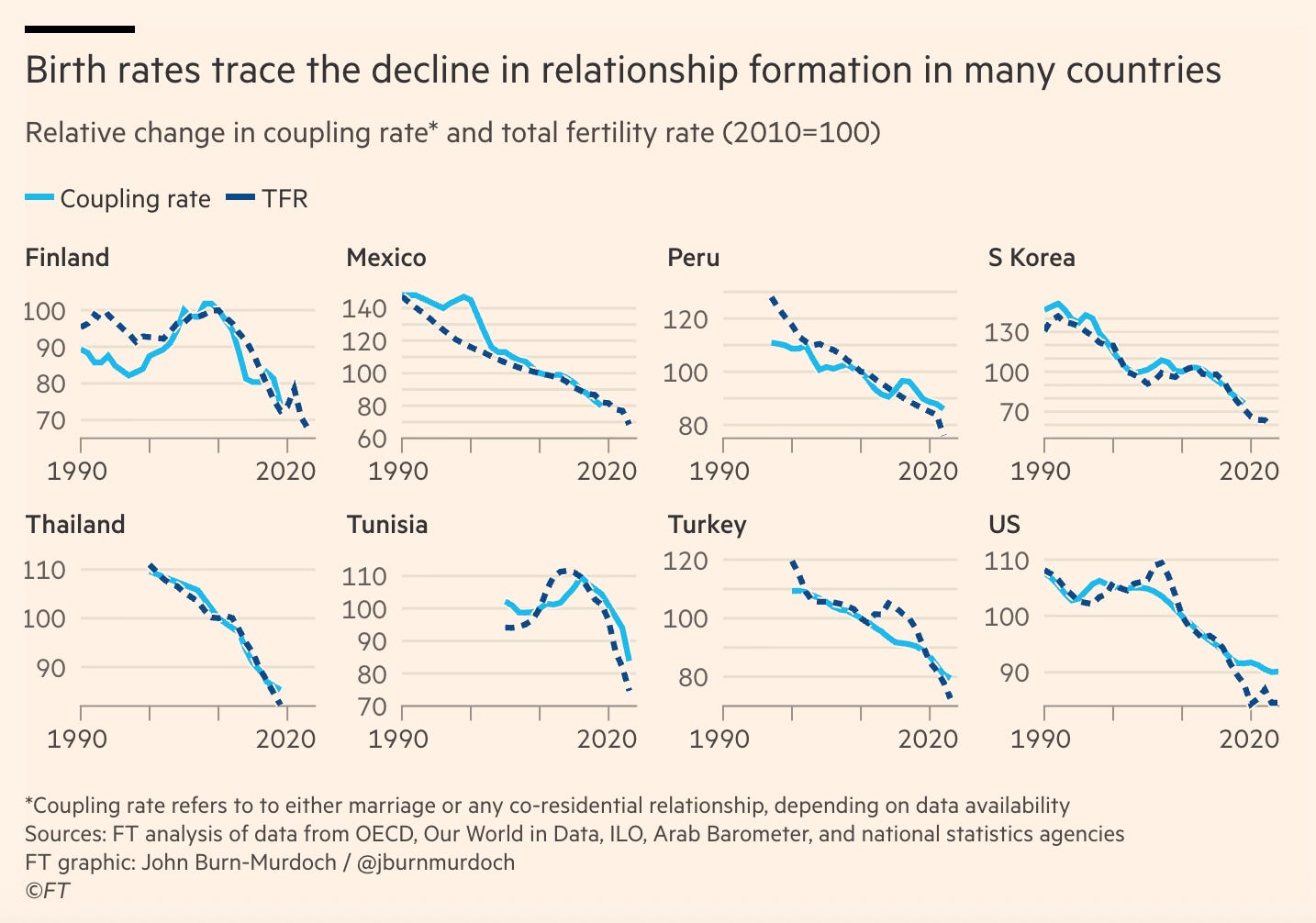
I care about the decline of coupling and marriage not because I consider myself a strict evangelist of matrimony—I think people should do what they can to enjoy themselves without hurting others—but rather because I think it bears on two of the most important questions about the future: (1) How many people exist, and (2) how happy are they? The relationship between romance and births is practically linear. Since 1990, Burn-Murdoch has shown, the decline of births traces the decline of relationship formation across many countries. Fewer relationships mean fewer people, and accelerating population declines around the world are, somewhat like climate change, a slowly accumulating phenomenon that will almost certainly shape the future of economics, technology, and the texture of human existence.
Then, there’s the mushy yet momentous question of whether people actually enjoy their existence. Self-reported happiness is declining in the west, and particularly in the U.S. Reviewing several decades of General Social Survey data, the economist Sam Peltzman came to the conclusion that “most of the overall downturn [in life satisfaction] is attributable to decline in marriage post-2000.” Reviewing Peltzman’s work, The Atlantic’s Olga Khazan provided some useful context:
One paper alone might be easy enough to dismiss, but this is a fairly consistent finding dating back decades in social-science research: Married people are happier. Period.
If the decline of coupling is upstream of both falling births and falling happiness, then the most important question is what’s happening at the source. In his new book Generation Uncoupled, Daniel Cox, a public opinion researcher and director of the Survey Center on American Life, considers a range of causes that span technology, culture, media, economics, and politics. In today’s interview, we talk about all of that.
In the end, we talk about men—especially low-income men without a diploma. “No group appears to be struggling more on the dating market than young men without college degrees,” Cox told me. “Compared to their college-educated peers, they are far more likely to be single and far less likely to have gone on a date in the last 12 months.” One reason is that, even after decades of rising female economic power, women in the dating market still value men’s economic potential more than height, politics, religion, or education, and low-income men without college degrees are often less affluent than the women in their neighborhoods and social circles. The decline of marriage cannot be reduced to any one thing, but it cannot be fully explained without considering the decline of what the sociologist William Julius Wilson once called “marriageable men.”
The Decline of Coupling and the Rise of the ‘Ick’
Derek Thompson: Your book is called Generation Uncoupled. What exactly has been uncoupled?
Daniel Cox: From the beginning, I wanted to tell a bigger story than one focused solely on the decline of heterosexual coupling.
Yes, we’re seeing a decline in marriage rates, with one study showing that the percentage of unmarried 40-year-olds has hit an all-time high—25 percent. But the book argues that problems with dating and romantic partnership are downstream from the decades-long deterioration of American social and civic life. To the extent that we’re experiencing a romantic recession, it is a symptom of this broader problem of social disconnection.
There’s a cultural dimension to all of this, as well. It’s not entirely that young people have fewer social opportunities, but that they are encouraged to prioritize their own personal experiences and expression. On social media, self-optimization culture teaches young people that the most coveted rewards in life are secured through individual effort and ambition alone. There is a fear that our relational obligations can work against these goals by restricting our autonomy. It explains why more young people worry about what marriage and parenthood will require of them, rather than the benefits they offer. Not surprisingly, rates of family estrangement are at record highs, prenuptial agreements are more popular than ever, and most young people now feel that obtaining a divorce should be made easier.
Thompson: You write that Gen Z is “neither partying nor praying.” They’re drinking less, going to church less, dating less, working fewer teenage jobs, and hanging out less. What did these seemingly unrelated activities teach previous generations about how to deal with other people?
Cox: Young adults are entering adulthood with a social deficit. As a result, their understanding of the world is shaped less by lived experiences and more by what they see online. And social media not only offers a warped view of human behavior, but it also excels at feeding our anxiety and fears.

Before the internet, teens had the opportunity to learn about the world from personal experience. Most of what they learned about themselves, and how they understood their social and civic responsibilities, was developed through their participation in community life—working a part-time job, spending time in church, playing Little League, hanging out with friends, and dating. It was almost entirely based on personal experience. Unfortunately, these activities are less central to adolescence than they once were because we’ve tacitly accepted replacing them with online experiences. Teens now spend hours online, and so much of it is passive—endlessly scrolling through content produced by strangers rather than talking to their friends.
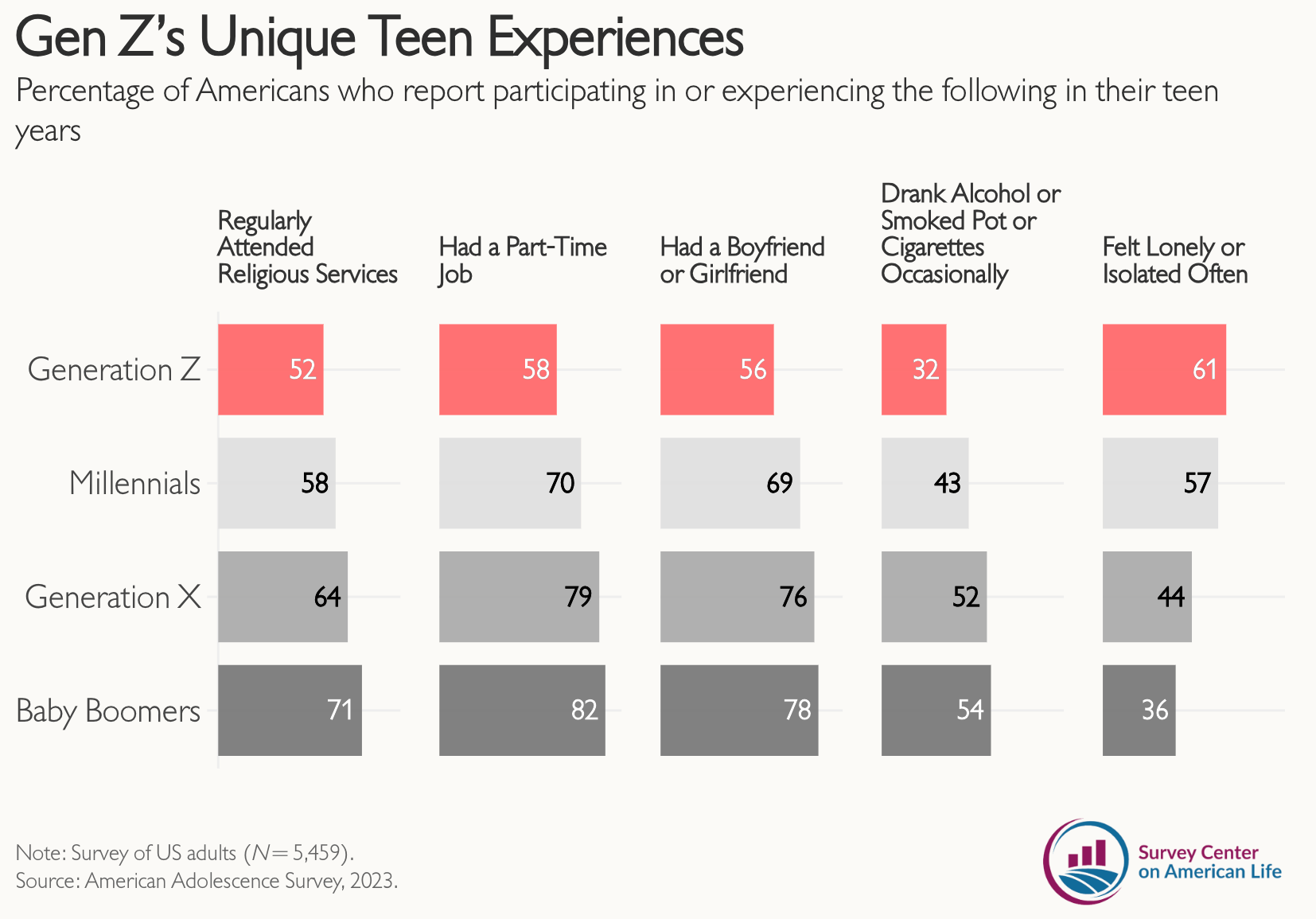
One inevitable result of this has been rising discomfort with friction and prioritizing the avoidance of embarrassment. It’s not a coincidence that concepts like “the ick” and “cringe” were introduced into our lexicon by a generation with less appetite for social risk and tolerance for awkwardness. This is tragic. I share one anecdote in the book about dance clubs. Over the last few years, DJs have started noticing that dance floors are empty; almost everyone stands around the periphery holding their phones. It’s undeniable the impact that phones are having on young people’s willingness to take risks. Nobody dances anymore for fear that they will look stupid, and that their joyful gyrations will be documented and disseminated online.
This anxiety about being surveilled is constant and unavoidable. It’s sort of like walking around in the Matrix where anyone you meet could potentially document and share an embarrassing moment, social misstep, or inartful comment. It’s made young people hypervigilant, less understanding, and less forgiving.
“Men with larger social circles tend to have much more romantic success. But that’s only true for men! The number of close friends a woman has seems to have little bearing on her ability to go on dates.”
What’s Driving the Gen-Z Political Divide?
Thompson: Let’s talk about the political gender divide. How much of it is actually young men moving right versus young women moving left? And how much of this gap is spilling over into dating?
Cox: The narrative that young women are moving left and young men are moving right is widespread. It’s also wrong. There is solid evidence showing that young women are becoming more liberal—with the shift starting around 2016.
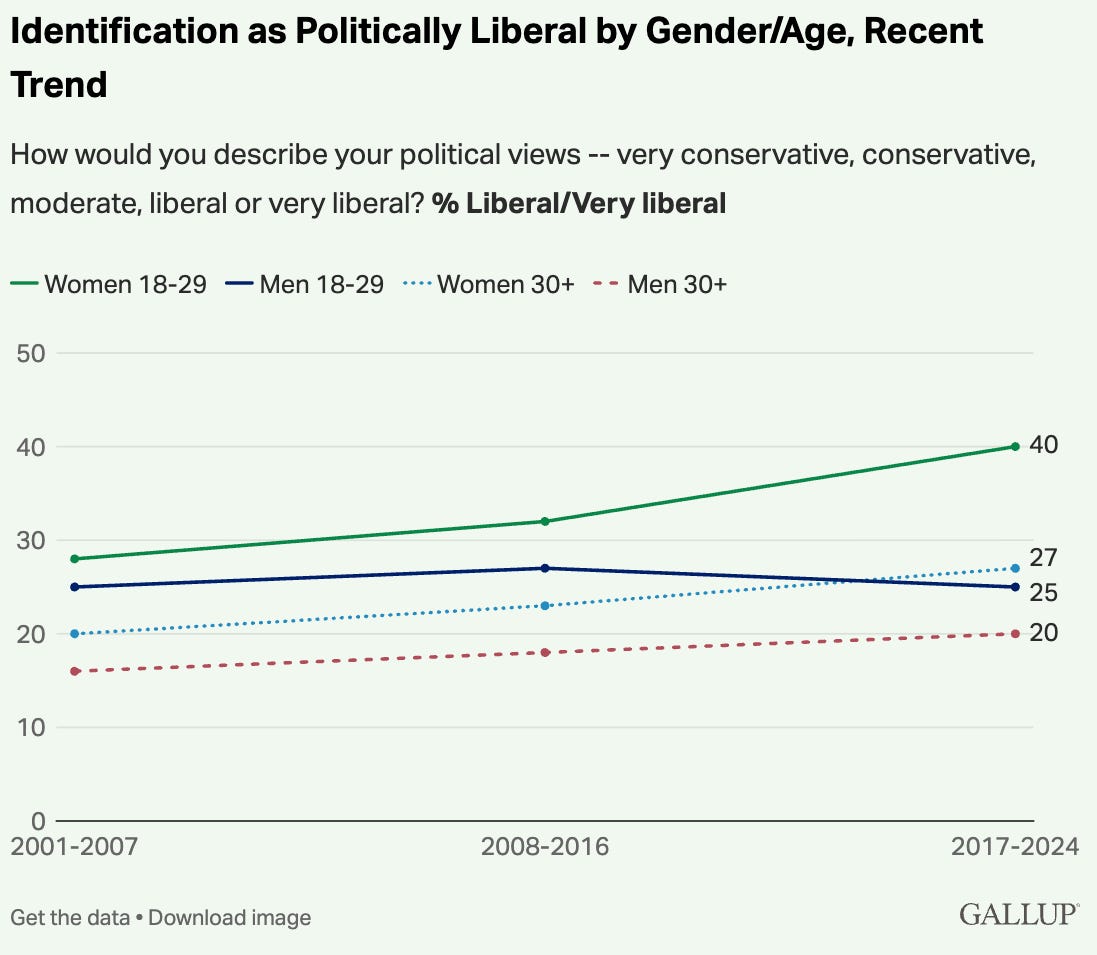
But what happened with men was somewhat different. They have not become more conservative, but beginning around 2012, they began abandoning the Democratic Party. They were not rushing into the arms of the GOP; rather, they became politically more disaffected. Four in ten young men today have a negative view of both the Republican and Democratic Party. And that was what led them to Trump. Young men express greater distrust in the political and economic system and subsequently were more attracted to anti-establishment candidates who promise to disrupt the current political order.
Gen Z has grown up with more personalized politics. In the Trump era, political identity became shorthand for character—your political views no longer signaled your position on an issue, but the type of person you were. And more young adults became comfortable screening out people with discordant views, leaving them more politically segregated both online and off. We found that more than half of young women have no close friends who support Trump.
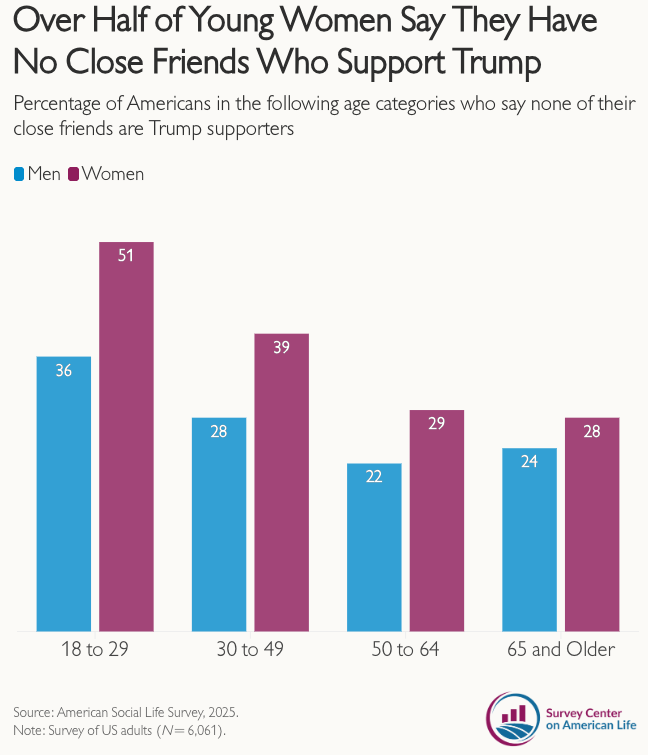
The internet contributed by flattening political discourse, making constructive conversation and compromise more difficult. And the internet took on a much more central role in how young people learned about politics. In this environment, purposeful political segregation could feel logical or necessary. In one survey, nearly three-quarters of college-educated young women said that they would never date a Trump supporter. When I talked with the young women about their objections, Trump’s policies almost never came up. Rather, it was his demeaning comments about women, belittling behavior, or history of sexual assault allegations. These were the dealbreakers.
Whatever happens in 2026, there are no signs of a political rapprochement. Pew’s 2026 benchmark study found a 22-point gap in party affiliation between young men and women. The gender divide in partisan identity is larger among young adults than any other age group.
Thompson: One takeaway I had from your book is that the gender divide isn’t fundamentally about politics. Upstream of that, there is an “experience deficit.” Boys and girls spend less time together, so they know less about one another; then the internet fills the vacuum with caricatures.
Cox: At the beginning of the book, I discuss a study showing that we’re literally talking to each other less. We’re speaking on average 300 fewer words a day. Young adults spend less time out in the world with peers and friends and more time at home, where their connection to the outside world occurs through a smartphone. Social media algorithms are extremely efficient at social segregation. One study of TikTok users found that gender was the strongest predictor of what appears in your social media feed. Young men and women can be sitting in the same lunchroom and be immersed in entirely different realities.
Algorithms efficiently deliver uncharitable characterizations of the opposite sex, and outrage entrepreneurs specialize in promoting this type of content. Podcasts such as Fresh & Fit are designed to stoke male aggrievement by presenting women as vain, shallow, and cruel. Researchers have found that social media can create “illusory norms,” the false idea that beliefs or behaviors presented on these shows or in their feeds are broadly representative. They aren’t.
Thompson: You write that men and women experience dating apps in almost opposite ways. Men feel invisible and frustrated with the amount of rejection; women feel inundated and dissatisfied with their options. Walk me through how the same technology produces two completely different forms of misery.
Cox: Men and women have somewhat different experiences on dating apps on average, but the immiseration has the same basic mechanism. By providing so many more potential romantic options, dating apps reduce our willingness to invest in any one person or date. Why would I go to all this trouble when I can swap it out for another person on another day? More singles rely on superficial evaluations or develop lists of excessive qualifications. It can make the process feel unforgiving—one misstep, and you’re done. It’s a volume problem. One young woman I talked to likened it to trying to find something to watch on Netflix; instead of making a quick selection, you spend your time endlessly scrolling through all the available options and not watching anything at all. The paradox of choice is applicable to dating. Studies have shown that the perception that we have abundant romantic alternatives reduces how satisfied we feel about the choices we eventually make.
Attention Infidelity
Thompson: One of my favorite concepts in the book is “attention infidelity.” What is it?
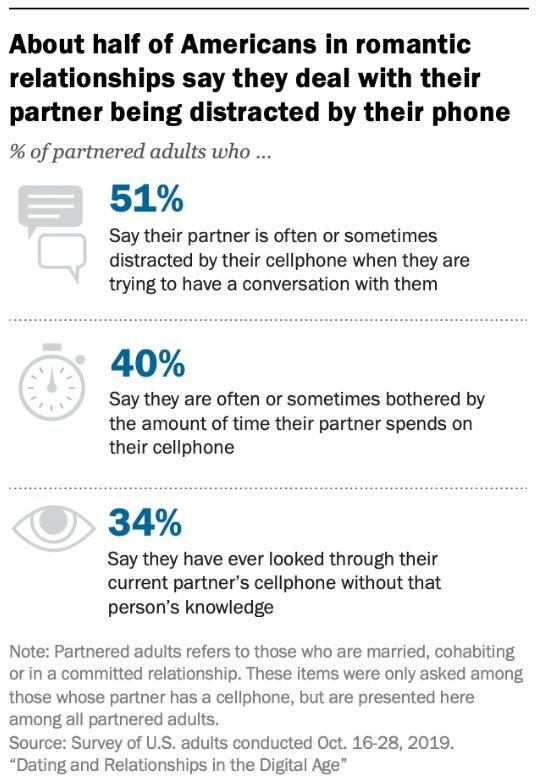
Cox: I wanted to name the experience that we’ve all had at some point—someone we’re talking to over dinner, during a meeting, or taking a walk disappears into their smartphone. They leave us, perhaps only for a moment, but in doing so they undermine a sense of trust and understanding that builds between two people who are sharing an experience. Smartphones and smartwatches equipped with social media are not simply distractions; they reduce our capacity to connect with another person by fracturing our attention. Even if we are physically present, the omnipresent draw to be somewhere else ensures that we are never entirely engaged. A single message, reminder, or notification can yank us away at any moment. This represents such a profound loss, and it has largely gone unnoticed.
Thompson: Do deep relationships require some degree of attention-monogamy that phones make much more difficult?
Cox: One of the most amazing things about the modern internet is that everything and everyone is there. You can satisfy any curiosity, reach anyone, and engage in any form of entertainment imaginable, which makes it such a powerful competitor for our attention. But this immediate and largely invisible access can create relationship problems. It has created entirely new categories of behavior—sometimes referred to as “micro-cheating”–– that teeter on the boundary of permissibility. Examples include continuing to message with an ex-partner, flirting with someone in the comments of a social media post, or hiding your relationship status. Without norms establishing appropriate behavior, couples are left to work out for themselves where to draw the lines. It can engender feelings of insecurity and the need to closely monitor a partner’s online activity. One survey found that 63 percent of young women in romantic relationships have looked at their partner’s phone without their knowledge. I don’t believe social media or smartphones are necessarily destroying romantic relationships, but they can severely degrade them.
Thompson: You describe social media as a kind of “distorted curriculum for intimacy.” If you’re 22 and haven’t had many serious relationships, what exactly is TikTok teaching you about men, women, sex, and relationships that you think is wrong?
Cox: Social media distorts our understanding of the world in a couple of ways. First, the majority of the posting is done by a very small minority. One-quarter of TikTok users produce 98 percent of all the videos posted on the platform. These people are not representative of their social group, their interests, or their views about sex and relationships. More of what users see on social media is professionally produced content from strangers. The other issue is that social media algorithms prey on our insecurities and anxieties. If you’re concerned about not being tall enough, you’ll be fed content about extreme methods you can use to gain a few centimeters or videos of attractive women deriding “short kings.” It’s not meant to reflect reality, but without a countervailing experience to draw on, this content becomes formative. Admonitions to get offline are good— “go touch grass”—but we should be encouraging young men and women to log off and spend time with one another.
Who, Exactly, Is Coupling Less? (Or: Are Men the Problem?)
Thompson: Half of 24-to-35-year-old men without college degrees are single, versus 31 percent of college-educated men, while there is almost no comparable education gap among women. What’s that about?
Cox: One of the most striking features of the gender divide in romantic outcomes is the way strong social networks matter for men, but not for women. Men with larger social circles tend to have much more romantic success than those with fewer friends. But that’s only true for men! The number of close friends a woman has seems to have little bearing on her ability to go on dates or attract a partner. One possible explanation is that a broader social circle provides more opportunities for men to meet prospective romantic partners. Surveys have shown that women have a strong preference for meeting partners through their existing social networks. Or perhaps very sociable men have other qualities, such as self-confidence, a sense of humor, or emotional maturity, that are appealing to women. Whatever the reason, social and romantic outcomes are closely intertwined. The fact that so many noncollege men struggle to develop and maintain strong ties of any kind puts them at a considerable disadvantage on the dating market.
Thompson: What’s happening to non-college men? Is it fundamentally an economic problem, a social problem, or a mating-market problem?
Cox: No group appears to be struggling more on the dating market than young men without college degrees. Compared to their college-educated peers, they are far more likely to be single and far less likely to have gone on a date in the last 12 months. Their social outcomes are worse as well. They have fewer friends and spend more time by themselves—and this is why so many struggle. For men, the health of their social network is strongly correlated with romantic success: men with larger friend groups do better.
But there are fewer places for men to gather, socialize, and access helpful models of masculinity if one was absent in their own home. Veterans’ groups, labor unions, and churches that once were central in the lives of many working-class men have disappeared. Male teachers disappeared from elementary schools during the same period. Male-only spaces that restricted access became less socially accepted—polls show that Americans are far more comfortable with female-only spaces. The social architecture that once helped men develop social skills and confidence, instilled values, and established cultural norms has collapsed.
Thompson: You say employment is the “threshold question” for women evaluating long-term male partners. Women have become vastly more economically independent, but the male-provider expectation seems remarkably sticky. Explain that a bit, but also answer this: Why didn’t women’s economic liberation produce an equally dramatic change in what women want from men?
Cox: I think women still want to feel that their male partner can provide a sense of security or protection. One of the paradoxes of modern life is that, even as women have attained greater economic power, status, and influence, it has not lessened concerns about personal safety. In some ways, young women today feel even more vulnerable. For women interested in starting families, this is even more important because early parenthood has negative economic repercussions for women and places them in a uniquely precarious position. What’s notable is how stable this view is across lines of age, racial and ethnic identity, and class—surveys show that women consistently prioritize financial security in prospective partners.
There’s an alternative view, which is that young women expect men will take on less of the domestic responsibilities, making their economic contributions more important. I’m less convinced of this argument. Plenty of young women I talked to voiced concerns about enduring inequality in childcare and household responsibilities, but said there were certainly men capable and willing to do 50/50 partnerships.
… Or Is Optionality the Problem?
Thompson: Is the deepest villain in your book something like … optionality? Dating apps give us more options; social media keeps alternative partners perpetually visible; therapy language tells us to protect ourselves; the culture tells us not to settle. But marriage, friendship, and family require accepting inconvenience and closing doors. So have we built a culture that’s extremely good at teaching people how to protect the self and unusually bad at teaching them how to belong to something outside of the self?
Cox: I think that’s right. I found that, in writing this book, what would bother and annoy me most was the argument that a good and meaningful life could be created through curation and self-optimization strategies. Maximizing our independence and control over our lives is the first-order goal. A corollary to this idea is that anything that places limits on our individual choices is inherently problematic. The most rewarding experiences in life are inherently limiting—it is living with the choice freely made. Deciding to enter into a committed relationship, get married, and become a parent means foregoing other possibilities because they place relational demands on us. We have an obligation to our partners, spouses, and children. And these experiences can, and often do, make us better! Speaking for myself, becoming a husband and father has led me to become more patient, empathetic, and generous. It’s a social improvement. We’ve built a culture that teaches young people to fear negative relational experiences; that solitude is better than friction. Romantic relationships do not have to be perfect—and in fact, never are—for them to be valuable.
Thompson: What is an important takeaway from your book that I’ve missed?
Cox: One of the most important revelations that emerged in writing it was that so much of the angst, anxiety, and exhaustion we feel is due to the growing imbalance of responsibilities between individuals and institutions. Individuals have taken on so much more of the social and civic work that was once primarily the province of churches, schools, civic organizations, and social clubs. Today, we organize book clubs, poker games, or movie nights ourselves. This requires a great deal of individual effort and initiative. I cannot tell you the number of different WhatsApp groups I’m now a member of that all require some degree of attention at various times. Our social lives are built and maintained through personal effort with little institutional support. It didn’t use to be this way. When social activities were primarily organized through schools, places of worship, or the local Rotary Club, norms of behavior made social interactions more predictable, which reduced social anxiety. They created a regular rhythm to our social lives. We’ve gained more autonomy over our individual lives, but it has come at a significant social cost.
The point that the increased prevalence of the idea that "a good and meaningful life could be created through curation and self-optimization strategies" leading to the belief that that "anything that places limits on our individual choices is inherently problematic" needs more attention in my life. The podcast landscape is filled with the idea that we can optimize our health, our time, and our relationships. Yet we know that great creativity and enjoyment comes from working within tight constraints, in art, in sports, and, yes, in relationships - yet it is hard to avoid the sirens of liberty, independence, and self.
I wonder if this desire to remove the friction of social networks, of organizations might only increase with "abundance" of certain things, and whether AI will also amplify that false sense of the potential of independence.