


There are two problems with the famous “male loneliness crisis”—the loneliness part and the male thing.
First, it’s not clear that loneliness is rising. The most careful studies show only a small increase in self-reported loneliness in the last few years, despite the significant increase in alone time among all Americans, especially young and low-income people.
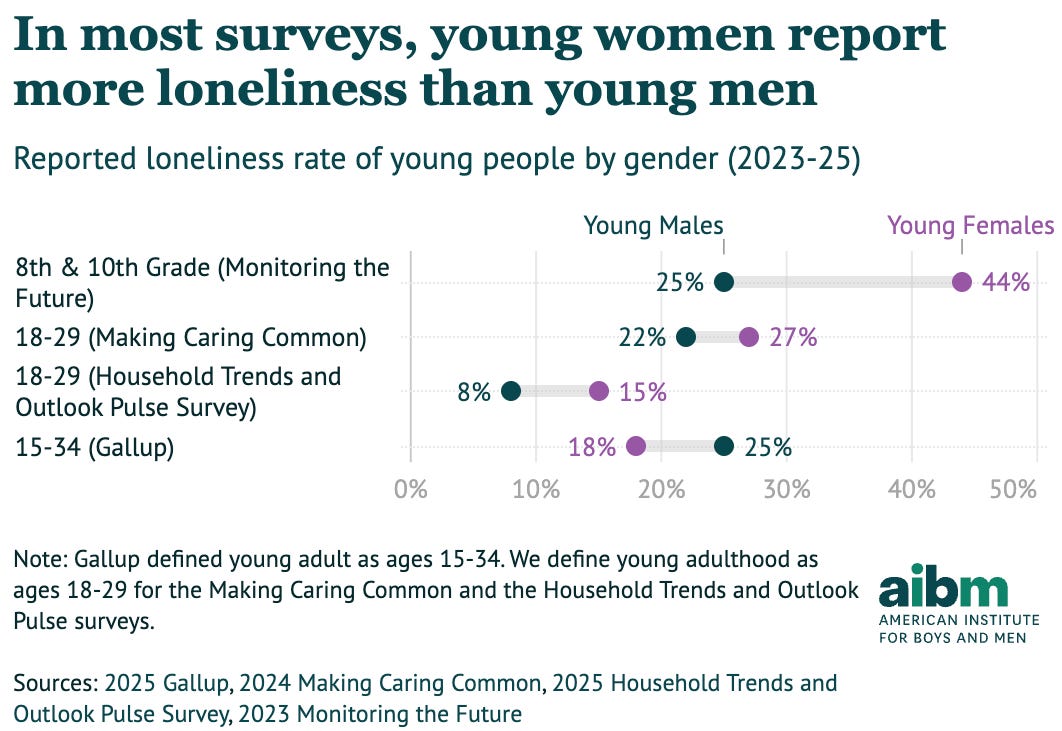
Second, there’s little evidence that men feel particularly lonely. One study by the American Institute for Boys and Men found that women are just as, or more, likely to say they feel lonely “frequently” or “always.” Other studies mostly find the same:
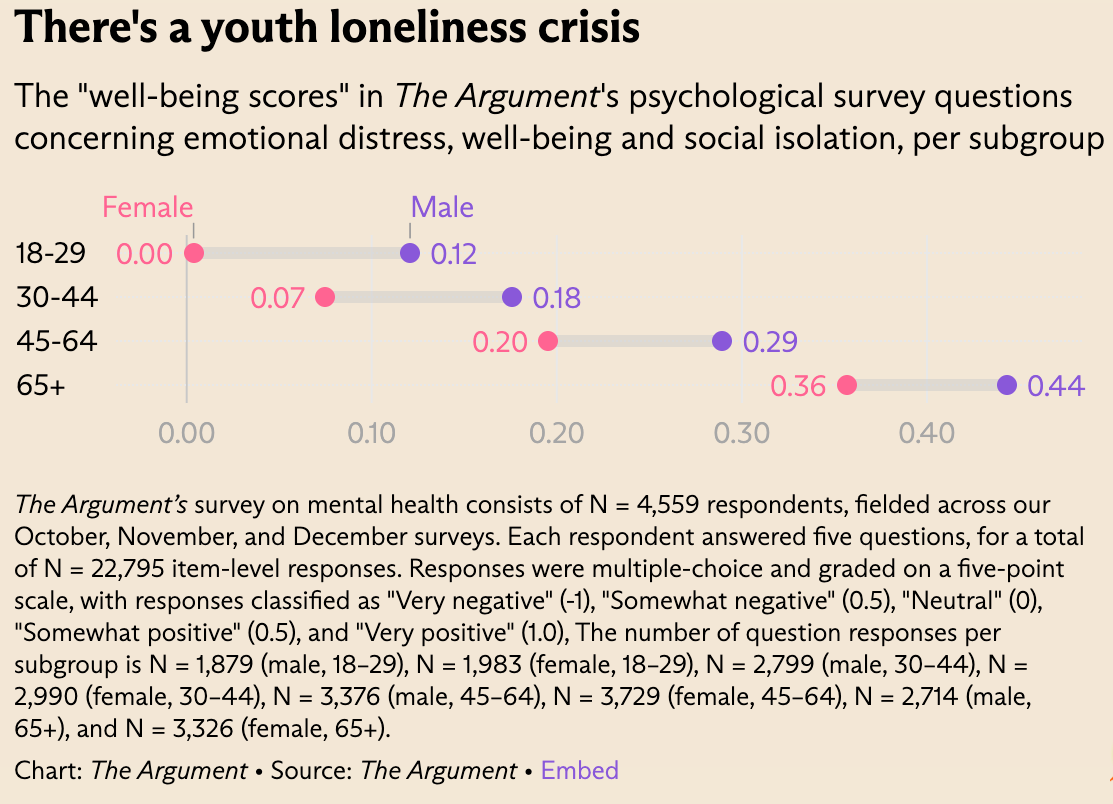
A separate survey from The Argument of more than 4,5000 people found that women consistently said they felt lonely more than men. More than gender, youth was a far better predictor of emotional distress and feelings of social isolation.
What do we make of this ostensible myth of the male loneliness crisis? One interpretation is that there is nothing to worry about, and everybody is fine.
The trouble with that interpretation, however, is the fact that everybody is so evidently not fine. In the last few years, rates of anxiety and depression among young people have set records. Several surveys—including the General Social Survey and the World Happiness Report—have shown US well-being in a ditch. Other surveys that measure Americans’ feelings about the economy (see: the University of Michigan Consumer Survey) and the country (see: Pew Research) indicate an unprecedented level of national gloom.

This all sets up one of my deepest-held hot takes about the state of the country: The problem isn’t that Americans feel lonely; the problem is that too many Americans, who are spending more time alone than ever, do not feel lonely enough.
Loneliness can be thought of as a biological cue to spend time with other people. But many Americans, enraptured by television and televisual media on every screen, are ignoring that ancient signal. They’ve withdrawn from the world of flesh-and-blood friends and replaced them with pixel-and-glass representations. Thus have beds and couches replaced bedrock communities and parasocial life has eclipsed social life.
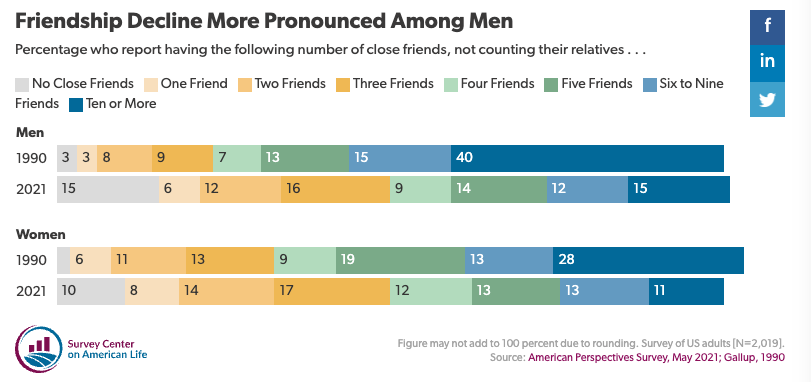
The number of Americans who say they have six or more friends has declined by about 60 percent in the last few decades, while the share of Americans who say they have no friends has surged. In both cases, it’s men who have lost the most. No, the problem isn’t that men are lonely. The problem is that many men wouldn’t recognize loneliness if it punched them in the gut and poured a beer on their head.
Laurie Santos is a Yale professor of happiness and the host of the podcast The Happiness Lab. In today’s interview, we talk about:
whether men are worse at making and keeping friends than women
how modern notions of loneliness and masculinity both emerged from the 19th century
when solitude is good and when aloneness is bad
how to talk to people—and the upsides of over-sharing
Are Men Worse at Friendship?
Derek Thompson: Do you think that men are worse than women at maintaining friendships in adulthood?
Laurie Santos: I think there’s lots of evidence to show that they are. I don’t think this is something deep-seated and biological about being a guy, but if you look at the data, men are doing worse in the friendship department. And we have to couch this in what’s happening generally, which is that over time, everybody’s friendships are going down. If you look at American Time Use Survey data, which has been studying people for decades, pretty much everybody across all age groups and both genders is spending less time in person with their friends than they did a few decades ago.
But that decrease is much worse for men. One study found that if you look at what’s standardly considered a good level of friendship -- do you have six close friends you could talk to? -- men have shown a decrease in that number by about half in the last couple of decades. And if you ask how many men say they have no close friendships at all, you see around 15% of American guys in midlife saying exactly that. That’s a fivefold decrease since folks have been running this survey.
Thompson: Let’s get into why. There is an overall structural trend toward aloneness and away from sociality, which I’ve called the antisocial century. But I want to narrow in on why this has been particularly isolating for men. I remember a conversation with Richard Reeves where he said women and even children are more likely to hang out face-to-face, but adult men are more likely to hang out in what he called shoulder-to-shoulder contexts. They require a centralizing activity to provide an excuse for hanging out. Let’s play golf, let’s watch the game, let’s go to the bar. Women are more likely to meet up in contexts that don’t need an excuse. Men need that excuse—video games, sports—which might mean it’s harder for them to come up with a reason to hang out in the first place.
Santos: The face-to-face versus shoulder-to-shoulder distinction is really important. Todd Rogers, a professor at Harvard Kennedy School, did a study where he went to the American Time Use Survey—which looks at how people spend their time, whether they’re eating, cooking, shopping, playing video games—and he asked men and women how likely they’d be to invite somebody to do each of those things. For women, it was most categories: “Yeah, I could invite somebody to go shopping, sit and have coffee, come over while I’m cooking.” For guys, it was basically watch sports or do sports. His idea is that it just doesn’t seem culturally acceptable for guys to invite other guys to do the things that time-use surveys show we actually spend most of our time doing. The categories that guys feel okay inviting other guys into are much smaller.
But the deeper question is why it’s so hard for guys to get together and chat face-to-face. And I think this comes back to traditional gender norms—not all guys, there’s lots of heterogeneity here—but more guys grow up with norms around independence, self-reliance, stoicism, not talking about emotions. That makes it hard to have the vulnerable face-to-face conversations that a lot of guys seem to avoid. And these are relatively new values. If you rewind to classical Greece, you find Achilles and Patroclus in the Iliad, and they are literal warrior dudes who openly wept when a friend died. If you look at early American history, you find our forefathers walking hand in hand, writing effusive poetry to one another. These norms were not always there.
Thompson: When do you think this conception of masculinity and friendship changed?
Santos: It seems like a lot of it changed in the late 19th century, for a couple of reasons. One is real differences in how people were conceptualizing gender. Back in the 1700s, the idea was that men were actually more empathic than women; women were thought not to have the requisite emotions for close friendship. That changes around the 19th century, when women become the caretakers, the providers. There was also more awareness of queer culture at that time, and because that identity was stigmatized, it caused straight men to become more paranoid about closeness with other men. Then into the early 20th century you get the traditional male gender norms everywhere were coalescing. Through the 18th and early 19th century, guys could be friends, openly expressing emotions. Then that changed.
Thompson: That reminds me of the history book Battle Cry of Freedom, whose opening chapter argues that in the 1850s and 1860s, the Industrial Revolution was sending men out of subsistence farming and into a new mechanized economy, where they became seen as being in charge of work. Women became guardians of the home. You had those separate spheres of influence, which had knock-on effects for what it meant to be modernly masculine versus feminine.
Santos: And we see the knock-on effects today. I interviewed the actor Andrew McCarthy, who wrote a book about the history of male friendship after realizing in his own midlife that he’d lost his friends. He went on a road trip to reconnect with old friends and talk with men around the country about their notions of friendship. One thing that struck him was that everybody he talked to, from Texas oil rig workers to guys in cities, talked about the pressure to provide as a key obstacle to male friendship in midlife. That pressure was central to why men just weren’t making time for social connection.
The myths of the male loneliness crisis
Thompson: The decline in male friendships is sometimes called the “male loneliness crisis.” But the evidence that loneliness itself is surging among men is not nearly as clear as the fact that aloneness is surging. You make the additional point that loneliness is subjective—someone can spend a week at a silent retreat and feel incredibly happy; another person can spend 12 hours alone and feel crushing loneliness—and intensely modern. Tell me how you think we misunderstand loneliness.
Santos: I talked to a historian named Fay Bound Alberti, who has a book on the history of loneliness. She argues that loneliness as we think about it today is actually a pretty new phenomenon. People often talked about being alone, but there were lots of benefits to it : spiritual connection, getting to know yourself, emotion regulation. And for most of human history, there was a sense that you were never truly alone; God was around, or you were one with nature. She argues that our modern notion of loneliness is essentially a 19th century concept that emerged as culture became more secular and more individualist.
She contrasts Robinson Crusoe, from the early 1800s, with the Tom Hanks film “Cast Away.” In Robinson Crusoe, being stranded was a moment of spiritual enlightenment, a chance to find yourself. In Cast Away, the whole point is that Hanks went crazy because he had no one to talk to. There’s a real difference in what we think alone time does.
That’s where psychologists have started asking whether our construal of loneliness is actually creating the feelings associated with it. Researcher Micaela Rodriguez has been studying whether talking about the loneliness crisis makes people more lonely. She runs studies where some people read a typical news article about the loneliness crisis and others read about the benefits of solitude. That simple intervention changes how people experience being alone. Your perception of how bad it is to be alone is making loneliness worse when you actually find yourself alone.
Thompson: When do you think aloneness is therapeutic versus clinically harmful?
Santos: Part of it is intention and choice. How we feel about being alone or with other people might be very different from whether we’re actually alone or with other people. Some of my deepest moments of loneliness have been at a party where I felt disconnected, physically surrounded by people but experiencing real loneliness. Versus a silent meditation where you feel transcendently connected to something larger than yourself. So being physically alone or with other people doesn’t map cleanly onto whether you feel connected. But how we think about it matters enormously. If you’re excited to be alone, if you frame it as solitude rather than aloneness, research shows even those linguistic choices make a difference.
Thompson: Here’s a take you might push back on. A lot of people now spend historically high amounts of time alone, but surveys show they don’t report being lonely. When I see the decline of friendships, of coupling, of time spent with other people, I think they should be lonelier. If they felt a little lonelier, they would socialize more, get off their couch, make friends. Strong social connections are physically and neurologically protective as we get older, and they pay dividends. My thesis is that people are alone because they’re so deluged with entertainment that it’s overwhelming their impulse to be around other people. They’re not feeling lonely in the moment, so they’re not making that next friend. And then 20 or 30 years later, we find out that friendships have declined.
Santos: I don’t think that’s a hot take, because I agree with you. Micaela’s point is specifically that one of the reasons alone time can feel so bad—when people are truly isolated and not entertaining themselves but feeling the weight of it—is how they construe it. Her move is to say: let’s make alone time healthier by changing how we think about it. Her move is not to say: never have social connection.
I think both of us would agree there’s a real problem with how much time people are spending alone compared to 10 or 15 years ago. And I think we saw signs of this even earlier. Think of Robert Putnam’s “Bowling Alone,” where he looked at how in the 1950s people joined bowling leagues and had politically and ethnically diverse communities. Then in the late 90s and early 2000s, people weren’t bowling in leagues anymore. And Putnam was already writing this before the internet, before streaming. He was worried about television. And his critics said, “You’re totally underrating the internet. It’s going to transform socialization and bring everyone back together.” Two decades later, socialization has declined further, and the share of people under 25 who say they go to or host parties has declined by 70%. Putnam was prescient and his critics were not.
Thompson: A theme we keep circling: chosen aloneness can be sacred. Aloneness you fall into chronically is what’s harmful. As the father of two young kids, when I’m traveling and I get breakfast alone at a nice hotel, it’s genuinely the most incredible thing in the world, not because I hate my family, but because it’s purposeful aloneness, a brief and bounded ritual before I go back into the chaos of a loud and loving family. Of course aloneness can be therapeutic. But practically every therapeutic molecule can be overdosed. And people can fall into an overdose of aloneness without realizing they’re slowly depriving themselves of the friendships that would pay dividends 20 years down the line.
Santos: That’s exactly right. And someone like Micaela would add that culture can make it harder to get to that Zen-like moment of aloneness. If you’re eating that hotel breakfast thinking, “I’m alone, I must be a freak, something is wrong with me,” it’s very hard to enjoy it. She’s part of a generation that is much more alone than previous ones, and she remembers sitting in a dining hall in college not thinking, “Great, a moment to myself.” She was thinking, “I’m a freak. I don’t have any friends.” What we want is to find healthier ways to have alone time—and that may actually improve our social connection time. When you get that moment alone with your eggs, you come home refreshed. You can be a better partner, a better parent. Healthy alone time can give you the bandwidth to do the sometimes effortful work of building good social connection.
TMI vs. TLI (Too Much Information vs. Too Little Information)
Thompson: You’ve spoken to the University of Chicago psychologist Nick Epley, who has done a lot of work on the counterintuitive psychology of connection. Tell me what you’ve learned about how we get this wrong.
Santos: One thing we get wrong about oversharing and TMI is that we often think about it in the context of social media : posting too much, blasting something about your boss on Facebook. And that makes us assume the same cringe judgment applies in real life. But what Nick studies, along with psychologists like Leslie John, shows that sharing more than you think is comfortable in real life is actually good.
Leslie John has been pushing the acronym TLI [Too Little Information] over TMI [Too Much Information]. Her idea is that not sharing enough quietly reshapes your life. If you don’t tell your colleagues about a disability, they can’t give you the help you need. If you don’t tell your partner about the small things needling you, those micro-frustrations add up. Being vulnerable is the path to true connection.
What Nick’s research shows is that people don’t react as negatively as you think when you share something. We worry about how competently others will view us when we reveal a struggle: “Will people think I’m a bad mom? Will they think I’m not good at my job?” But other people aren’t thinking about competence. They’re thinking about your warmth. They’re thinking, “This person shared something with me. They trust me.” And how do you react when someone shares something vulnerable? You tend to reciprocate warmth and openness. But we forget this when we’re the one doing the revealing, and so we share too little.
Thompson: One of my favorite stories from Nick is that he loves to get incoming students at the University of Chicago’s Booth School of Business into an auditorium and ask them to turn to the person closest to them and share their deepest fears or disappointments. Initially these students start writhing with discomfort. And he says, “We’re doing this.” Fifteen minutes later, he cannot get them to shut up. There are tears streaming down faces. The conclusion he’s driving at is that there’s a latent desire to share that often goes un-acted on because of a kind of social anxiety, a fear that revealing something true about ourselves will trigger judgment. When instead what tends to happen is reciprocity: vulnerability begets vulnerability, kindness, empathy.
What does this tell us about modern psychology? Are we demanding too much of ourselves to be introverted? Do we fear sharing more than we should?
Santos: It shows something I talk about constantly: our minds lie to us. We pursue happiness and social connection incorrectly because we have bad theories about what will make us feel good. Nick’s work shows we’re just bad at understanding the consequences of social connection. We’re bad at predicting how much people like us. We’re bad at thinking about what expressing something vulnerable will do to how we’re judged. And each one of these mistaken theories is preventing connections that would genuinely improve our lives.
One of my favorites is the Liking Gap, from psychologist Erica Boothby. When you ask “how much is this person going to like me after our conversation?” you consistently underestimate the answer. If you look at college roommates or new office hires and ask them how much the people around them like them, they consistently underestimate it.
Beautiful Mess Effect
Thompson: I think social media makes this much worse. Social media is so good at making in-group versus out-group messaging go viral that we can easily mistake the virality of online hostility for the way people relate in the physical world. But these are two completely different worlds with almost different rules. Online, outgroup hatred is a key to virality. In person, reciprocity tends to dictate relationships. If you’re nice to someone on a bus, they don’t say “go to hell.” You get what you give. It’s very hard for people who spend a lot of time on TikTok or Twitter, absorbing the popularity of hostile messaging, to then imagine meeting those same strangers in real life. And many times you don’t even meet them -- you just respond to a critic online and they say, “Oh my God, I love your work.” The moment people can see each other and know they’re being seen, the entire calculus of interpersonal psychology changes.
Santos: Nick makes a related point that doesn’t even require social media polarization. For most of human history, the only way to communicate was face-to-face in real time. Now we have texts, emails, Slack. And one of the things we know psychologically is that text dehumanizes us. It’s very hard to see a full mind in it, because you don’t get the emotional expression you get in person or even on a podcast. This is why you can’t tell if a text message is sarcastic or sincere. And if you think about how much of the human species now connects in text and text-like media, it makes sense that we’re misreading each other constantly.
The second bias I love is what’s called the Beautiful Mess Effect. We think that if we show our vulnerabilities or mess-ups at work or with friends, people will be put off. But what actually happens is that people like us more -- we seem human, more relatable, more like them. Sharing your mess signals trust and invites people to help. So we walk around with an incorrect theory that being vulnerable will make us less likeable, when in fact it makes us more so.
Naming these biases helps. When I’m on the verge of sharing something vulnerable or striking up a conversation with a stranger, I notice the cringe voice saying “don’t do it.” And I’ve developed some evidence-based courage to tell that voice: the data says you’re probably wrong by about 50%.
The Founders’ theory of happiness
Thompson: As Americans, the pursuit of happiness is inscribed into our founding document. But a theme of this episode is that many modern notions -- of male loneliness, of friendship, of what it means to be alone -- are recent inventions. In this 250th year of America, what did “the pursuit of happiness” mean in 1776 versus what we think it means in 2026?
Santos: As you might guess, we’re pretty off. Darrin McMahon, a historian at Dartmouth, has a book called “Happiness: A History” where he looks at this across time. For most of human history, you didn’t think you could pursue happiness, because it came down to luck. Even the word “happiness” comes from “hap” -- happenstance. Then in classical times, Aristotle and the Greeks started to think happiness was achievable, but the way to pursue it wasn’t to go after pleasure -- it was to pursue virtue. Courage, prudence, kindness. What Aristotle called eudaimonia: a life of flourishing. Happiness wasn’t about your own hedonic pleasure.
This changes in the 18th century, around the founding of the United States, for several reasons. Pestilence and disease were receding. Little creature comforts -- better bedding, lighting, chimneys -- were more available. Religious notions shifted away from Calvinist misery-now-happiness-later toward the idea that hedonic pleasure was compatible with a good life. So this is the world in which the founding fathers were operating: the first era in which pleasure was considered genuinely acceptable to pursue. But these were also scholars steeped in classical thought. Darrin McMahon’s idea is that they held a dual notion of happiness -- hedonic pleasure, yes, but achieved through virtue and through seeking happiness for the community, not just for yourself.
Interestingly, the word “pursuit” meant something different in the 18th century. It was connected to prosecution -- the hunt -- with the understanding that in going after happiness, you might kill it. So the preamble gives us an unalienable right to life and liberty, but happiness? You just have the right to pursue it. Implicit in that was the idea that it wasn’t guaranteed. And the work of pursuing it was the classical work of cultivating virtue.
Fast-forward to 2026 and you look at looksmaxxing and TikTok influencers and self-help culture and you think: we got way off track. We forgot the virtue part and we forgot that it wasn’t guaranteed to us.
Thompson: One conclusion I take from that story is that the Aristotelian concept of happiness that may have inspired Jefferson had this patina of virtue that is inherently social -- you are courageous not for yourself but for others. But when I think about looksmaxxing or “good vibes only” culture, it’s entirely an internal monitoring system: “Am I happy now? Is this a good vibe?” That’s a pull inward rather than an extension outward toward other people.
Santos: And two things go wrong when we do that. Psychologist Iris Mauss at UC Berkeley studied what she calls the paradox of happiness: the more we pursue it, the less happy we tend to be. One reason is that people who think of happiness as something social -- cultivating everyone’s flourishing -- are not as subject to hedonic adaptation. We get used to pleasures, we return to baseline. But if you’re pursuing kindness and generosity rather than hedonic pleasure, we’re less subject to that adaptation. The pitfalls of pursuing happiness don’t come up as much if you pursue it in this eudaimonic, social way.
The other pitfall is what psychologists call meta emotions -- emotions about emotions. When we constantly ask “am I happy yet?”, we often feel we come up short, and then comes the frustration, the shame, the “I should be doing better.” That makes us feel worse. The paradox is that the more we chase happiness in this individualist, self-monitoring way, the further we get from it. And the more we’ve strayed from the founders’ notion that happiness is about other people, social connection, and these social goods -- the worse we’ve made the very self we were trying to satisfy.
Thompson: It also seems that when we help other people, we can know that we’ve helped them in a way that we can’t always know that we’ve made ourselves happy. Self-happiness is a difficult endpoint to measure. Was I happy at that restaurant? Was that wine good enough? But if I shared that wine with my wife and we spoke lovingly about our kids -- those things have clear yes or no answers. You did it or you didn’t. But when you’re doing something purely to make yourself happy, the endpoint is impossible to truly know.
Santos: Yes. And we just tend to have fewer of those judgy meta emotions when it’s about other people. If you gift a friend a bottle of wine, you’re not agonizing over whether it was the right choice the way you might if you’d bought it for yourself. We have these built-in mechanisms for the warm glow of doing something for others that are just less prone to self-criticism. We are built to be connected. And the more we get away from connection, we do that at peril -- not just for our sense of belonging, but for our overall pursuit of happiness.
I'm fortunate to have a small group of men that I have meaningful friendships with, although they're all long-distance because I moved away from my hometown after the pandemic. Aside from them, my male peers (middle-aged, middle-class, college educated) struggle with identity now that their kids are grown up, they are on the downside of their careers (or have been laid off), and they no longer excel at sports. As a sociologist, I suspect that my experiences are common.
The gender difference in friendships is noticeable in reactions to news shared on Facebook. When my writer wife shares her successes, dozens of her women friends weigh in to say how thrilled they are her. When I do the same (I'm a songwriter and musician), most male friends respond with sarcasm or don't respond at all. Most former guy friends frustrate me and I've given up trying to connect with them.
On the topic of male friendships, a part of definitely seems cultural and mainly a western thing.
In other parts of the world like the Middle East or Central Asia, men tend to have very close and strong friendships that are often long lasting/durable.
Small signs of intimacy like kissing on the cheek as a greeting or hand holding tend to be less stigmatised. Even not too long ago in American history, men being more intimate in their friendships wasn’t uncommon. You can find photos of men in the 1800s being very touchy in them, far more than you’d see of photos of groups of men today.