


Ten years ago this week, Donald Trump stunned the world to win the US presidential election. Last night, in his final midterm election, the president’s party suffered a historic collapse. Today, his own vice president is publicly brainstorming ways to distance himself from the administration’s agenda.
It may take years to understand what Trump has done to America. But I think this is it. I think the Trump Decade is over. And, frankly, I think I might still be in a state of shock.
Democrats didn’t just win the House by the largest national vote margin in decades. James Talarico won a Senate seat in Texas by 12 points—more than Kamala Harris carried in sky-blue states like Illinois or New Jersey in 2024. Jon Ossoff won his reelection in Georgia by 18 points—more than the Harris ‘24 margin in places like Connecticut or New York State. In Kansas, where no Democrat had won a Senate seat since the Great Depression, Adam Hamilton won comfortably. In Mississippi, prediction markets now have Democratic Senate candidate Scott Colom surging above 90 percent to take a state that Trump recently carried by 23 points.
When commentators say “I don’t recognize this country,” they typically mean it in a bad way. But, in my frazzled state of disbelief, I’m genuinely finding it hard to wrap my mind around an election result where Kansas voted like New Hampshire and Mississippi voted like Wisconsin.
More thoughts:
1. This was a generational wipeout for Republicans.
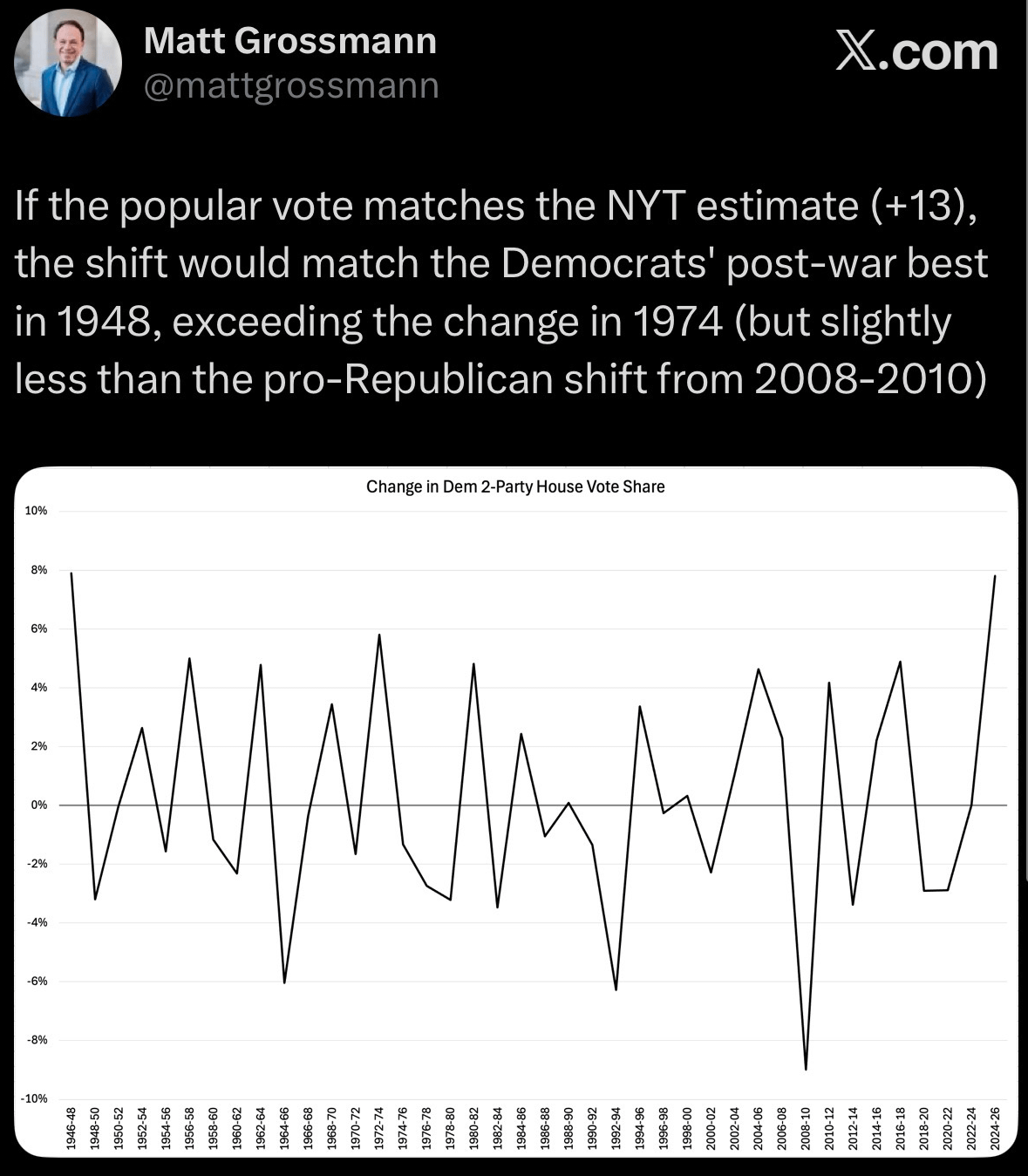
The Democratic Party’s margin of victory in the overall national vote for House seats is expected to be about 13 percentage points. That would be the largest Democratic rout in at least half a century, according to the New York Times. Two years after several news outlets announced that Trump had created a vibe shift in American history, we’re looking at a Watergate-level swing back to the left.
2. It was also a ‘generational’ moment for Democrats.
James Talarico is 37. Jon Ossoff is 39. Abdul El-Sayed is 42. Iowa Governor-elect Rob Sand is 44. The political order that has governed America for most of my adult life has been overwhelmingly dominated by Baby Boomers. But the candidate class is changing. The “Mr. Brightside caucus” of Millennial libs has an opportunity to write a new chapter in American politics.
3. Donald Trump is very good at running for president, but he is very bad at being president.
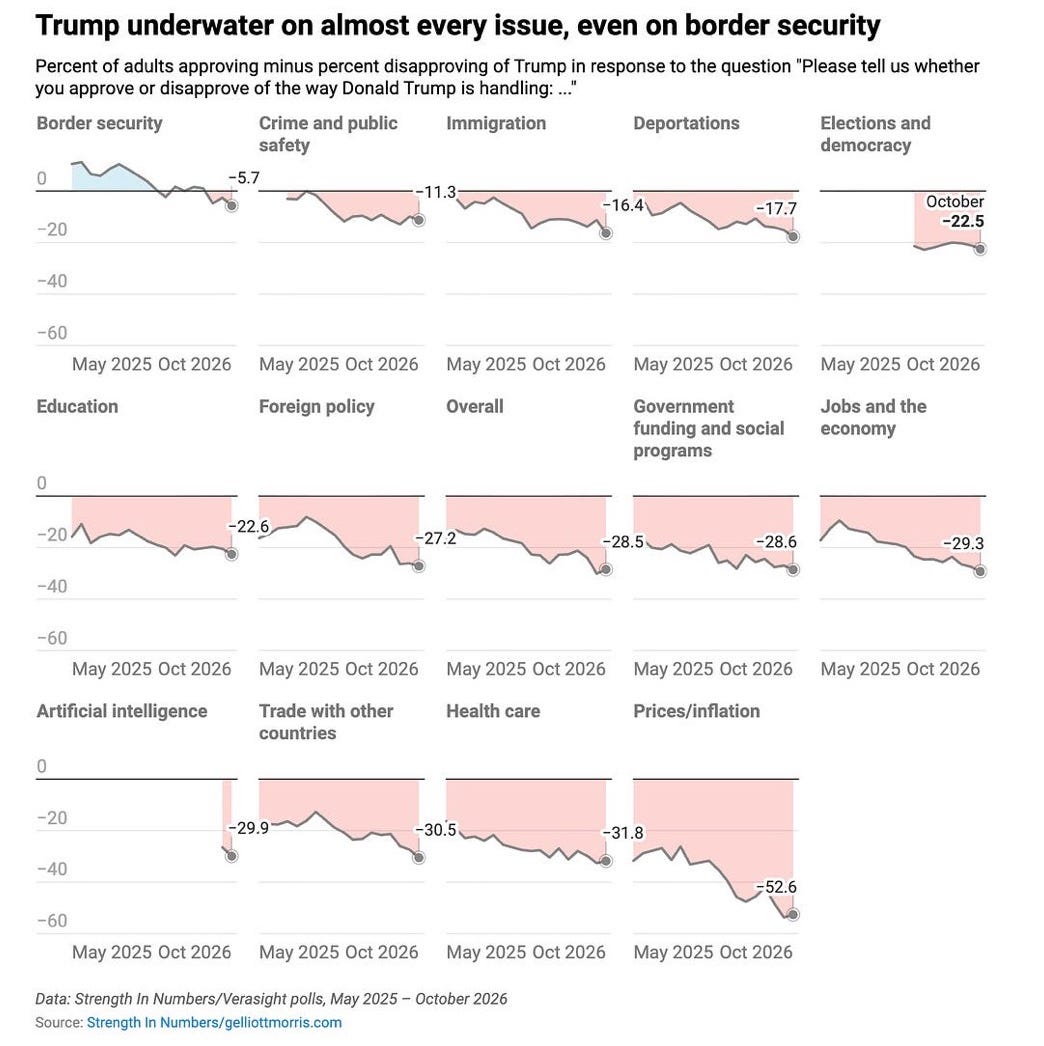
The problem with Donald Trump is not simple. It’s not just that he’s a bad president whose final pitch to voters involved talking endlessly about the shape of men’s butts and the ins and outs of White House renovations. It’s not just that he’s devoted himself to corrupt self-enrichment, spending his afternoons coating the White House ballroom in gold leaf while Americans struggle to afford gas. It’s not just that Americans increasingly oppose every single policy priority of the administration. It’s not just that he responded to frustrations about border control by dialing up a brutal immigration enforcement policy that destroyed 100 percent of his gains among Hispanic voters. It’s not just that he won a cost of living election in 2024 and then moved immediately to raise import prices with a historic tariff regime and then followed that up by sending gas and diesel prices higher by invading Iran in a military action that at once violated two campaign promises—to do something about high prices and to do nothing regarding military involvement in the Middle East. No, the deeper problem is that, on top of all of this, the man just plain sucks at candidate selection. Trump pushed out popular conservative senators in Texas and North Carolina for insufficient loyalty and backed horrendous wannabes that gave Democrats a chance to win in parts of the country where not even the most hopium-addled lib would have dreamed of winning in January 2025.
That Donald Trump is a unique political talent cannot be denied. But what kind of political talent is he, really? The president is now 2-0 running as an outsider trying to wrest the presidency from Democratic hands (2016 and 2024) but 0-3 in elections where he is already the president (2018, 2020, 2026). In an age of anti-incumbency, Trump is the epitome of the incumbent curse, a generational genius of charismatic negativity who has no idea what to do with the reins of power once he seizes them—other than marshal the machinery of the federal government to drive public opinion against him.
4. Democrats, don’t lie to yourselves: This is not a permanent realignment. The middle is molten.
Two years after almost every demographic shifted right, literally every demographic shifted toward Democrats, according to the New York Times. The biggest shifts were among voters under 30 (+32%), men under 45 (+31%), and Hispanics (+28%). Two years ago, some commentators—like me!—speculated that Trump had captured young voters and made serious inroads among Hispanics. But on Tuesday, those groups moved toward Democrats more dramatically than any other.
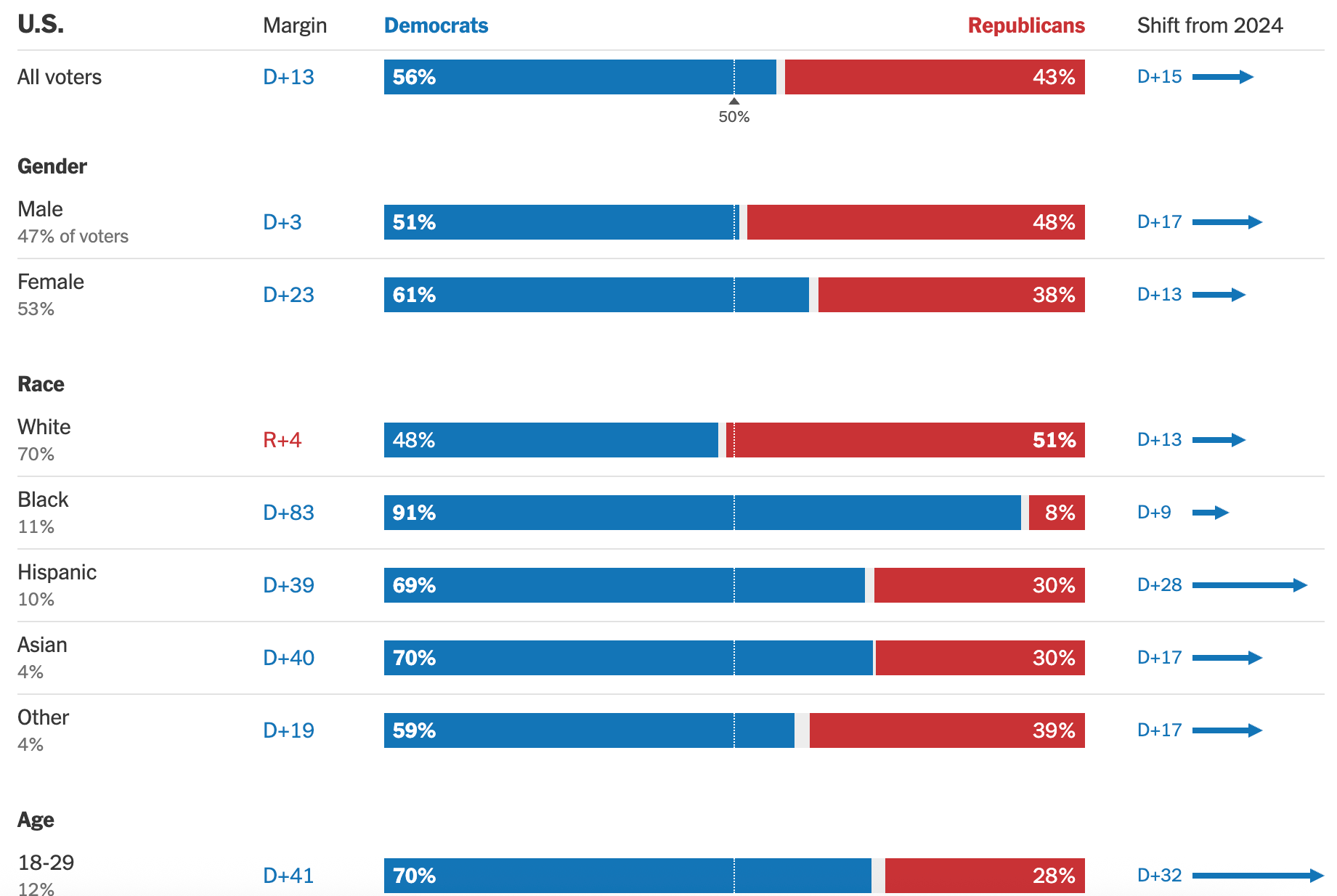
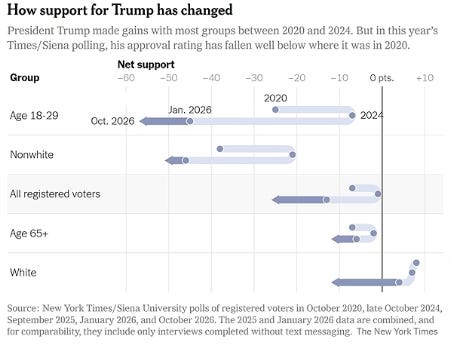
Is it a permanent realignment? I doubt it. I think it’s more likely that, in the 2020s—an era of high inflation, high interest rates, low institutional trust, global crises, and existential fears about climate change and AI—there are a lot of loosely attached independent voters who can toggle from party to party. Young voters and nonwhite voters (who are, themselves, disproportionately younger than whites) are not so much punching tickets to join a party as they are leasing one-year terms to vote for one group, only to punish them in the next election if things don’t improve. Just look at these swings!
5. Yes, ‘moderate’ candidates outperformed, but …
Most analyses of the election that I’ve seen so far find that moderate candidates outperformed self-described progressives or leftists throughout the country. Even the night’s big winners, like El-Sayed, ran behind less overtly left-wing candidates in their own state. Here’s Yascha Mounk:
In Michigan, the most closely watched race, Abdul El-Sayed, a progressive, is predicted to win his Senate race against Mike Rogers by a robust margin of about [6] points. But on the same day in the same state, Jocelyn Benson, a more mainstream Democrat, is predicted to win her governor race against John James by a margin of about 12 points. In Minnesota, Florida, and Maine the story was similar: there, too, more moderate candidates outperformed more progressive ones by a clear margin.
I understand the logic that Democrats need to win in places like Texas, Alaska, and Kansas to hold the Senate, and winning swing voters in these states will almost surely require a different politics than that which electrifies the populations of Park Slope or downtown Seattle. That said …
6. … the country is moving left quickly on anti-rich politics, which complicates some tidy definitions of ‘moderation’
Look at Talarico. He’s a soft-spoken Christian who’s walked back some of his progressive commentary from several years ago to focus his message on unity and loving his political opponents and aspiring to represent the voters who disagree with him. In this way, he sounds like a Millennial Obama.
But he is also critical of billionaires, social media companies, media conglomerates, and “people at the top,” in ways that remind reporter Jeff Stein (author of a forthcoming Bernie Sanders biography) of Sanders and AOC. Is this moderation? Is it populism? Is it cultural moderation combined with economic populism? Some fourth thing!?


7. AI is a big political loser right now. It just is.
A few weeks ago, a pollster told me on background that his survey data indicated that Americans are more opposed to the local construction of data centers than they are to the local construction of high-security prisons. So, I wasn’t surprised to see AI get killed at the polls. In exit surveys, voters overwhelmingly said that they didn’t like AI. Out of 44 local ballot measures that opposed data center construction, 43 passed.


Texas is set to exceed Virginia as the largest state for data center construction. But incoming Democratic governor Gina Hinojosa promised to impose a data center moratorium in the state, unless tech companies agree to a new social compact on construction. Among other things, her platform demands that data center builders use American union jobs and guarantee that electricity and water prices won’t rise.
As Ben Thompson writes, the political constraints on AI are about to become a very big deal, economically and politically:
My thesis — driven not just by national results and the Texas governorship, but also the fact that, as this thread documents, nearly every relevant local ballot measure opposing data centers won or is winning (the only exception so far was in North Dakota) — is that the constraint on AI dispersion has shifted once again. First we were short on compute, but that ramped; now we are short on memory, but that will ramp; we were coming close to being short on power, but that will be rectified. The final constraint is political, and that may be the most imposing constraint of all. Not only is it harder to solve, but it actually interferes with solving the other constraints. Many of the theories about AI assume that it becomes a commodity; I think it’s just as likely we are looking at scarcity for much longer than we expected, which will have ripple effects on everything.
8. Big Money had a bad night
A popular take that I see all the time is that “billionaires are increasingly controlling our elections.” It’s popular in part because it’s somewhat true: The share of campaign financing coming from billionaires has soared in the last few election cycles, which would pose an existential crisis to democracy if it turned out that a handful of individuals could translate their income into political power that further entrenched their corporate power and wealth, creating an endless, vicious cycle of plutocratic self-gifting.
But reality is rarely as cut-and-dried as the takes we use to describe it. As the New York Times’ Teddy Schleiffer points out, billionaires just got their asses handed to them. Elon Musk just wasted hundreds of millions of dollars propping up Ken Paxton in a blowout election in Texas. From sea to shining sea, up and down the ballot, the Tech Right lost, Republican donors lost, and AI lost. There’s a funny paradox here, where “Billionaires increasingly control our elections” feels true, but precisely because it feels true, it cannot fully be true, because voters react to the feeling of being bought by revolting against the billionaire class.
9. So, we’re just going to never tax anything again, that’s the idea?
California’s billionaire tax? On the road to failure. Property tax limits across the country? They’re succeeding. Taxes on tips? Trump hates them. Taxes on the poor? Democrats are against them. Taxes on the rich? Republicans are against them. Taxes on seniors? Even progressives want to freeze them.
Are you getting the picture?
The U.S. has an enormous and growing debt that will likely require tax increases in addition to spending cuts. The Democratic Party has priorities that will expand those deficits unless new taxes are levied. But both parties are busy telling voters over and over again that we can cut taxes forever, while frequently promising new spending programs. I’m not sure how this turns out.
10. Nobody knows what the Republican Party is right now.
Donald Trump is hideously unpopular in every context, except the context that matters most for Republican presidential hopefuls—which is to say, among die-hard Republicans who show up to vote in primaries. This will create a conundrum for conservatives who recognize that they have to move beyond his policies to win any national election without distancing themselves from a man who still possesses a voodoo-like power over the party faithful.
Today, Vice President JD Vance gave us a glimpse of what that might look like, in a long post whose bottom line is that Vance believes that Americans dislike the Iran War, high prices, and America’s overly close relationship with the Israeli government.

To sum things up: Vance wants the GOP to end the war that Trump started; to focus on the cost of living crisis that Trump exacerbated with tariffs and wars; and to change America’s relationship with Netanyahu when it was Trump who embraced Bibi’s theory of bombing Iran. The message here seems to be: I stand for Trumpism, which means doing the opposite of Donald Trump in every way. Ok, good luck, I guess!
I see several paths forward for post-Trump GOP politics. The first is a Catholic MAGA fusion represented by JD Vance, which attempts a kind of Trumpless Trumpism, with significantly more Yale Law School theory and significantly less stump-speech charisma. The second is a quiet neoconservative comeback, typified by Marco Rubio doing his best 2000-era George W. Bush impersonation. The third is an off-the-wall, anti-establishment conspiracy movement headlined by RFK, Jr. And the fourth is corporate neo-Reaganism as embodied by someone like Ron DeSantis. I suppose an outsider, like Tucker Carlson, could jump into the ring, but I would guess that he’d essentially pitch himself as an offshoot of the RFK wing—an angry conspiracy-monger with very few principles outside of the spooky suggestion that somebody somewhere is out to get you.
11. Finally: ABUNDANCE
With a blend of frustration and amusement, I’ve followed the narrative that abundance has petered out after a buzzy 2025 campaign. Frustration, because it is natural to feel a bit of possessiveness about the fortunes of one’s pet project. Amusement, because I genuinely don’t know what people are looking at when they claim that the principles in the book melted on contact with reality.
Housing and energy comprise the first two chapters of the book. The Road to Housing Act is the most significant national housing legislation in decades. Among other things, it entices states to accelerate their housing construction rules and makes it easier to build certain kinds of houses. The permitting bill under strong consideration would be the most significant energy legislation in decades.
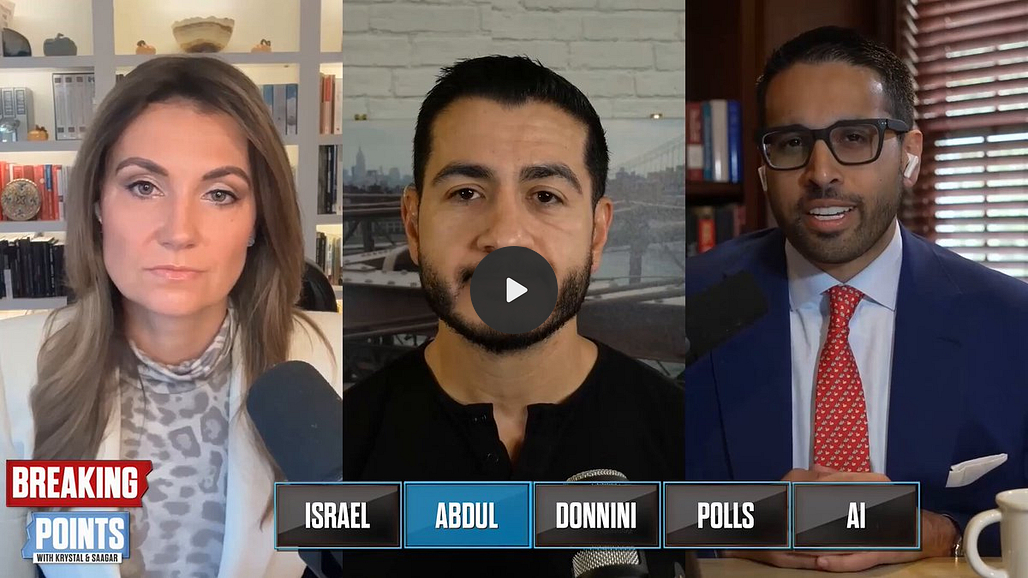
When Saagar Enjeti cornered Abdul El-Sayed about his plan to freeze property taxes on his podcast, the Michigan Democrat responded that of course, of course he supported building more homes to reduce prices. This is all I ever hoped for: Even politicians whose most online supporters absolutely hate me are embracing the book’s theses as if supply-side solutions to America’s problems are obvious and noncontroversial.

What’s more, abundance has been on the ballot across the country, as Brianna Johnson points out. North Carolina Senate nominee Roy Cooper said people should be able “to live lives of abundance” in his closing argument, and Alaska Senate nominee Mary Peltola’s first video called Alaska a “place of abundance.” Pennsylvania Gov. Josh Shapiro—whose gloss of the book’s themes is “Get Shit Done”—ran an October ad with a local Republican praising him for speeding up permitting, while NYC mayor Zohran Mamdani campaigned for measures to speed up housing, cut red tape, and bring down costs for families.
Gubernatorial candidates Katie Hobbs (AZ), Amy Klobuchar (MN), Xavier Becerra (CA), and Maura Healey (MA), Senate candidate Mark Warner (VA), and House candidates Maggie Goodlander (NH-2) and Manny Rutinel (CO-08) have all run ads touting their efforts to build more housing to bring down costs. In California, the most heavily contested races, from Nithya Raman in the LA mayoral race to Scott Wiener in CA-11, are all about housing, especially building more.
Call it a failure if you wish! I wish all my ideas failed half as miserably.
I don’t know man. I got this feeling like Han Solo turning back to Luke Skywalker after he shot down one Tie fighter, and saying “Great. Don’t get cocky, kid.”
Not so sure I'd shrug off the failure of California's billionaire tax as just another example of anti-tax rhetoric, since it was very deliberately designed not to be threatening to most voter's pocketbooks. It seems to complicate your assertion that the country is moving to the left on anti-rich politics.