


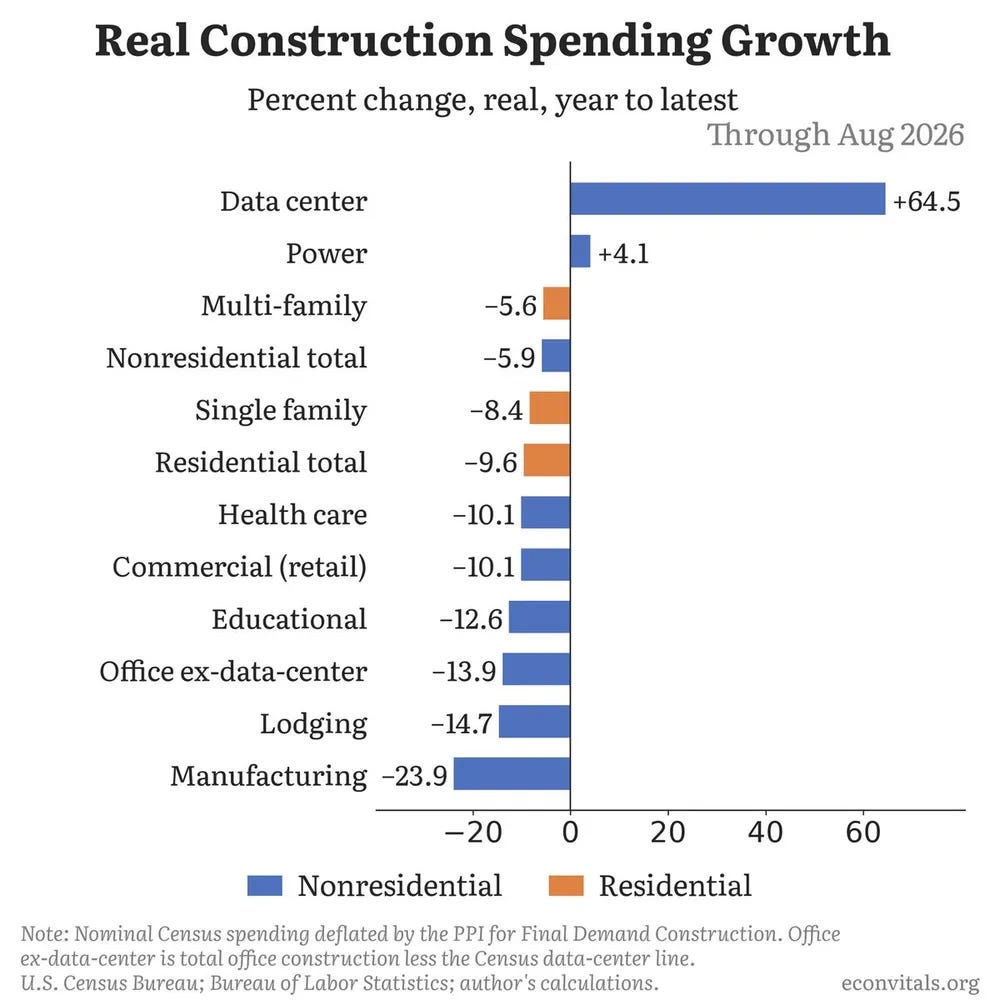
News about artificial intelligence feels both overwhelming and starving for context. On Sunday, I’ll read that the AI industry is booming, and on Monday, I’ll learn that its revenue is plateauing. On Tuesday, I’ll read that AI is driving economic growth, but on Wednesday, I’ll read that it’s strangling the economy by squeezing out the construction of everything that isn’t a data center.
After weeks of feeling lost in a sea of decontextualized AI factoids, I decided that what I really needed was a structure. A story.
Today’s newsletter is a fact-by-fact, chart-by-chart story about what AI is actually doing to the economy. Read the whole thing, and you’ll learn the answers to questions like these:
What’s the best data we have on whether Americans actually want, use, or like AI?
Why does the construction of AI (such as the issuance of debt, the buying of chips, and the building of data centers) seem to be changing the world faster than the actual capabilities of AI?
Is AI expanding the US economy, taking scarce resources from critical sectors, increasing the cost of goods and money across the economy, or … weirdly, doing all three?
What does the latest data say about how AI is, or isn’t, affecting youth unemployment and the job market?
How can AI revenue be surging, while several cases for an AI bubble are simultaneously strengthening?
Thank you for reading. If you find stories like this valuable, please subscribe and share.
The Big Picture: Americans Use AI, Think It’s Helpful, and Hate It
1) AI adoption is rising faster than any technology in recorded history.
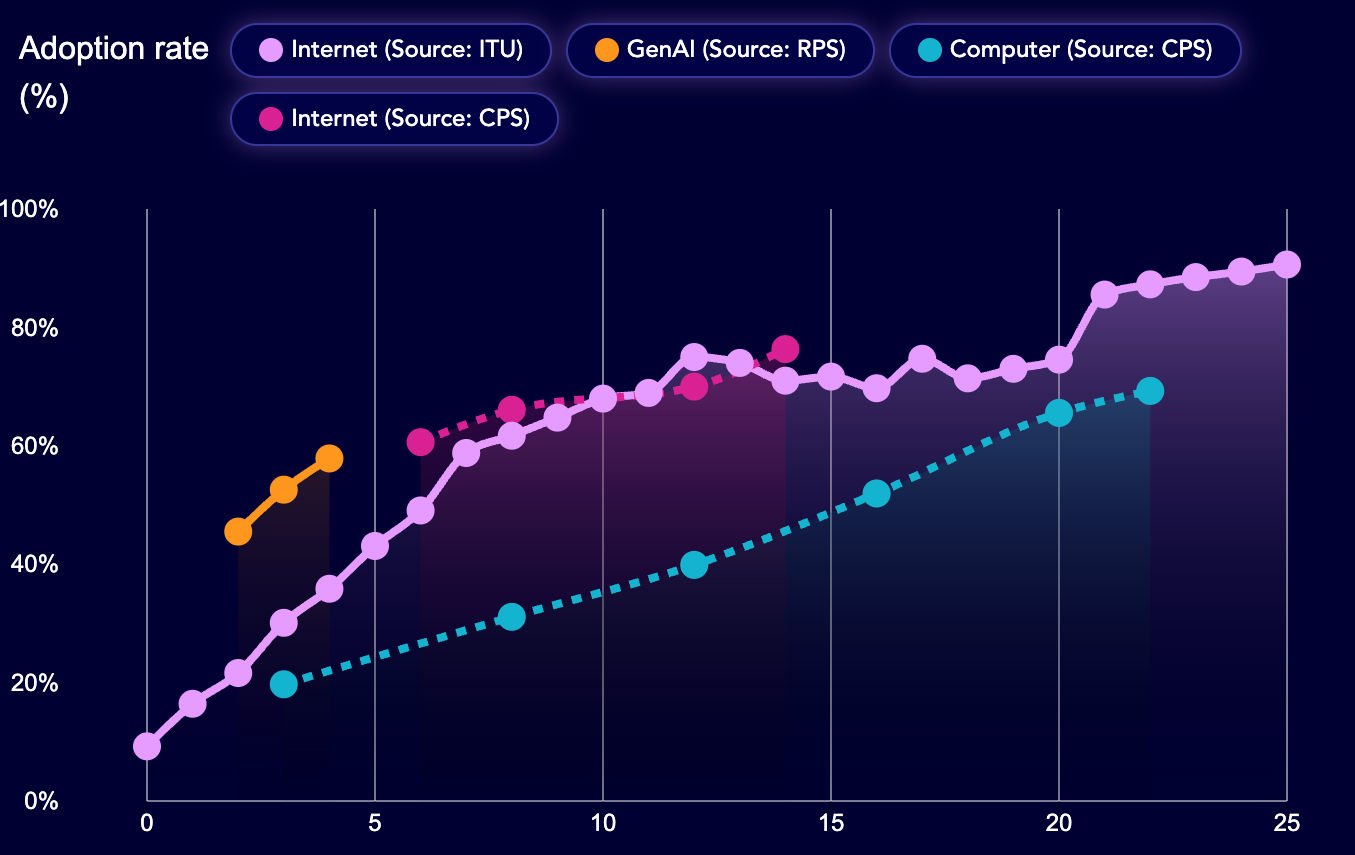
Most technology is not like Athena. It doesn’t spring fully formed from its father’s mind and preside as a god over the planet. It is born more like babies are born: somewhat helpless, desperate for attention, and leaving much to be desired in the realm of usefulness. It took decades for the telephone to go from invention (in the 1870s) to 50 percent adoption in the United States (in the 1940s). It took television about a decade to do the same. It took the Internet less than a decade. But it took AI about three years, making this the fastest-growing technology on record.
2) If you use AI for daily work, you’re in the minority. (If you personally pay for AI for work, then you are, statistically speaking, very weird.)
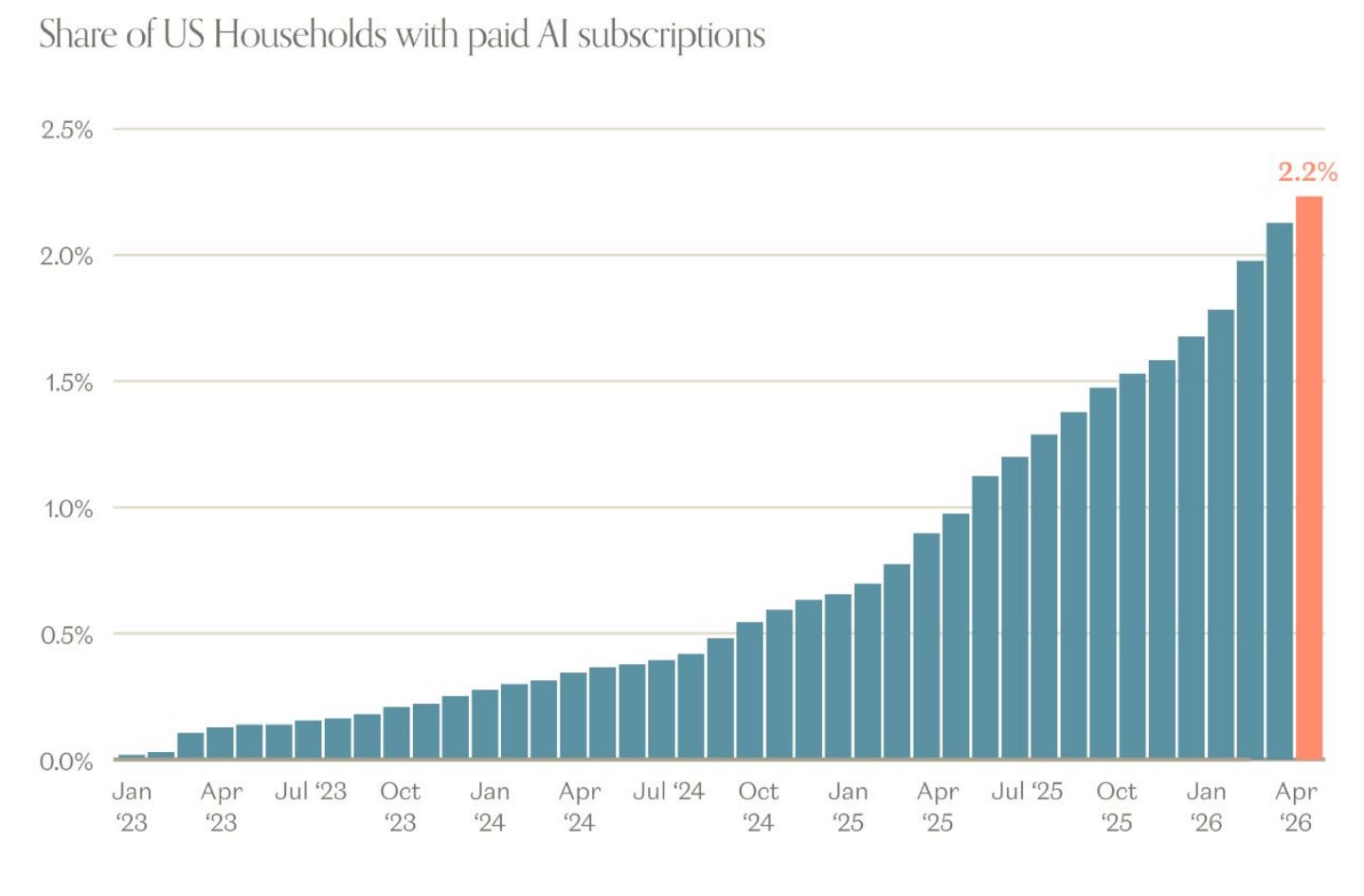
While half of Americans say they use AI chatbots, usage is more common outside of work. Daily use for work is much rarer—between 10 and 25 percent, depending on the survey. While most businesses on the platform Ramp say they pay for AI, data gathered by Andreessen Horowitz finds that less than 3 percent of US households report having paid AI subscriptions.
3) While Americans think chatbots are useful, they also say AI is societally destructive.
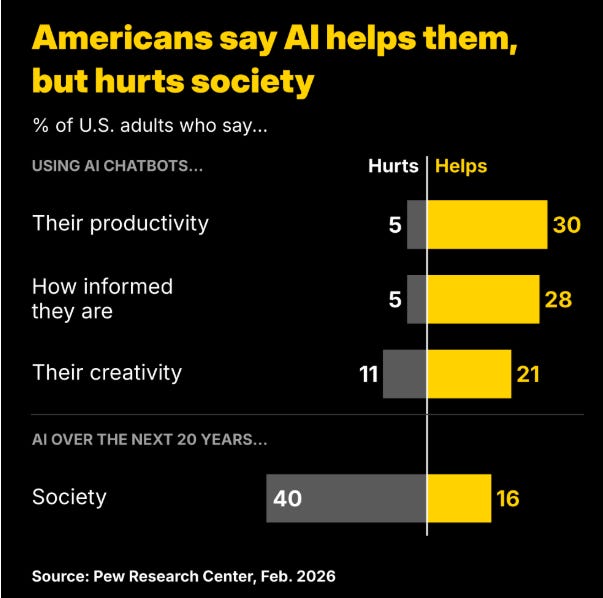
Chatbots: Good for my work, bad for the world. This appears to be the consensus among Americans who use AI. They are roughly six times more likely to say chatbots help their productivity than hurt it and twice as likely to say they help their creativity than hurt it. But overall, Americans are very negative on AI’s effect on society, with a large plurality saying that AI has a mostly negative effect on society. (I must say plurality because many Americans tell Pew, with admirable humility, that they have no idea what AI will do to them personally, or to society. One sympathizes.)
The AI Economy: Billions in Revenue, Trillions in Spending
4) The cost of building AI is approaching $1 trillion annually …
As a share of the economy, this is the most expensive infrastructure project since the 19th century railroads. Ominously, that was a project that both changed the country and created a bunch of recessions, because the buildout created so many bubbles.
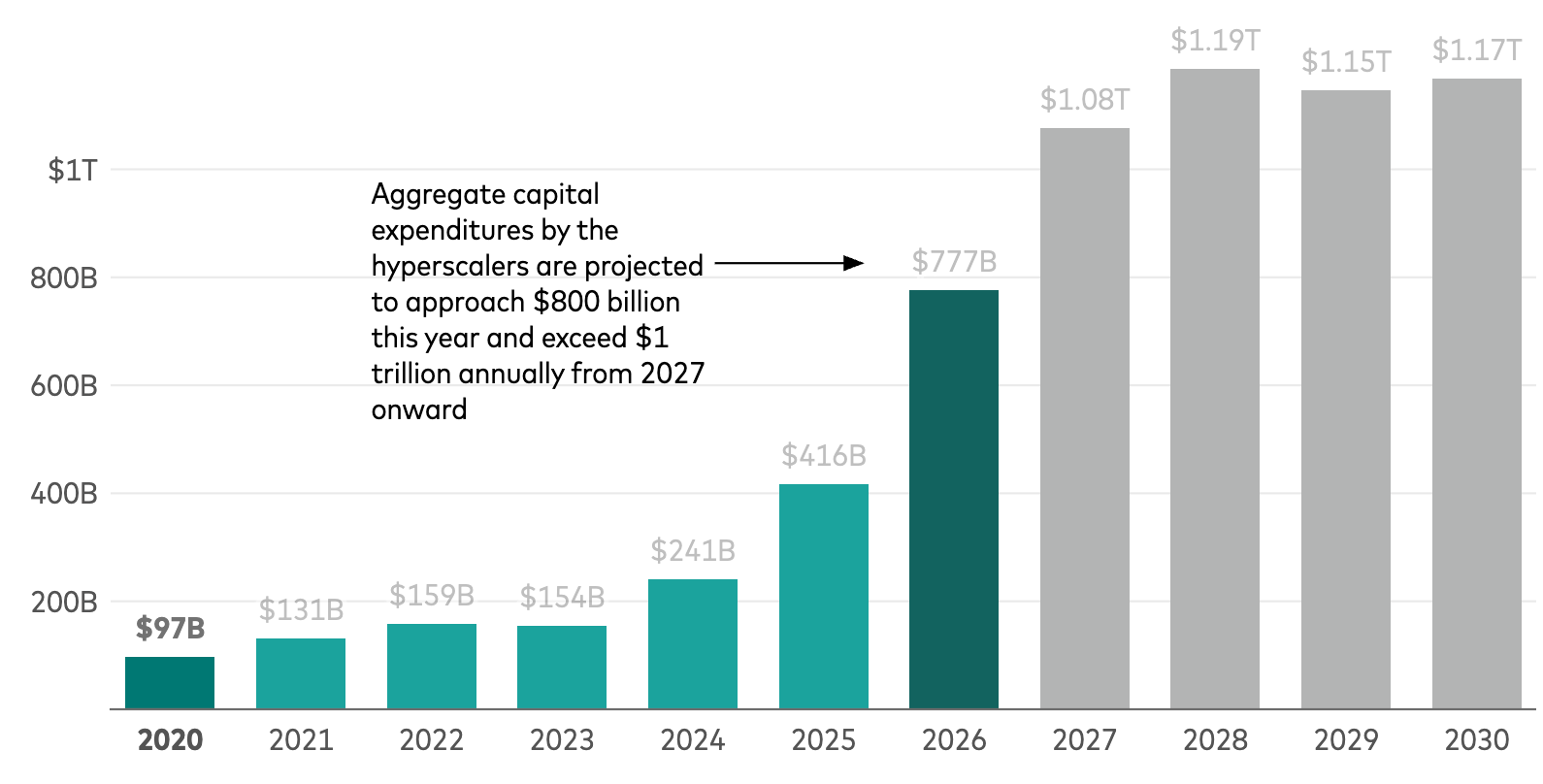
5) … and it’s creating a new set of winners that bestride the economy like a colossus.
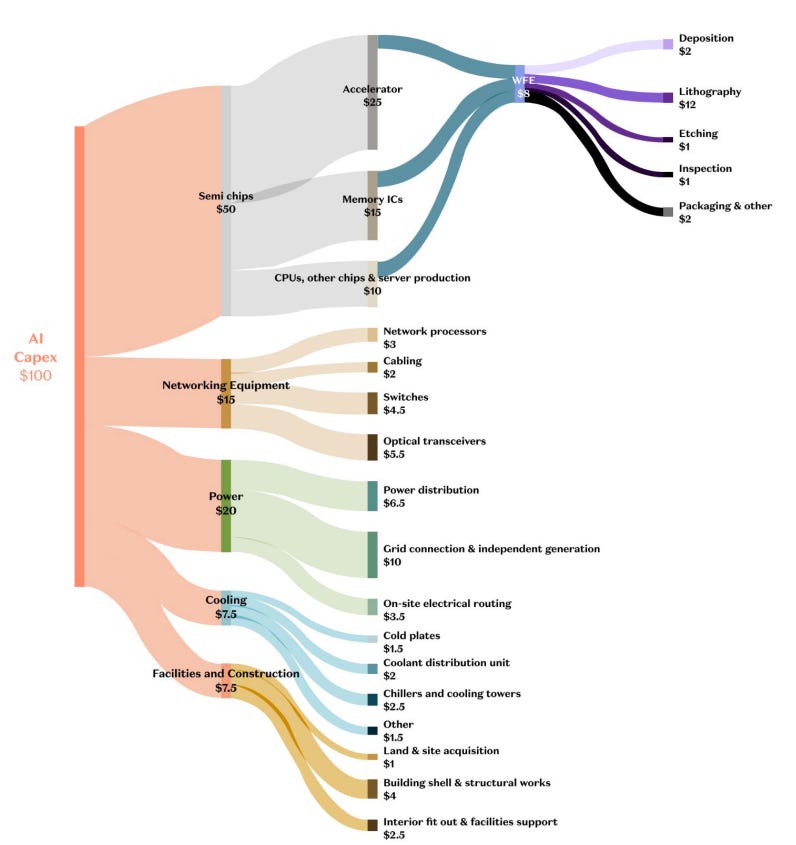
What is “AI capex?” The term is thrown around so frequently that I was delighted to find a Sankey diagram to help me understand it. For every $100 spent on AI, about $50 goes to computer chips, $20 goes to powering the data center where the chips live, $15 goes to networking equipment, and $7.50 each goes to cooling and construction.
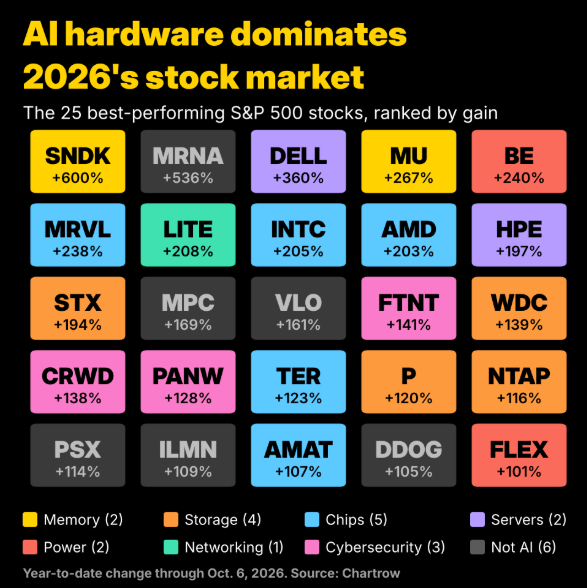
6) The winners of the AI boom dominate stock market returns in 2026.
Naturally, the companies that produce all the stuff I just named above— GPUs, networking, machines that power and cool data centers—have made absolute bank. Nineteen of the top 25 best-performing stocks in the stock market are directly related to the AI buildout, including Sandisk and Micron (e.g., memory chips), Dell and Hewlett (e.g., servers), and Bloom and Flex (e.g., data center power and cooling). Take out the non-AI stocks, and the S&P 500 is actually down in 2026.
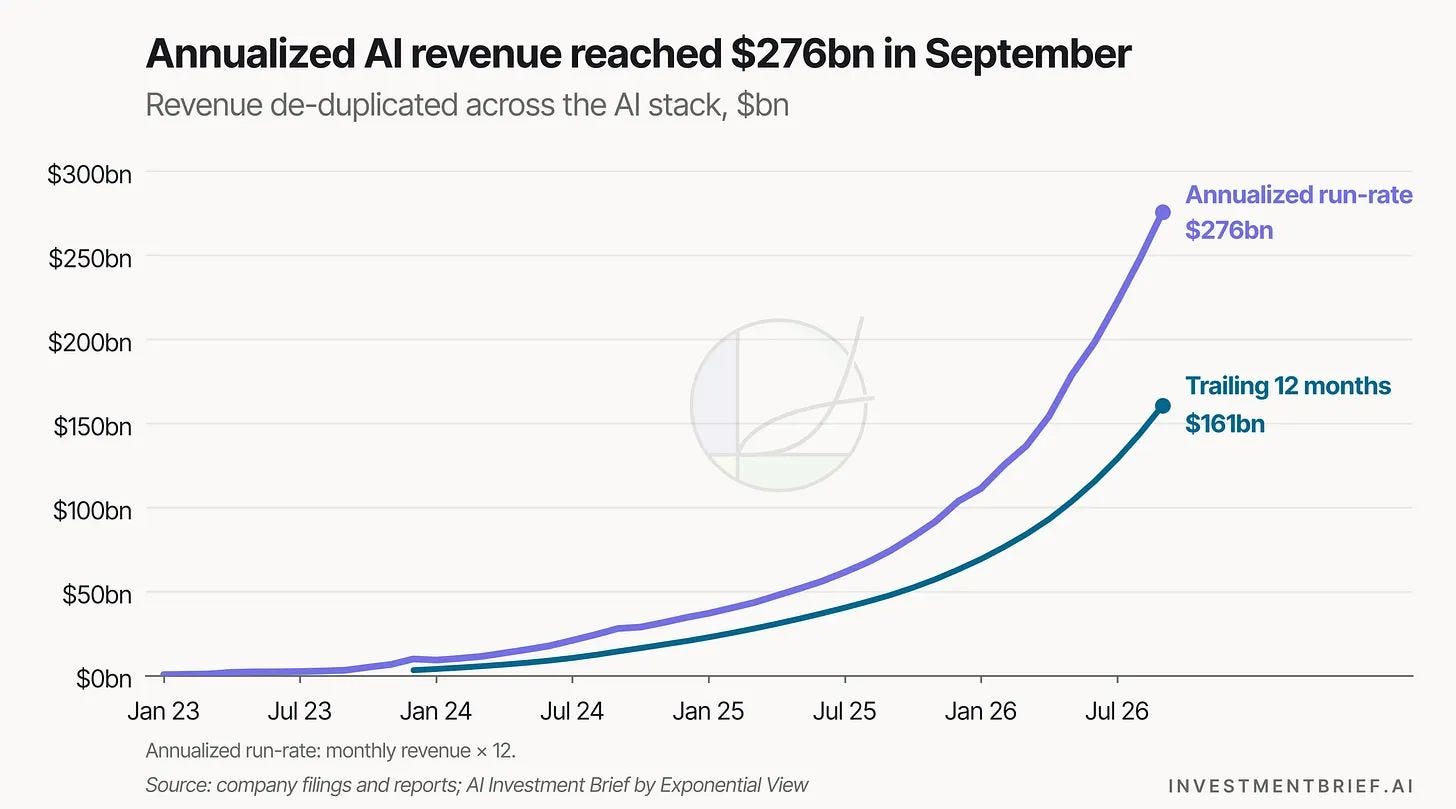
7) AI spending has exploded in 2026, but there is evidence that it might be hitting a plateau.
Industry-wide revenue figures are notoriously tricky in AI. But one source I trust to track the growth of external, deduplicated AI revenue is Azeem Azhar and his team at Exponential Growth. They’ve pegged external AI revenue at around $280 billion annualized, as of September. We are basically talking about one of the fastest-growing industries in modern memory. But the big question is whether the growth rate that has impressed investors in 2026 will continue in 2027, 2028, 2029…
… and there are some wobbles that we have to talk about. Ara Kharazian, the chief economist at Ramp, has reported that in August, the top 1 percent of businesses that Ramp tracks actually reduced their AI spending per employee by 10 percent. One reason why that statistic is meaningful is that AI spending is so concentrated. According to Apollo, the top 10 percent of AI customers account for more than 90 percent of model and data center spending.
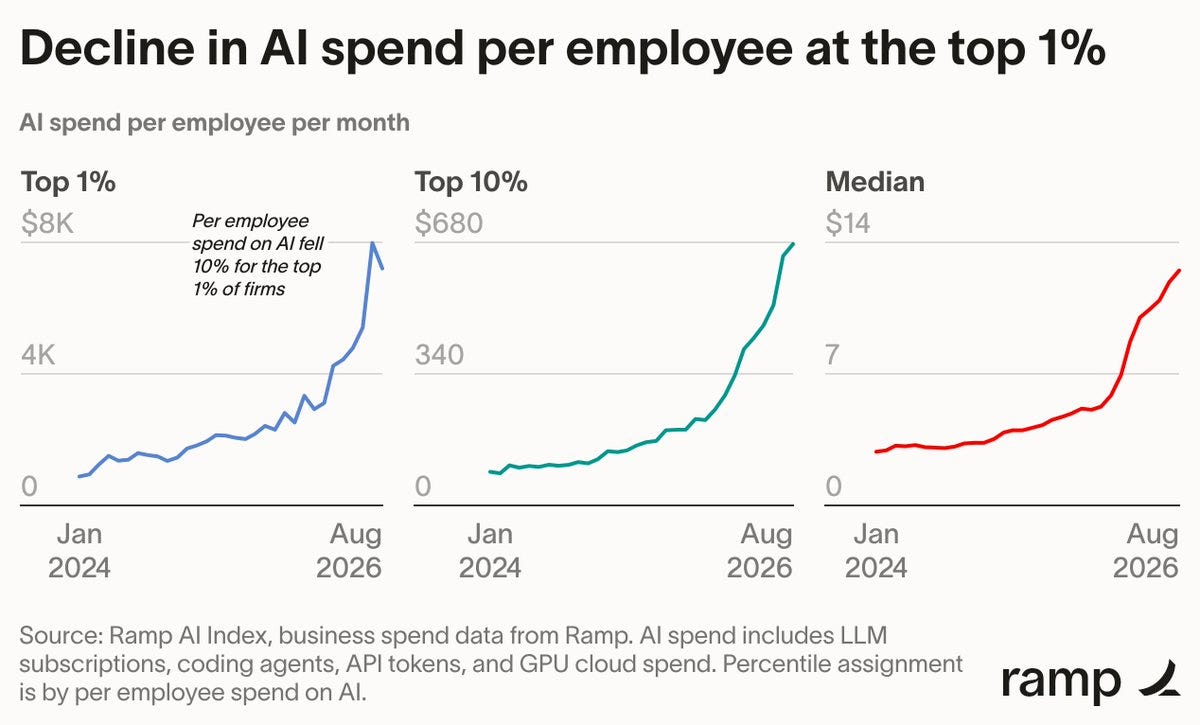
“We’re seeing more cracks in the AI thesis as a number of drivers show spend topping out,” writes Kharazian. Indeed, there’s some evidence that Anthropic’s annualized recurring revenue (ARR) has plateaued around $75 billion, with OpenAI—current ARR: ~$50 billion—continuing to grow.
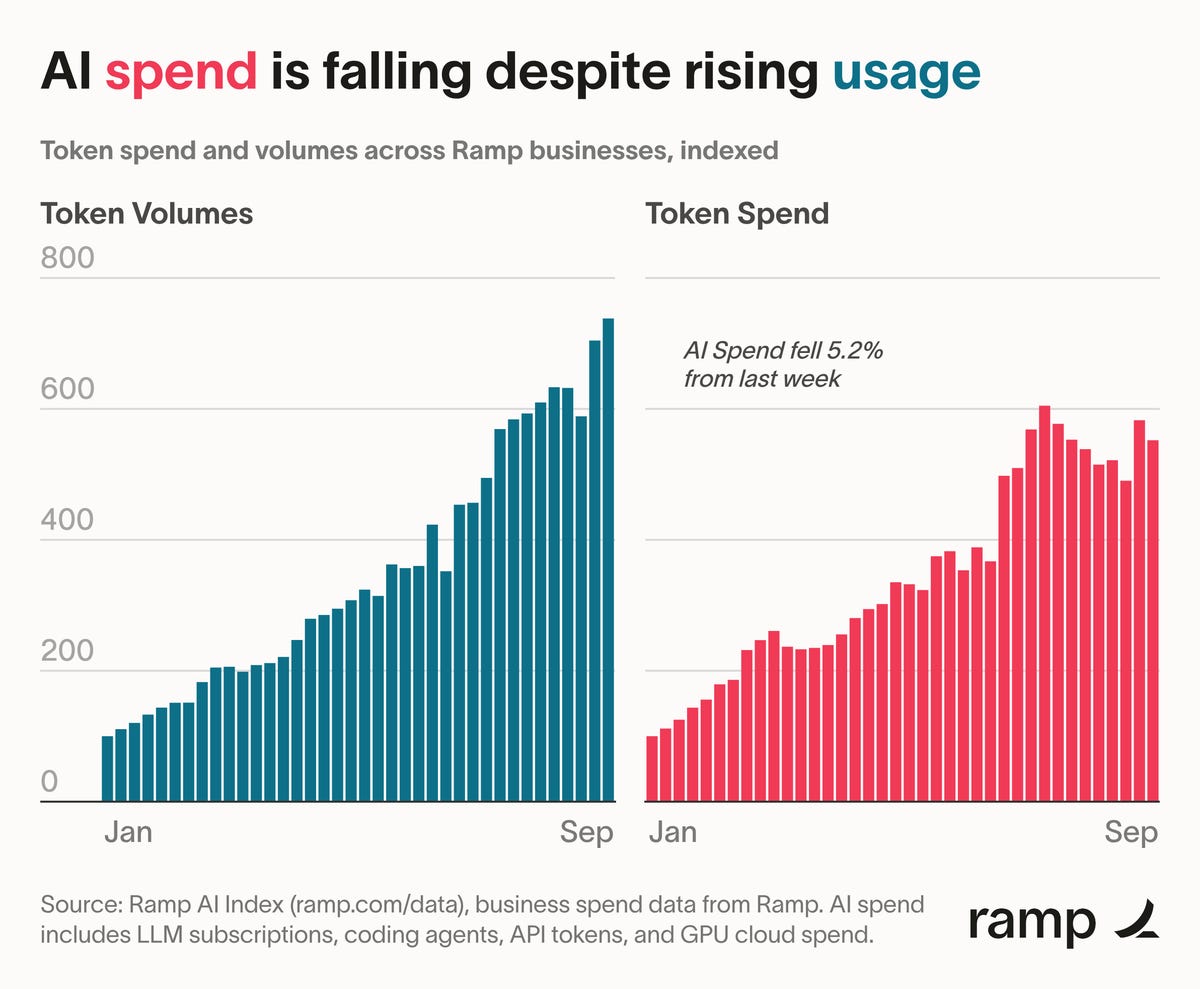
8) Pressure from open-weight models and domestic competitors are compressing margins, which could make it harder for some companies to earn back what they spend.
What’s really going on with AI revenue growth? Maybe the numbers are wrong. Maybe it’s August, and a lot of engineers take off in August. Or maybe something bigger is happening. Kharazian’s take: “It’s not because of open Chinese models. It’s model wars”—meaning, price cuts and consumers shifting to cheaper models made by American companies. Indeed, the average token price of AI models used from OpenAI and Anthropic has been falling since July.
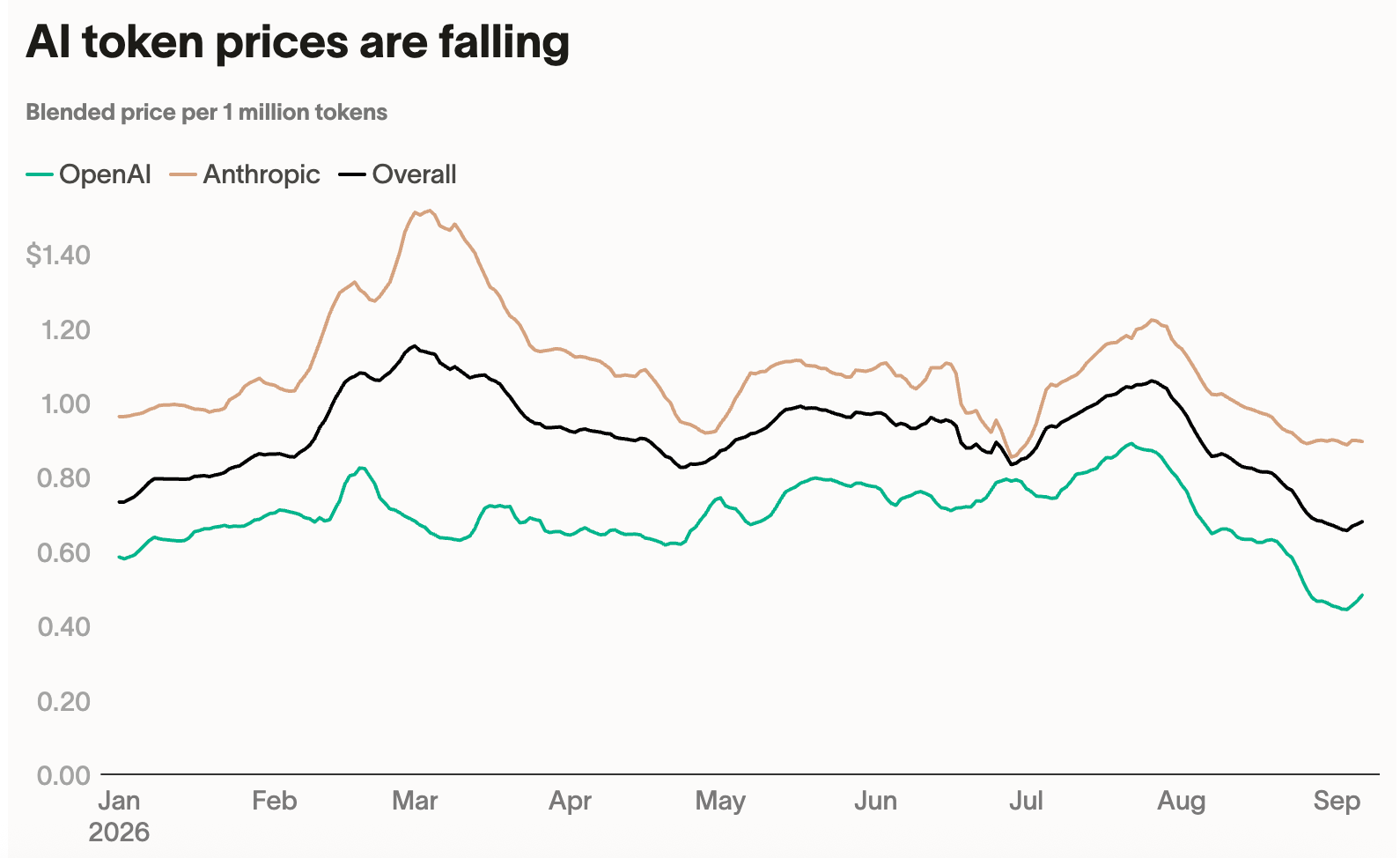
9) The strongest case for AI being a bubble, as of right now, is …
Here is the single strongest case that AI is a bubble, in one sentence:
