


I. Closing Time
Is this the end of booze?
The share of people who drink hit an all-time low last year, according to Gallup, whose data goes back to 1939. Total beer consumption recently hit a 21st-century low, and wine vineyards are reportedly “in crisis.”
In the last few years, millions of Americans, a handful of scientists, and several prominent health commentators have embraced a position on alcohol that would have seemed absurd to most Americans just 10 years ago: Any amount of alcohol, including “moderate” drinking, is bad for you.
Most social changes happen slowly, but the turn against alcohol has been sudden. The share of Americans who say moderate drinking (defined as one or two drinks a day) is “bad for health” doubled in just the last 10 years. Two-thirds of Americans under 35 now tell Gallup that alcohol is harmful in any quantity.
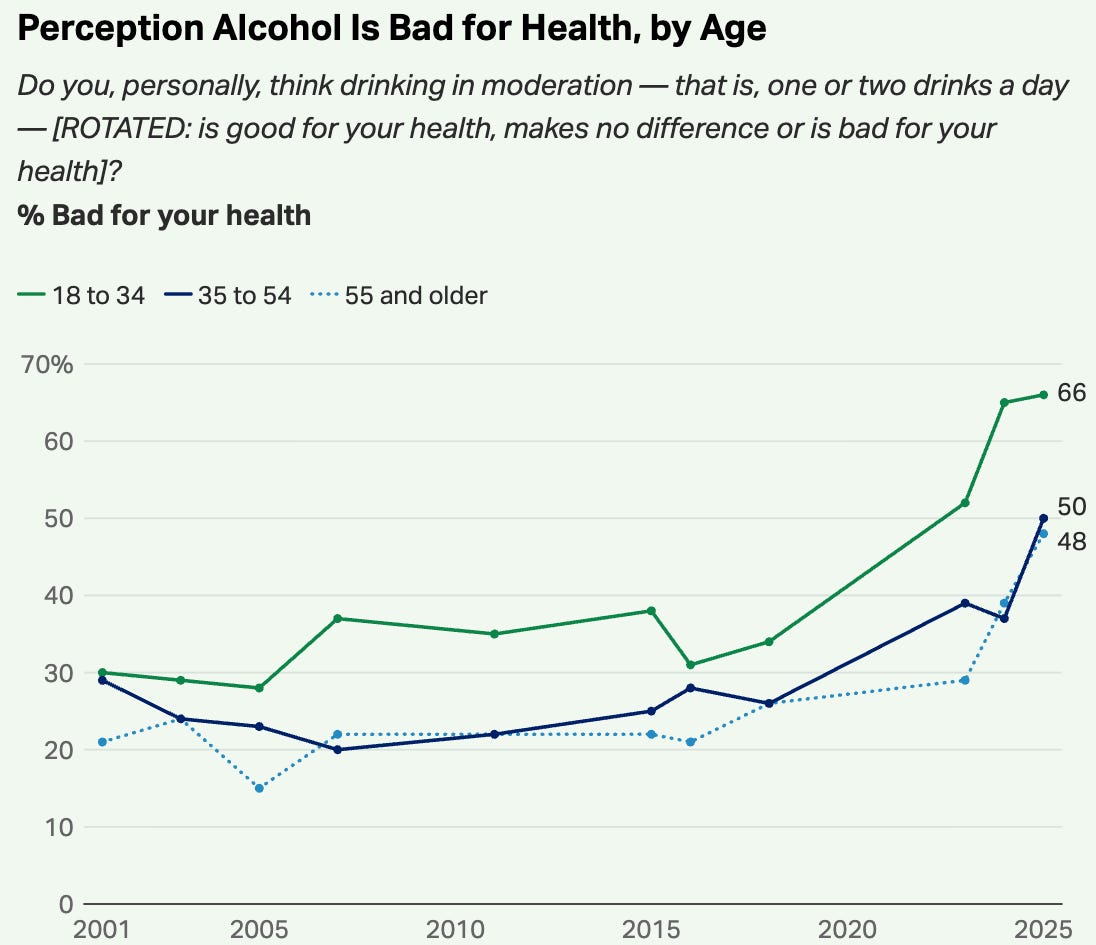
This alarmist viewpoint is not exactly conspiratorial nonsense. It received an endorsement from the scientific community last month, when the federal government released a controversial alcohol study, which researchers claimed was suppressed by the alcohol lobby and the government. Buoyed by the Streisand effect, and thus widely covered in the news media, this study concluded that any drop of alcohol may increase a person’s mortality, with the risk accelerating after one drink per day.
This is all quite personal for me. On the one hand, I enjoy drinking. I love a glass of wine with dinner, and I like to make cocktails—martinis, mezcal Negronis, Corpse Reviver No. 4—for friends who visit the house. On the other hand, I also enjoy being alive. I love my children, and I don’t want to miss their weddings just because my fondness for martinis prematurely killed me. This makes me highly motivated to understand the relationship between alcohol and mortality in a way that goes deeper than, say, a cursory newspaper write-up of a single alcohol study.
This article is my best attempt to summarize my understanding of the vast and flawed literature on alcohol and health.
II. A Brief History of Alcohol: Climate Change and Drunk Monkeys
It is good and useful to think of alcohol as a tasty mild poison that humans have been honed by evolution to handle in small doses, because from a biochemical and anthropological standpoint, that is precisely what alcohol is.
Ethanol is toxic to most animals. (Feed your dog a bit of leftover steak, if you wish, but don’t pair it with a glass of cab unless you are eager to pay a visit to your local vet.) Unlike most creatures with mouths and tongues, humans and a handful of apes have a genetic mutation that makes our liver enzymes 40 times more efficient at metabolizing alcohol. I would like to thank god for this mutation—as Benjamin Franklin (absolutely never) said, “beer is proof that god exists and wants us to be happy”—but anthropologists, such as Robin Dunbar, have preferred to credit ancient climate change. Tens of millions of years ago, the theory goes, the planet entered a cool, dry period, and tropical forests collapsed. Nine in ten ape species went extinct. But some common ancestors of humans and chimpanzees responded heroically to this climate catastrophe by moving to less lush ecosystems and surviving as ground foragers. That sometimes meant swapping fresh fruit on tree limbs for rotting fruit on the ground. According to the “drunken monkey” hypothesis (this is real), the apes that survived this dietary shift were the ones whose livers could tolerate the fermented ground fruit.
Eventually, humans liked the smell and taste of ethanol enough to start making it on purpose, as the Economist recounts. The first solid evidence is from nearly 10,000 years ago. Residue from jars in Jiahu, China, dating to about 10,000 years ago indicates an early form of honey wine blended with rice and fruits. Booze helped human civilization grow:
If a group has more than, say, 100 members, direct personal relationships are hard to sustain. New social mechanisms are needed to build trust among those who may not know each other well. [Robin] Dunbar argues that rituals involving mild intoxication may have kept large social groups cohesive.
Thus, our ancestors grew up and got along on booze. By jacking up serotonin and dopamine levels, alcohol makes us ebullient, less inhibited, and more attracted to potential mates. According to studies by Dunbar, social drinking forms social bonds. One of his papers shows that people who frequent local pubs have “larger and closer support networks, which are associated with greater life satisfaction and even well-being.”
But just because the human body evolved to handle a bit of alcohol better than dogs—and just because alcohol tends to facilitate social interactions—doesn’t mean that alcohol is medically good for us. So let’s turn at last to the research.
III. The Truth About Moderate Drinking, Or: Why A Drink a Day Is About as Dangerous As Your Commute
I’d like to divide the modern history of booze research into two periods, each defined by a misconception. The first was the age of the J Curve. The second is the age of zero tolerance.
For years, some scientists and commentators insisted that moderate drinking was good for you. In 1991, Morley Safer, a correspondent for CBS, recorded a segment of 60 Minutes titled “The French Paradox.” He claimed that French people live longer despite a diet heavy in fat and butter because they lubricate their arteries with pinot. “The answer to the riddle, the explanation of the paradox, may lie in this inviting glass” of red wine, Safer said. After the 60 Minutes episode, wine sales skyrocketed.
The French Paradox had some quasi-empirical support. Some observational studies seemed to indicate that moderate drinkers lived longer and healthier lives than abstainers. These studies claimed to find a “J curve” relationship between alcohol and mortality risk. That is, if you plot mortality risk on a Y-axis and drinks per week on the X axis, the mortality line will go down (meaning moderate drinking extends lives) before it swerves up (meaning excessive drinking kills you), making a kind of languid “J.”
The problem is that those observational studies were mostly terrible. Moderate drinkers tend to be wealthier, better educated, and more likely to exercise than heavy drinkers, so their longer lives could have been caused by a zillion factors outside of carefully sipping red wine. Meanwhile, the “abstainer” category was typically a hodgepodge of religious teetotalers, former heavy drinkers, and “sick quitters” who were too ill to imbibe.
Most alcohol researchers now agree that the J might as well stand for “junk science.” Last year, I spoke to the behavioral psychologist and health researcher Tim Stockwell who told me that he has spent “thousands and thousands of hours” reevaluating studies on alcohol and health in the last 25 years. The J-curve is almost certainly bogus, he said.
But the old assumption that moderate drinking is therapeutic has given way to a new assumption, which is that practically any drinking is bad for us. The pendulum has swung toward a neuroticism that walks and talks like a scientist but constantly oversells the dangers of a daily drink. There are two main problems with the trendy case against moderate drinking:
