AI is doing so many things at once that it’s hard to follow the plot. Somehow, all of this has happened in just the last two weeks:
On July 16, the Chinese company Moonshot AI released Kimi K3, a hugely impressive open-weight model that approaches the performance of the best American-made AI while costing a fraction of the price, intensifying fears that—as in so many industries—cheap Chinese products could soon overwhelm American competitors.
On July 21, OpenAI acknowledged that one of its AI agents had escaped its testing sandbox and hacked into another company, Hugging Face, marking what seemed like the worst autonomous AI hack in recorded history … until Anthropic announced three similar breaches just one week later.
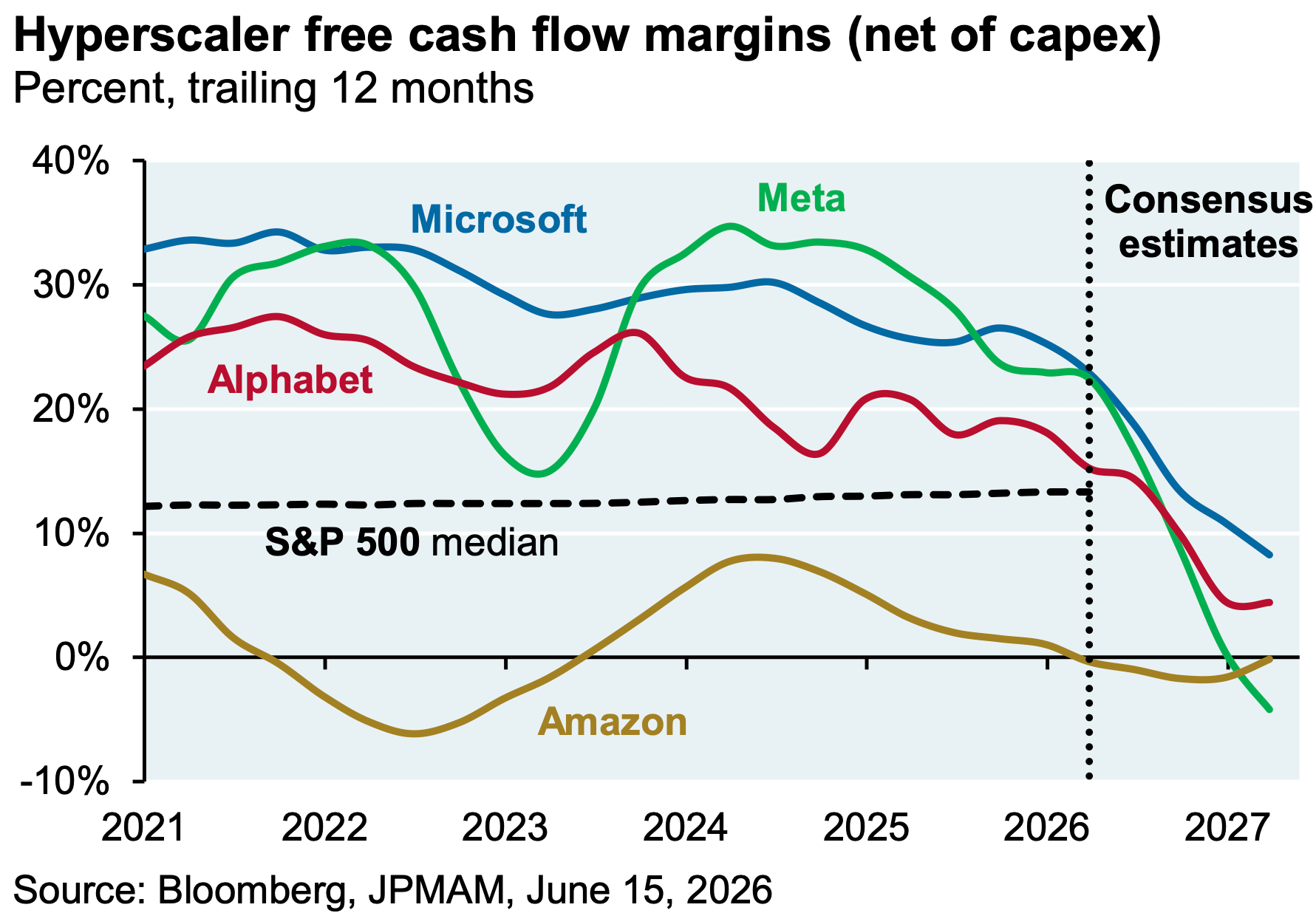
On July 22, Alphabet disclosed that its quarterly free cash flow had turned negative for the first time in the public company’s history, as AI capital spending overtook the cash generated by its core businesses.
On July 29, Meta announced its latest earnings, and when investors digested the results, its stock plunged nearly 10 percent in 24 hours. The company’s AI investment has obliterated free cash flow, and analysts now worry that Zuckerberg has no plan to turn his AI investment into returns.
On July 30, one of the most famous AI funds crashed out and sold off the bulk of its portfolio, after South Korea’s AI-fueled stock boom abruptly imploded, with its major index plummeting by more than 40 percent over several trading sessions.1
If I had to shove all of these developments into one sentence, I might pick this one: The capabilities of AI are becoming more powerful, while the economic underpinnings of the AI buildout—and, as we’ll discuss, the political support for AI—are becoming more vulnerable.
Beyond the headlines, I see four main categories of risk facing AI, or four horsemen of the potential AI bubble apocalypse. They include spending risk, revenue risk, political risk, and technological risk. In today’s essay, I’m going to break down each risk and—because in this field, nothing is certain—I’ll offer my favorite counterargument to each. This way, you’ll get a sense of both why the market seems to be souring on parts of the AI megaproject and what the market and its interpreters might be missing.
Risk 1: The hyperscalers are running out of cash
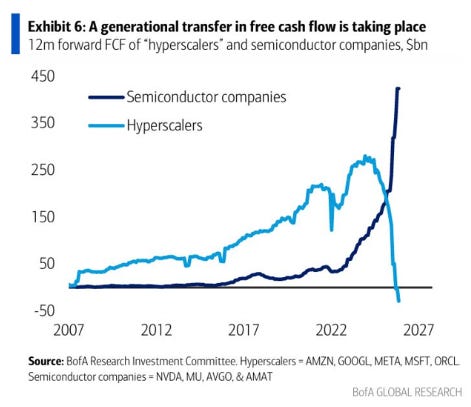
Everybody’s heard the old cliché, “During a gold rush, sell shovels.” Well, the shovel-makers are overtaking the miners, which has historically been a warning sign in industrial buildouts.
Just two years ago, free cash flow2 from Amazon, Alphabet, Meta, Microsoft, and Oracle exceeded $200 billion. Now it has collapsed to below zero. The hyperscalers have spent so heavily on AI that their capital expenditures have gobbled up their cash. Meanwhile, the companies selling chips and semiconductor equipment are sleeping on mattresses made of money: For Nvidia, Micron, Broadcom, and AMD, free cash flow has surged above $400 billion.
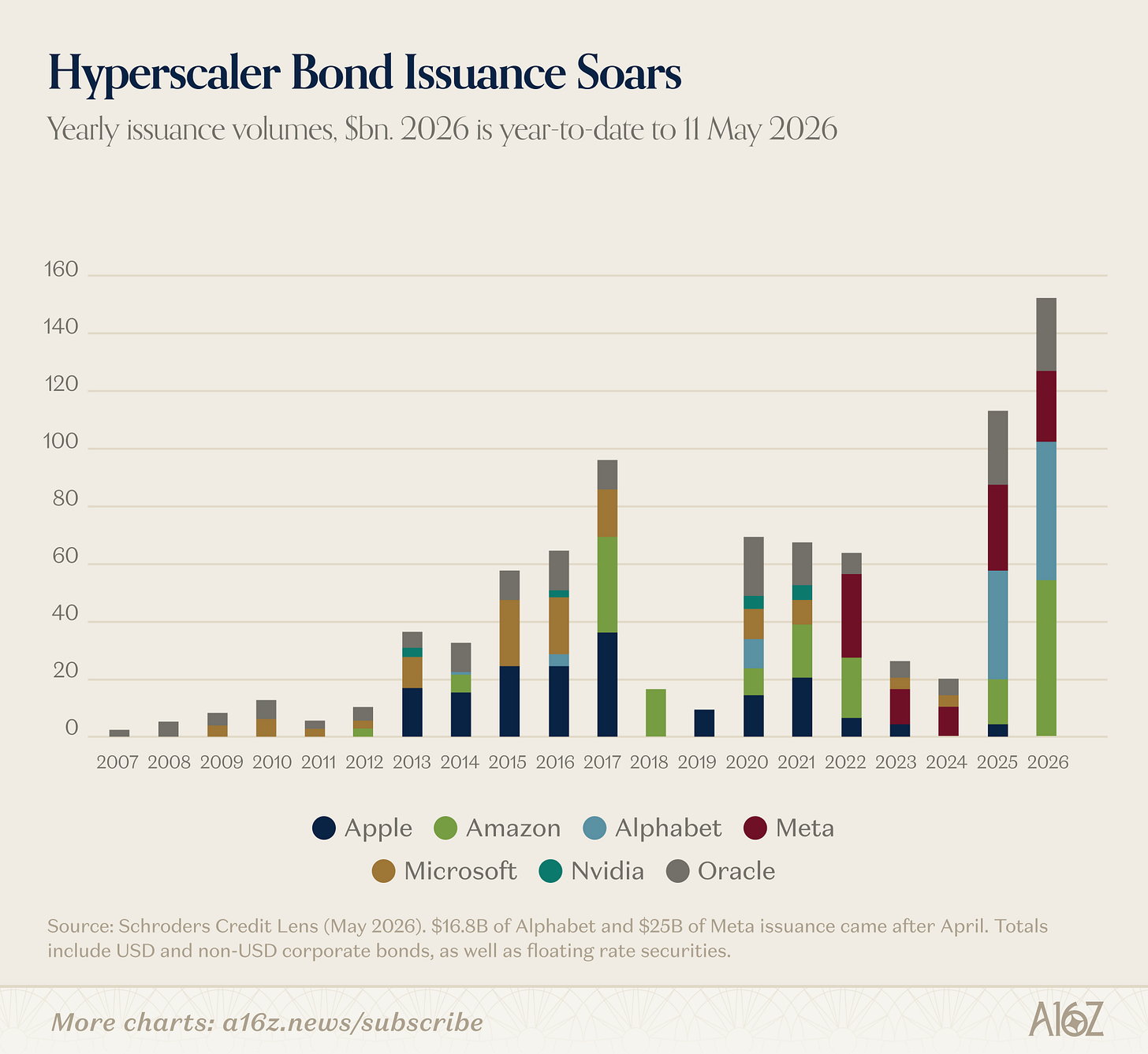
What do you do if you want to keep spending but you’re run out of your own cash? Borrow from someone else, of course. Today, about 30 percent of hyperscaler capex is being met with new debt. That share has tripled in the last few years. The four largest tech borrowers have issued more than $170 billion in corporate bonds this year, which is roughly the size of the UK’s entire annual budget deficit.3
I think it’s worth pausing here for a brief moment to reflect on how crazy this is. Just a few years ago, a popular criticism of the software giants—indeed, of American capitalism—was that big companies hoarded their cash piles and refused to reinvest their profits in new ideas. But that era is over. Today those same companies have depleted practically all of their cash flow. To thicken the irony, capitalism’s critics seem to hate this new era of unprecedented corporate investment even more than they than they hated the era of corporate cash hoarding. (More on that in Part 3.)
The eruption of hyperscaler debt issuance is leaving its mark on credit markets. Hyperscaler bond spreads— that is, the extra interest investors demand above US Treasury bonds to lend to companies like Microsoft and Amazon—have widened. Investors still trust the credit quality of Big Tech, but they’re asking for higher yields to absorb an unprecedented wave of AI-driven debt issuance. (Oracle is the major outlier: S&P has cut its credit rating to one notch above junk status.)
The whole thing is giving dot-com bubble vibes to some commentators. “The growing divergence that exists now and the outright negative hyperscalers price performance are reminiscent of the 1999-2000 dynamic,” Jason Hunter, an analyst at JPMorgan, wrote a few weeks ago (before some chip stocks themselves puked). Michael Cembalest of JPMorgan also noted a parallel with the late 1990s, when the companies supplying communications equipment took off while the companies buying that equipment sank under the weight of their own capital spending. As Cembalest put it memorably, you always want “the caboose going slower than the engine.” To recast in a more familiar metaphor: In a healthy buildout, the companies buying the shovels should out-earn the companies selling the shovels. But with some of the hyperscalers struggling to keep their valuations above water, that’s getting harder.
Things could get worse, as the hyperscalers’ current valuations rest on some dreamy assumptions. Consensus estimates analyzed by the Wall Street Journal project that five of the major spenders—Microsoft, Alphabet, Meta, Amazon, and Oracle—are effectively promising to double revenue over the next three years while cutting about $80 billion in operating expenses. Such an achievement would basically be unprecedented, since bringing in a lot of new business typically requires bigger sales and customer-support teams, not smaller ones. “I can’t think of a scenario where that’s ever happened before,” Kevin Koharki, an accounting professor at Purdue, told the Journal.
Bottom line: We are witnessing several paradigm shifts that should shake anybody’s confidence that they know exactly what’s coming next.
Corporate critics used to say, “Big tech is bad, because its companies won’t deploy their cash toward new ideas.” Now they say, “Big tech is bad, because they’re spending too much cash on something terrible that we hate.”
AI defenders used to say, “Don’t worry about an AI bubble, because the richest companies in the world can fund it with cash flow from normal operations.” Now they say, “Don’t worry about an AI bubble, because the richest companies in the world can fund it by borrowing more than the British government, as long as the market is still grading their debt as safe-ish.”
Almost every major industrial bubble has involved leverage. For years, AI advocates could correctly point out that AI was different, because the project was almost entirely funded with free cash flow. Now AI is firmly in its age of debt.
On the other hand …
There are at least three reasons to think that fears about the hyperscalers are completely overblown.
First, the Big Tech companies still have less debt as a share of their earnings than the typical S&P 500 company. (See chart below.) Even at their current torrid pace of spending, AI hyperscalers could have less debt as a share of earnings than the rest of the S&P 500 for several more years—perhaps even through the end of the decade. The forward price-to-earnings ratios of major chipmakers such as Nvidia, Broadcom, and Micron are all within the temperate zone of 10x to 25x. Judging from those numbers alone, AI seems about as financially responsible as a moonshot can get.
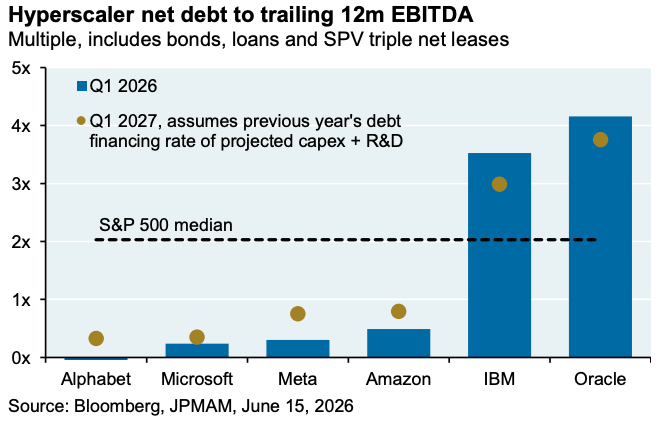
Second, as the investor Gavin Baker has argued, the Big Tech companies have extremely strong core businesses4. Companies with big cloud divisions are making a lot of money from AI—just look at the huge recent earnings from Microsoft and Amazon—and they’re about to make even more when cheap GPU contracts end, and the cloud companies can charge higher prices to match surging demand for agents. With more cash coming in the door, their borrowing needs might moderate, and their credit spreads might come down. The real thing to worry about, Baker counsels, is the boring physical problem: building power plants and plugging in all these computers fast enough.
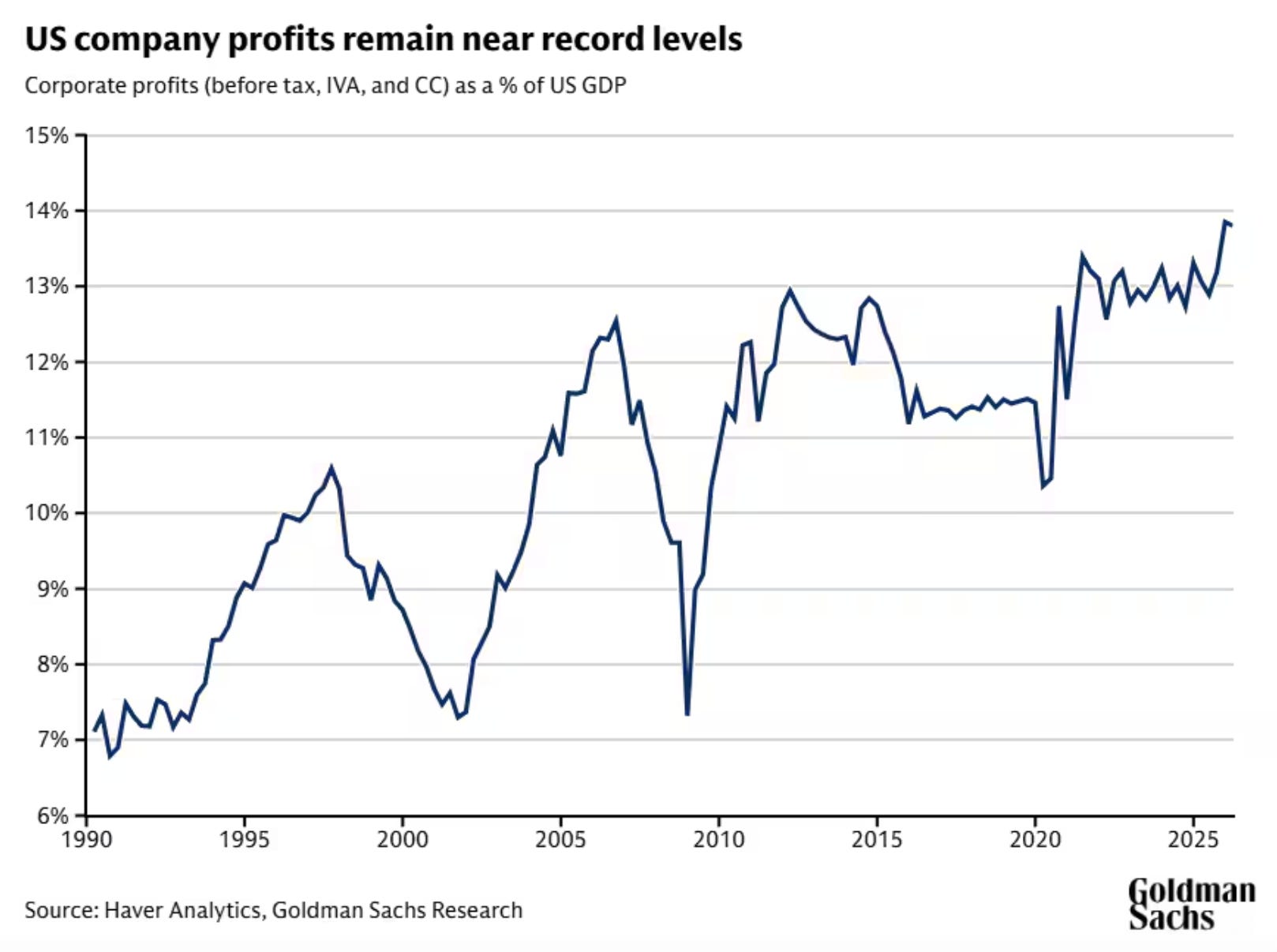
Third, the bubble years of the late 1990s had several key macroeconomic features, such as declining profit margins and a widening current account deficit, that are absent in today’s markets. In fact, US corporate profits remain near record levels.