


In the last few weeks, I have sensed a trembling in the air and a turning over of narratives in the realm of artificial intelligence. Think of it as a double vibe shift in AI.
The first shift has occurred at the level of AI models—from an emphasis on speed to an atmosphere of paranoid caution. For years since ChatGPT debuted in 2022, the frontier labs have raced to put their latest technology in the hands of consumers as fast as possible. But two weeks ago, Anthropic claimed that its newest AI model, Claud Mythos, is too powerful and dangerous to release to the broader public. Mythos appears to be so skilled at cyberhacking that the company’s current safety and monitoring methods do not seem sufficient to stop something catastrophic from happening if the software were to be released to hundreds of millions of people at once. Instead the company has made Mythos available to a handful of companies, including Microsoft and Apple, to “find and patch security vulnerabilities in critical software programs,” as Kevin Roose reported in the New York Times. OpenAI is also looking to restrict access to its most advanced models.
The second shift has occurred in the realm of AI supply and demand—from “AI is surely a bubble” to “for now, it surely is not.” For much of last year, the AI bubble case was easy to make. The AI capex buildout—that is, the cost of all those chips, data centers, and electricity—amounted to the largest private-sector infrastructure project in history. And since many of the similar-but-smaller projects turned out to be bubbles, it naturally followed that this, the mother of all capital expenditure projects, would become the mother of all capex bubbles.
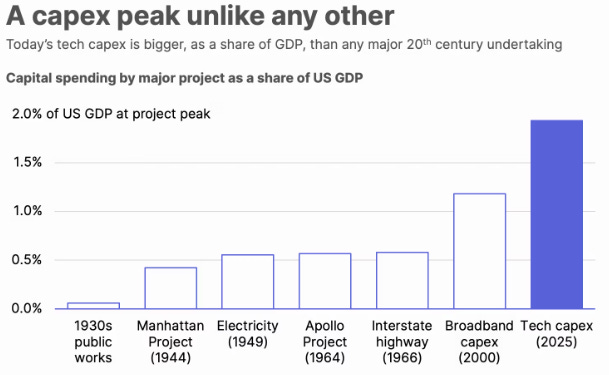
But it now seems that the biggest problem facing AI is not a shortage of demand—that is, a shortage of customers—but rather a shortage of supply—that is, consumer demand is so white-hot that the hyperscalers cannot provide sufficient compute to keep up with customer needs.
This dual vibe shift is a seismic development. For years, skeptical analysts have analogized AI to the 19th century railroads—a transcontinental tech program that crashed the economy with popped bubbles over and over again, on its way to changing the world. But I now think it might be useful to study AI as akin to something more like the dawn of electricity in the early 20th century, when builders struggled to keep up with demand but nonetheless created a set of enormous financial and political headaches for the U.S.
THE BUBBLE THAT WASN’T (OR: WHY I CHANGED MY MIND)
In the last few months, three big things have pushed me toward thinking that AI might be the opposite of a bubble. Each of these developments has pushed me back into the history books to look for the right historical analogy for AI, which I’m particularly excited to tell you about.
