

Every week, I save dozens of screenshots of charts, essay passages, science and economics papers, and tweets. Every few months, I collect my favorite ideas, organize them by topic, and publish them in this newsletter.
In this edition, I’m trying something a bit more ambitious. I’ve organized the morsels of information under several themes—let’s call them: “megatrends”—that define the 2026 news cycle and that I think will continue to shape the world in the months, and years, to come.
Today’s megatrends span economics, health, artificial intelligence, culture, politics, and media. Free subscribers will get to read the first two megatrends, on economics and health—plus a “historical interlude” that was too interesting to leave out. Only paid subscribers will get to read more about the state of AI, a paradox in politics, and an eerie new trend in the media.

Megatrend #1: CULTURE
The Anti-Social Century
A little announcement that probably won’t be surprising to folks who’ve followed my work in the last year: I’ve signed a contract for my next book, and it will be about the ideas I’ve worked on for the last year that I’ve been calling “the anti-social century.” I see this as a natural follow-up to Abundance. If abundance is a critique of, and solution for, the problems of material flourishing—how do we build homes, reduce energy costs, power technology, and invent scientific breakthroughs, all of which can make people’s lives easier and better?—the anti-social century addresses the cultural, or “post-material,” problems that are often beyond the scope of political economy. The last few years have seen an astonishing decline in happiness and sociality in the U.S., which has coincided with a rise in alone time, anxiety, mental distress, and a toxic form of individualism that I described in “The Monks in the Casino.” I want to better understand how this happened and what “we”—at the level of individuals and institutions—can do to fix it.
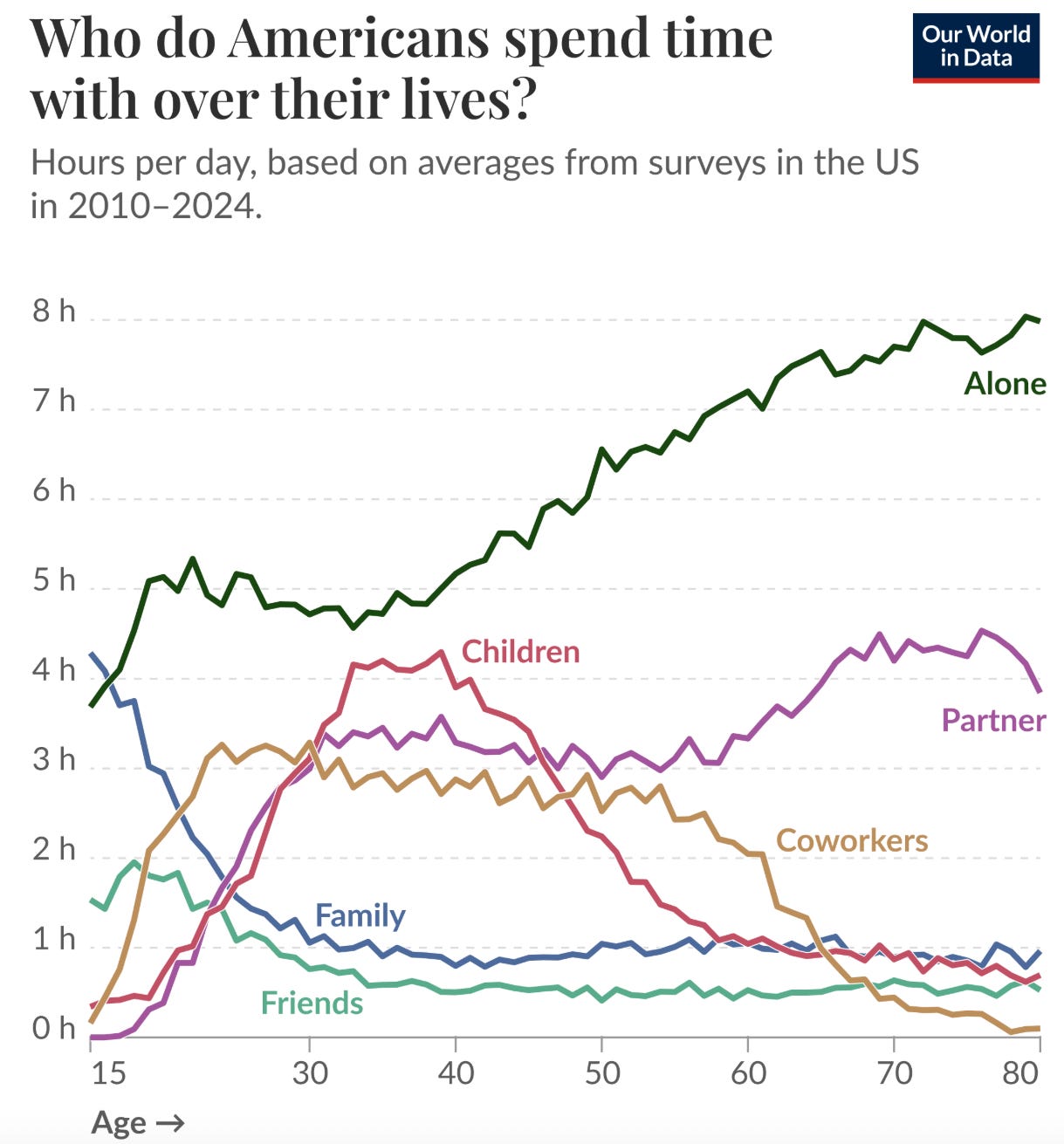
Life as “time spent with.” One of my favorite graphs from the miraculous Our World in Data site is this breakdown of how the typical American spends their day between the ages of 15 and 80. One way to read this chart is that time spent with our parents peaks in our late teen years; time spent with friends peaks in our early 20s; time spent with coworkers peaks in our mid- to late-20s; time spent with our children peaks in our 30s and 40s; time spent with our partners peaks in our 60s and 70s, and time spent alone increases steadily as we get older. One way to think about the anti-social century is that it is a kind of society-wide conspiracy to increase alone time, due to a phalanx of forces that are reducing time spent with practically everybody who isn’t “just me.”
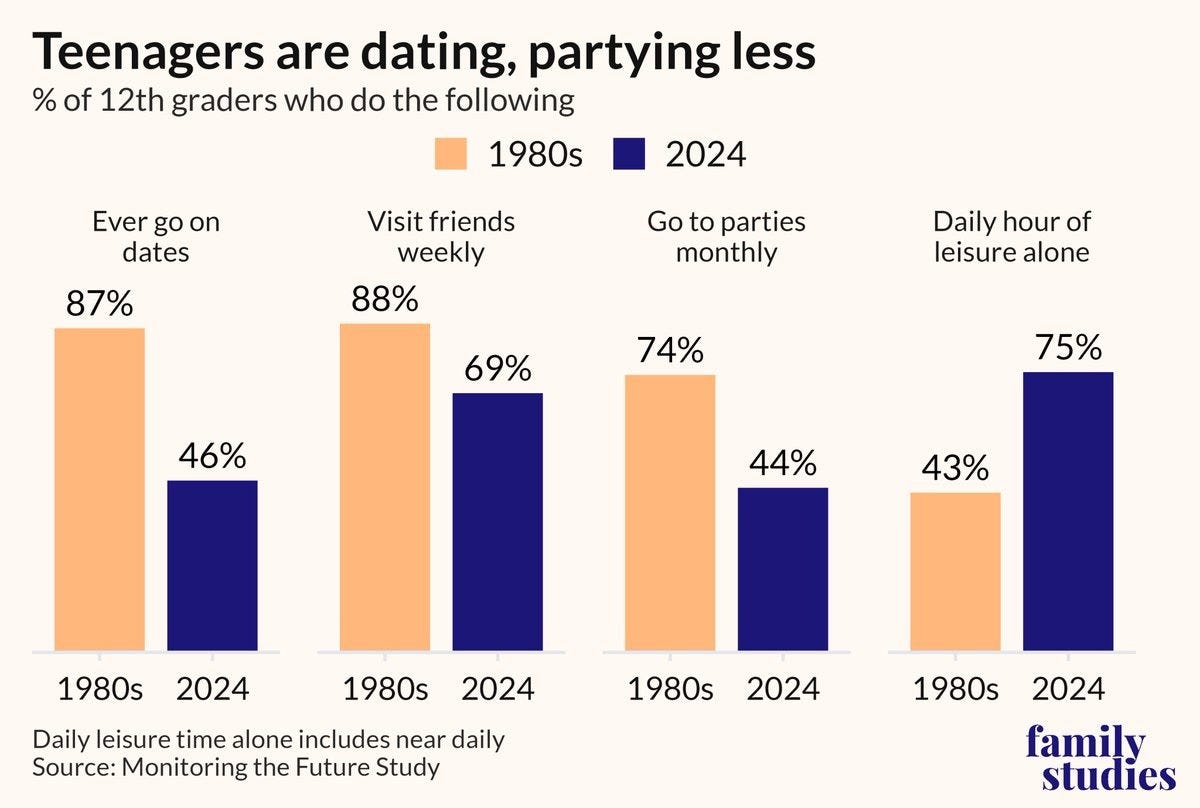
Time spent with partners, children, coworkers, and friends declines as Americans couple less, have fewer children, work alone, and spend less time with friends. Partner time declines as Americans are dating and marrying less. While parents are spending more time with their children, fewer Americans are having kids in the first place. Between 1976 and 2024, the share of women 40-44 years old without children increased by 80 percent and the share of “never married” women increased by more than 50 percent. With the rise of remote work and sole proprietor firms, or one-person startups, there is less time spent among coworkers. As for teenage friendship, the numbers are dire. The share of 12th graders who “ever go on dates” has declined by 47 percent since the 1980s; the share who “visit friends weekly” has declined 22 percent; and the share who “go to monthly parties” is down 40 percent, according to the Institute for Family Studies.
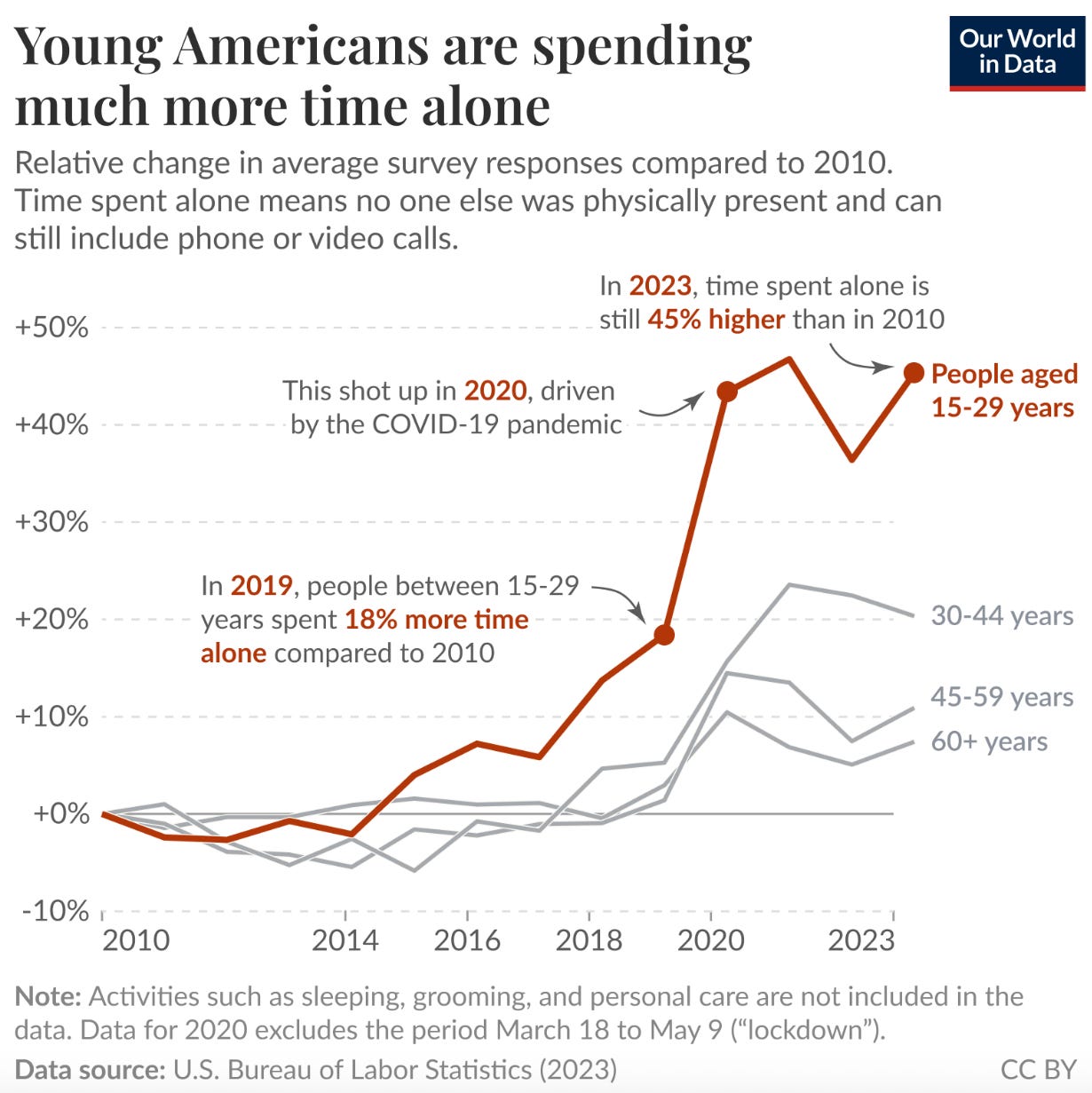
Put it all together and Americans are spending more time alone than in any period for which we have good data. This is especially true for young Americans, who have historically been the most social group.
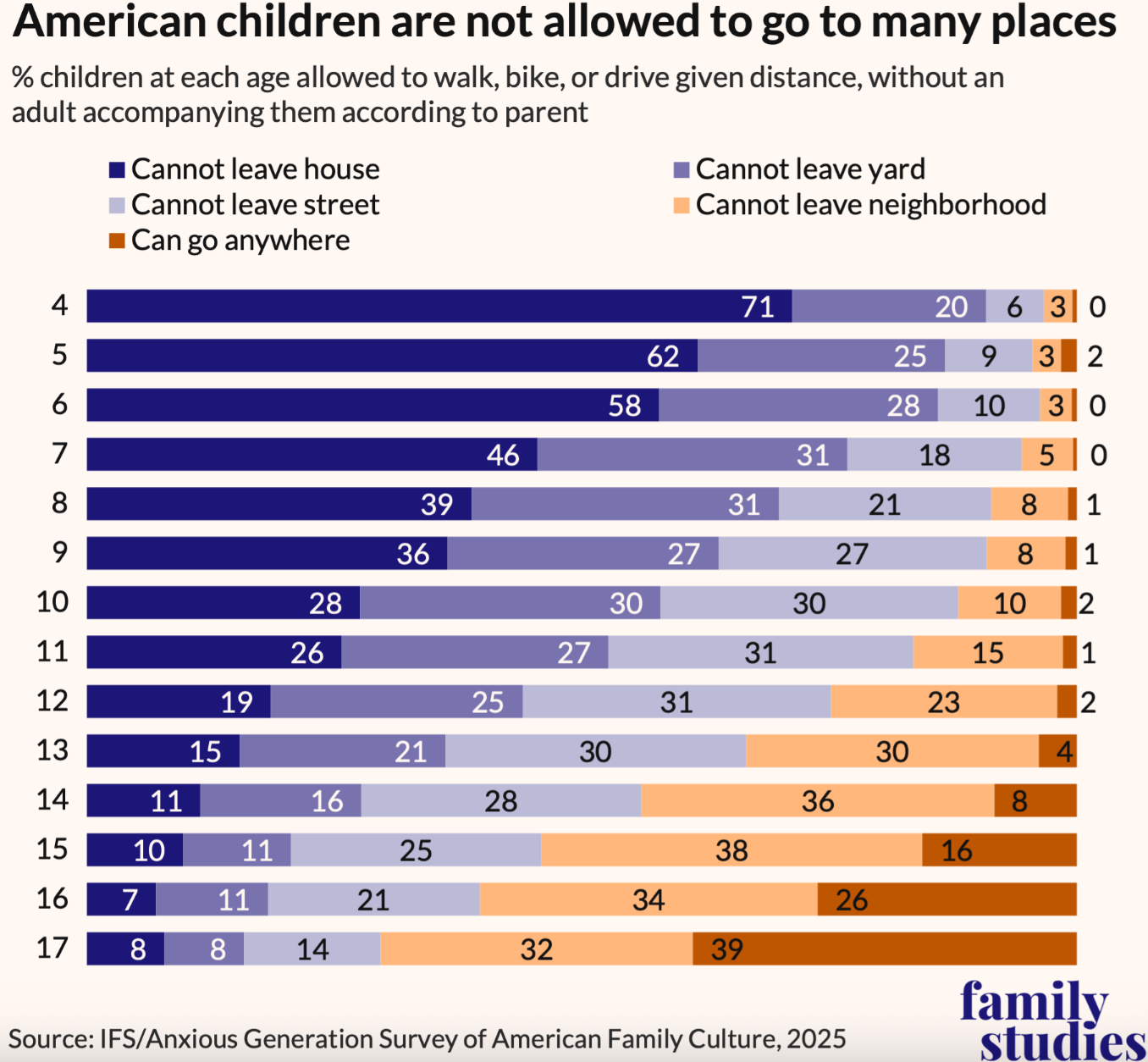
There are many forces to blame, but just for now, let’s blame American parenting. According to the Institute for Family Studies, one in ten teenagers isn’t allowed to leave the house without an adult companion, and 80 percent aren’t allowed to leave the neighborhood without an adult. The latchkey generation of kids who came and went without supervision gave way to a helicopter model of intensive parenting and strictly guarded childhood. Homebound and phone-bound, today’s adolescents and teens spend more time in their rooms and less time playing with friends than any cohort ever studied.
There are some reasons to be optimistic. I see more people paying attention to the problem of solitude and thinking about socializing as social fitness—something that you “should” do not only because it’s fun but also because it’s physically and neurologically good for you. I’m also seeing more policies to increase socializing. If the last 20 years has been an uncontrolled experiment to roll out phones to children without much care for how it would affect their mental health, we might be in a new phase of controlled experiments to deprive young people of those same devices. A giant study of school phone bans published in April found that “lockable phone pouches” did not significantly improve school attendance or self-reported classroom attention, while average effects on test scores were “consistently close to zero,” with high schools seeing modest positive effects. That all sounds rather dispiriting. But the lasting effects on happiness seemed real: phone bans seem to cause first-year disruptions followed by real increases in subjective well-being.

The philosopher Jacques Ellul wrote in The Technological Society that new technologies shape us as much as we shape them; what they make efficient becomes what we value. A child, or an adult, or an entire civilization might think that they are using a new technology neutrally or instrumentally, but over time institutions reorganize themselves around what technology makes expedient. I think this is essentially what phones have done to the modern world. College students and study participants consistently claim that they regret much of their phone use, but the technological capability of the phone to command and hold attention consistently overrides the traditional communal value to spend more time with books, in nature, or around other people.
There is another way. Toward the end of my reporting for the anti-social century cover story for The Atlantic, I came across a reference to the novel Seveneves, in which Neal Stephenson coined the term “Amistics.” Derived from the notoriously anti-tech Amish, the word refers to the practice of carefully selecting which technologies to accept or reject. Far from dispensing with all new technology, the Amish take pains to adopt only those new products that uphold their existing values. So, solar and wind energy is allowed, because it enables useful work, but television is out, because it interferes with family time. As I wrote:
If the Amish approach to technology is radical in its application, it recognizes something plain and true: Although technology does not have values of its own, its adoption can create values, even in the absence of a coordinated effort. For decades, we’ve adopted whatever technologies removed friction or increased dopamine, embracing what makes life feel easy and good in the moment…
We should ask ourselves: What would it mean to select technology based on long-term health rather than instant gratification?
MEGATREND #2: HEALTH
Building the Do-It-All Drug
GLP-1 drugs like Ozempic (semaglutide), made by Novo Nordisk, and Zepbound (tirzepatide), made by Eli Lilly, have demonstrated extraordinary effects beyond the treatment of type-2 diabetes and obesity. In the last few months, randomized studies have shown GLP-1s can reduce psoriasis severity by up to 80%, treat addiction disorders, ameliorate several kinds of mental distress, and melt fatty liver disease. New and better GLP-1 drugs are waiting in the wings. Let’s review what these drugs can and can’t yet do—and what’s coming next.
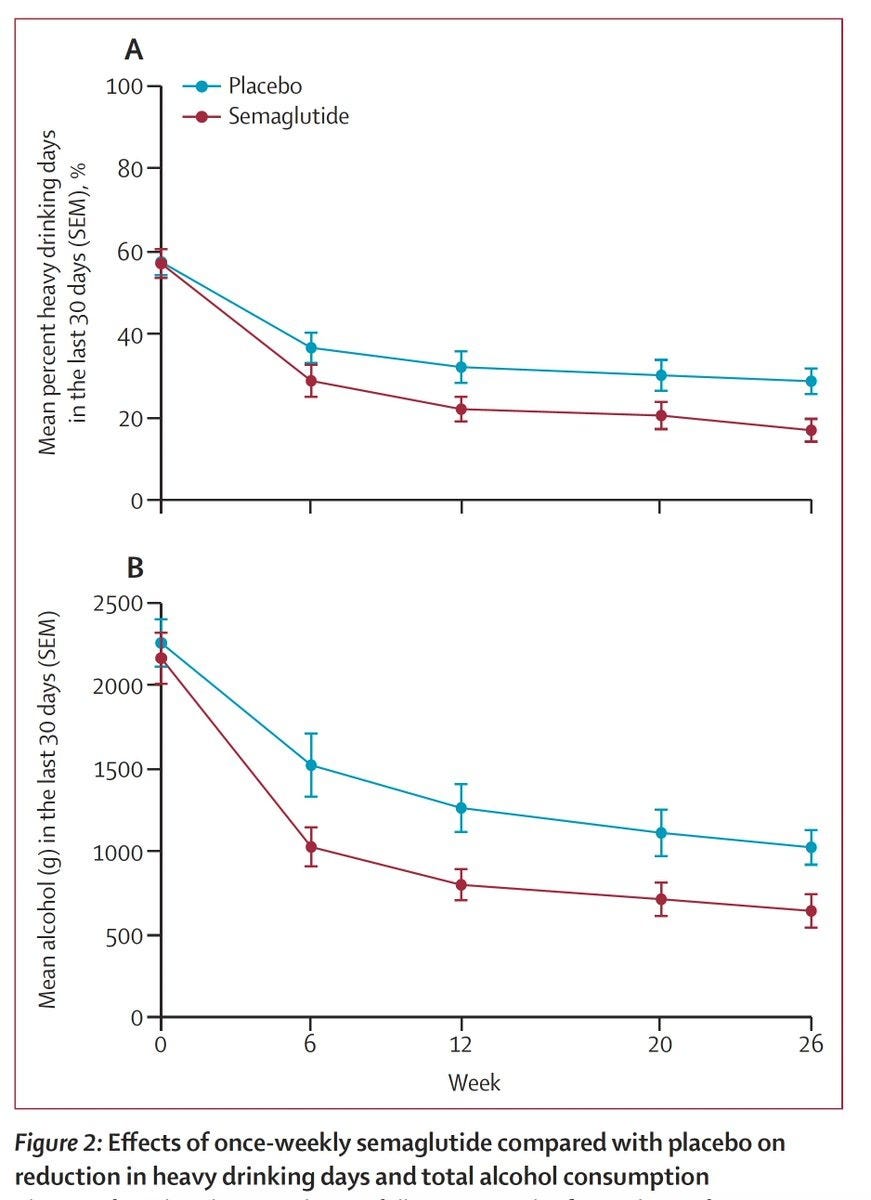
Help with addiction disorders? Yes. A placebo-controlled, double-blind trial of Ozempic found that the drug reduced both heavy drinking days and overall alcohol consumption among people seeking treatment for addiction.
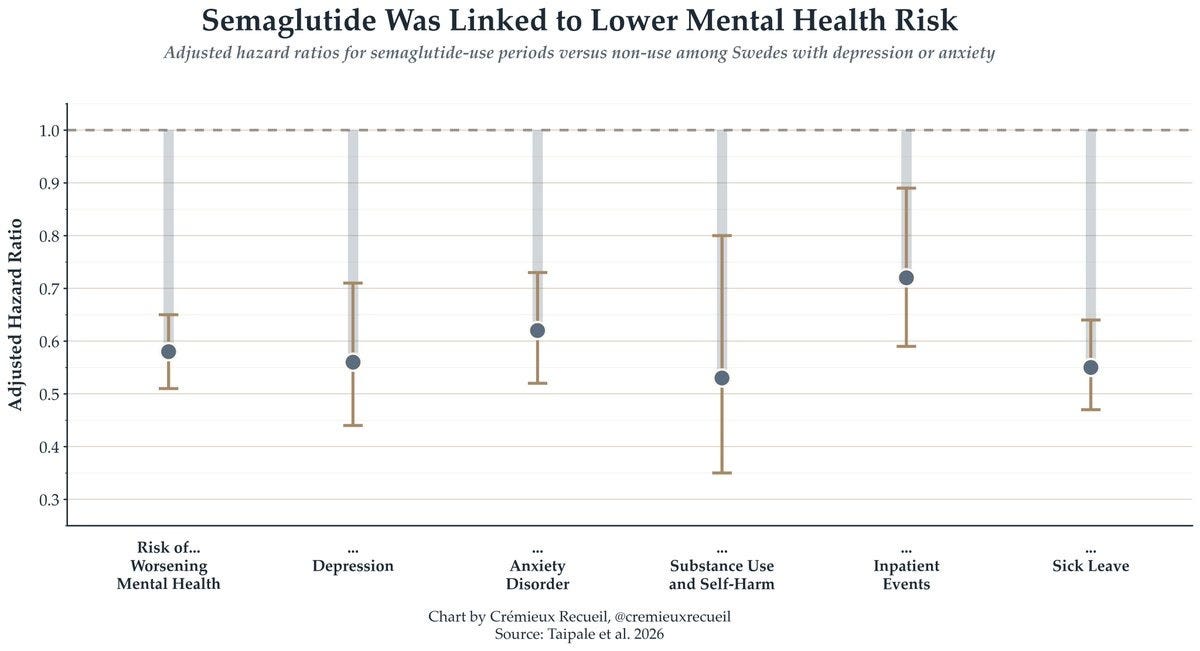
Help with mental distress and anxiety? Yup. An April study of more than 100,000 people in Swedish electronic health registers found that semaglutide use was associated with lower risk of worsening mental illness, self-harm, depression, anxiety, and worsening substance use disorder.
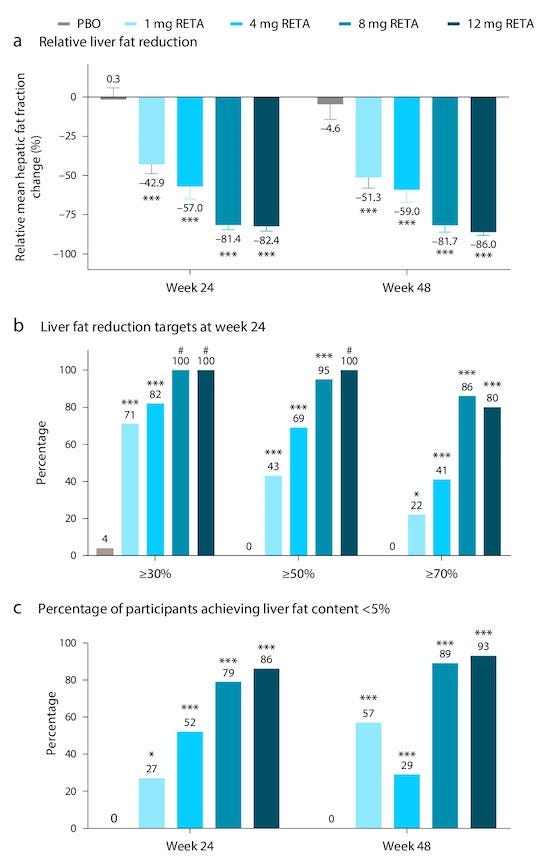
Crush fatty liver disease? 100%. (Er, well, 80%.) The next big GLP-1 drug coming down the pike is retatrutide. While the first generation of GLP-1 drugs targets the GLP-1 hormone exclusively, Lilly’s popular Mounjaro drug (a.k.a., tirzepatide) targets two hormones: GLP-1 and GIP. Retatrutide is a triple agonist that targets three gut hormones: GLP-1, GIP, and glucagon. Reta is most celebrated for its historic weight-loss effects, which seem even more dramatic than tirzepatide or semaglutide. But in a recent study, patients on retatrutide saw an 80 percent reduction in liver fat. Fatty liver disease affects millions of Americans, and there is no FDA-approved treatment for it other than admonitions to lose weight. But retatrutide’s targeting of glucagon seems to melt liver fat even more effectively than it causes weight loss.
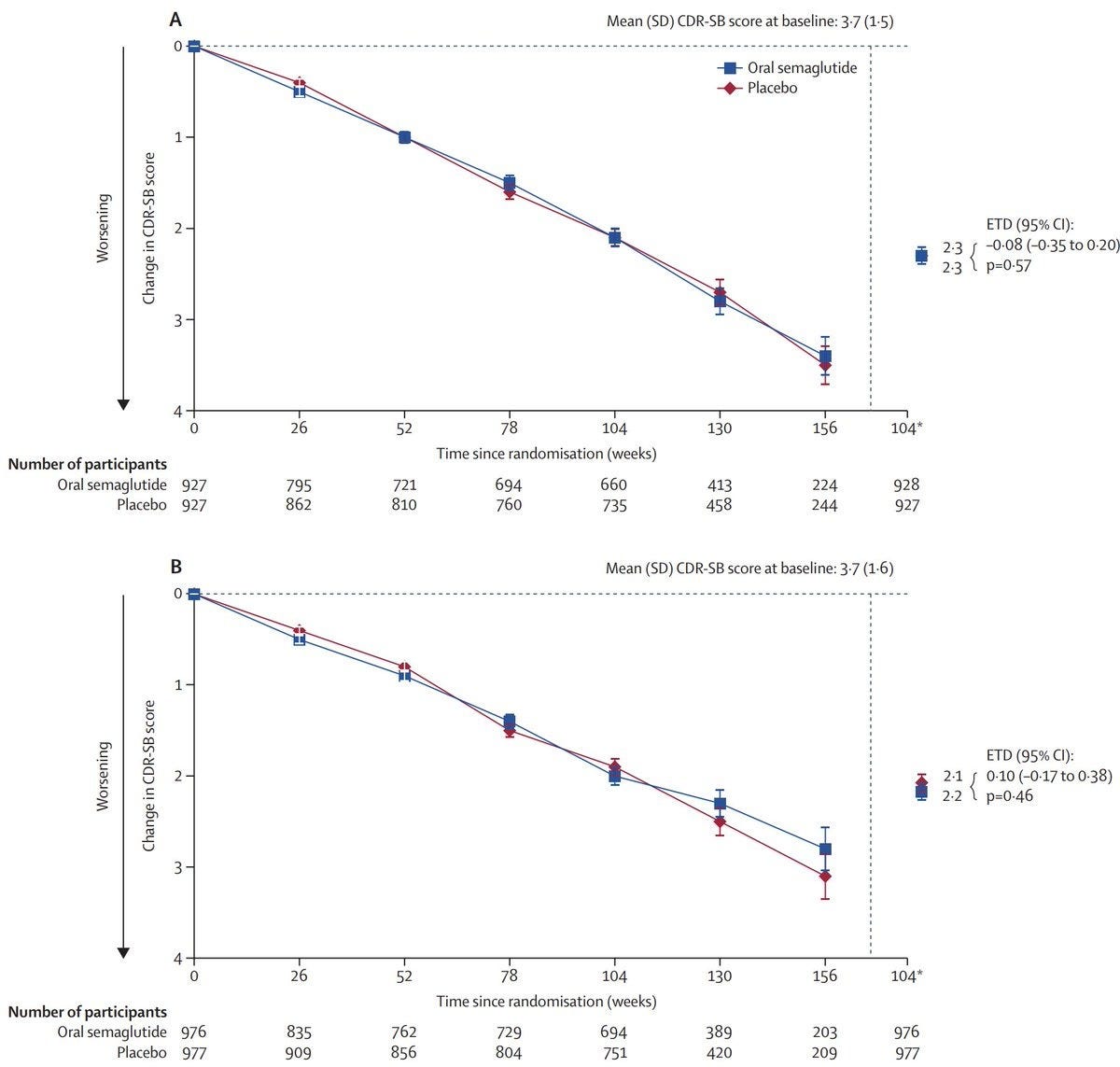
Stop Alzheimer’s? Not yet. A Novo Nordisk-funded trial of oral semaglutide among elderly Americans found that the drug did not seem to slow worsening Alzheimer’s symptoms. In the charts below, you’ll see two groups—BLUE on semaglutide vs. RED on a placebo. The nearly identical declines on a cognitive test over 156 weeks indicate that GLP-1s failed to make much of a difference in the progression of the disease. (It’s still possible that the use of GLP-1s earlier in life reduces the likelihood of ever developing Alzheimer’s, but this hasn’t been studied yet, and a high-quality study could take many years, or even decades.)
Fuck everything, we’re doing five agonists. The Onion once published an article entitled “Fuck Everything, We’re Doing Five Blades,” in which an imaginary Gillette executive proposes adding a fifth blade to the company’s new razor. (”I don’t care if they have to cram the fifth blade in perpendicular to the other four, just do it!”) Well, somebody from pharma took that essay as inspiration. While semaglutide, tirzepatide, and retatrutide target one, two, and three hormones, respectively, scientists are now exploring a quintuple agonist “that combines the body weight-reducing and blood glucose-lowering effects of GLP-1R–GIPR co-agonism with the insulin-sensitizing and anti-inflammatory effects of lanifibranor via its targeted delivery into GLP-1R- and GIPR-expressing cells.” As scientists add targets, one could imagine a GLP-1 drug that both melts fat, fights inflammation, and even preserves muscle tone. In other words, I don’t care if they have to cram the fifth agonist in perpendicular to the other four, just do it!
Historical interlude: Creativity secrets of Alexandre Dumas
Alexandre Dumas could write. What the man couldn’t do was stop writing. By his death, Dumas had produced more than 100,000 pages of book text, which is the equivalent of writing a novel the length of War and Peace every seven months, for four straight decades. In his miracle years of 1844 to 1846, Dumas wrote both The Three Musketeers and The Count of Monte Cristo—the latter of which is both incredibly long (more than 1,200 pages in most modern editions) and also considered by many one of the greatest novels of all time.
How did he do it? Dumas was “often accused of operating a fiction factory,” Michael Dirda writes. But the fact that none of his research assistants achieved anything of note on their own strongly suggests that Dumas was the final hand to put pen to paper. His workflow:
[Dumas’s] particular genius lay in transmuting dry historical records into vibrant page-turners through his mastery of dialogue, pacing, and dramatic confrontation. Dumas would first talk over a book with an assistant, perhaps ask him to do some research and prepare an outline, then follow up with further discussion of the action and plot, this time in more detail. Only when he had settled the whole are of the novel in his own mind did Dumas put pen to paper. As he once said, “As a rule I do not begin a book until it is finished.” He then wrote fast, a single draft on blue paper, never bothering about accents, commas, and punctuation, working long hours at a time.
“Do not begin a piece of writing until it is finished” is a fun idea. Personally, I think my best essays are similarly “finished” before they are “started.” That is, if I begin the writing process without really knowing what I want to say, I wind up not saying much of anything but rather circling, circling, circling a strong contention that would have been better developed if I had done more research or talked to more people. My best essays are sometimes the ones whose theses I can describe in detail before I write the first sentence of the final draft.
