

This is an expanded and revised version of an essay that originally ran in The Argument, an online magazine where I am a contributing writer.
Billions of people look at their phones and see the whole world. But some theorists look at the whole world and see only phones.
The rise of youth anxiety? It’s the phones. The rise of global populism? The phones, again. The surge in attention disorders in the U.S.? The global decline in literacy? The scourge of political polarization? Phones, phones, and more phones.
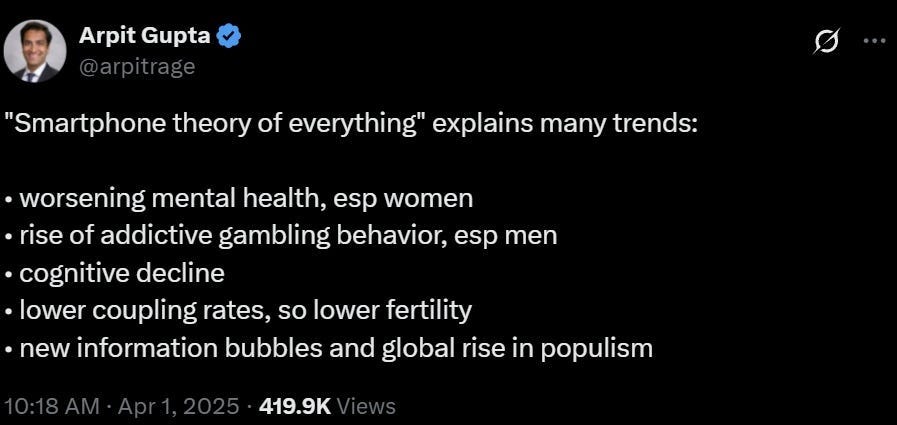
The NYU professor Arpit Gupta has called this the “Smartphone Theory of Everything.” It is the notion that an unholy nexus of smartphones, the Internet, and social media is uniquely to blame for practically every modern malady.
But which of these associations are backed by solid evidence, and which are backed by little more than confident assertion?
I have been reporting on this space for several years, and this article is my best attempt to separate the strongest claims from the weakest, according to the best science available. Rather than base my analysis on individual correlational studies, I leaned on randomized trials, meta-analyses that evaluated hundreds of studies, and a “consensus survey” that asked hundreds of academics what they thought about the effect of smartphone use on personal and mental health.
In my experience, the loudest voices can sometimes misrepresent the underlying evidence. The strongest proponents of the SToE often ignore the stubborn fact that phones are global but their worst effects are strangely concentrated in the richest, English-speaking countries. But the fiercest critics of the SToE often ignore the findings of randomized trials and real-world experiments, such as phone bans in schools, which have mostly shown that taking phones away from people makes them a little happier and better at focusing.
The subject of smartphones’ effect on the world is so vast, so complicated, and in some cases so uncertain that the remainder of this article is divided into two parts. First, I’m going to break out four big truths about the smartphone/social media/internet literature. Second, I’m going to do my best to take the most common claims about smartphones in the world—e.g., they make people sad, distracted, conspiratorial, unmarried, etc.—and place these claims into three buckets: (1) Strong evidence; (2) Mixed evidence; and (3) Weak evidence.
If I do my job well, this article can serve not only as a useful synthesis for scholars and ordinary readers but also as a living document that I can update every year, as we learn more about the 21st century’s most famous theory of everything.
I. FOUR BIG TRUTHS ABOUT SMARTPHONES
1. Smartphones and social media are hard to study well. This basic fact cuts two ways. It means SToE crtitics can overstate the evidence, but it also means the evidence can understate the real effect of phones.
“Getting clean causal evidence on the long-term impact of phones and social media is devilishly hard,” said Matthew Gentzkow, a Stanford economist. “Re-running history without iPhones or Facebook is not a feasible experiment. The randomized experiments we can do are generally short-term limited interventions, and observational data analysis over longer horizons faces big hurdles in inferring causality. The hard work of research is stitching together the data points we can muster to fill in the overall picture while remaining cognizant of how much we don’t know.”
People like to compare smartphones and cigarettes. Let me say something here that begs to be taken out of context: I wish smartphones were cigarettes. If the phone experience were a mass-manufactured bundle of chemicals that we could test in isolation against a control group, then the science of proving or disproving the harm of phones would be trivially easy. This whole essay could be one sentence long: We did some tests on phones, and they’re definitely giving people cancer.
Unfortunately— for research purposes, only—smartphones are not tobacco. Everybody’s online experience is unique, which means that everybody is effectively smoking a slightly different cigarette. No surprise, then, that observational analyses struggle to prove causality, and randomized experiments to prove causality are typically brief and limited. You can’t assign child participants to heavy social media use for a full year, and you certainly can’t randomly assign kids to use their smartphones in a specific way for a long time. (“Hi Madison, we need you to spend your entire junior year marinating in angry left-wing Reddit posts to measure the impact of online Marxism on the teenage mind” is not a plausible study design.) If you force participants to deactivate Facebook in a study, they might just download Twitter; in fact, that’s exactly what happened in a 2020 study. If you force them to give up their phones entirely, they’ll still need to maintain desktop web access; in fact, that’s exactly what happened in a 2025 study.1
Another reason that smartphones are hard to study is that, like alcohol, they might have small effects on the majority population and large effects on a minority population. In 2020, Instagram’s own analysis concluded that its product “made body image issues worse” for one third of teenage girls. That’s a big number! But it also implies that for the majority of teenage girls, Instagram had a small or negligible effect. And, of course, most people are not teenage girls.
Cellphone Cassandras can exaggerate the conclusions of careful research, which often show small overall effects. But critics of the SToE often ignore practical conclusions by fixating exclusively on small overall effect sizes, despite the evidence of significant long-tail effects. Maybe both sides should get comfortable thinking about social media as “attention alcohol”: fun if moderately problematic for most, and very dangerous for some.
2. There’s something weird about America—and, maybe, the entire English-speaking world.
One of the most interesting wrinkles in the smartphone theory of everything is that while phones are everywhere, the problems that they cause are often rising fastest and first in the richest countries—especially in the U.S.
Take the theory that smartphones make people sad. According to the latest World Happiness Report, happiness among young people has plummeted most severely in Western developed countries that speak English, such as the United States, Great Britain, Canada, Australia, and New Zealand. On the other hand, “happiness at every age has risen sharply in Central and Eastern Europe,” the report said. In East Asia, happiness is increasing “at every age.” The same is true for suicide. Emergency-room visits for suicide attempts among young women soared across the Anglosphere in the last few years. But as I’ve reported, the suicide rate among people ages 15 to 19 fell in most European countries in the last decade.
Or take attention deficit disorders. The surge in ADHD cases seems to be another US-heavy phenomenon, with American child diagnoses rising at roughly twice the rate of European countries. To understand rising anxiety and attention disorders in the U.S., we have to recognize the phenomenon of diagnostic inflation—i.e., medical providers expanding the definition of anxiety and ADHD to treat more cases.
Or take polarization. The U.S. also seems to be an outlier in some maladies that are associated with smartphones. A 2020 paper on polarization in the west found that “affective polarization”—the degree of hostility that people feel toward the party they oppose—rose fastest and first in the U.S., with most of the increase predating the smartphone age. The researchers wrote that polarization took off in the 1990s, right around the introduction of Fox News, which was 20 years before the smartphone revolution took off.
Or take populism and distrust. Again, the strongest effects seem concentrated in the U.S. A 2023 Nature Human Behaviour review of 496 articles found that digital media is most strongly associated with declining political trust and growing populism in developed democracies, such as the United States. In developing democracies, by contrast, the largest effect of digital media on politics seems to be that it increases political participation.
What do we make of all this? One interpretation might be that if smartphones are global and these effects are localized, then the smartphone theory of everything is just bunk. I don’t buy that. I think it’s more likely that smartphones are an active ingredient that’s interacting with other phenomena that are distinctly western or American, in order to create berserk local effects. It’s possible that in a few years, most academics will agree with some version of this thesis statement: Compulsive phone use along with under-regulated social media reliably produce widespread anxiety, attention issues, polarization, populism, and institutional distrust in highly individualistic societies with a culture of diagnostic inflation [i.e., expanded diagnostic guidelines for anxiety and ADHD], negative-affect prevalence [i.e., people online constantly talking about their anxiety and ADHD], and high levels of negativity in the news ecosystem … and post-2010 America was simply the first and most dramatic example of all these ingredients coming together.
3. People overrate phones’ effect on misinformation—and underrate their effect on information.
In 2018, Gentzkow and other researchers paid about 1,700 Americans to deactivate Facebook for four weeks before the midterm elections. Those who logged off were happier, less anxious, and less politically polarized.
Findings like these have trickled through academia into mainstream media and the public discourse, where parents, teachers, depressed youths, and politicians are well-primed to see smartphones and social media as The ProblemTM. But here’s what almost nobody talks about: The people who deactivated also knew less in general about the world. In a second, larger study of more than 35,000 Facebook and Instagram users, the same thing happened.
This finding is a Rosetta Stone for the smartphone debate, because it reveals something both sides keep getting wrong: Smartphones are above all an information-delivery system—a relentless, inescapable IV drip of news, connection, outrage, friendship, conspiracy, solidarity, and garbage—whose effect on any individual depends significantly on what’s in the drip2.
If smartphones are making Americans depressed, conspiratorial, and anxious, it might be because the news is structurally becoming more depressing, conspiratorial, and anxious. In 2023, researchers at the University of Pennsylvania, Indiana University, and London Business School used AI to trace positive vs. negative words across tens of millions of newspaper articles from the 1850s to the 2020s. For more than a century, news positivity hovered around a stable average. But after the 1960s, negativity surged. “News coverage has just gotten more and more negative every decade in the last 50 years, especially when you adjust for economic recessions,” UPenn economist J. H. van Binsbergen, a co-author on the paper, told me. As I wrote in an essay for The Atlantic, I suspect that as the media industry got more competitive in the past few decades, publishers desperate to command reader attention doubled down on the old clichés that “if it bleeds, it leads” and “bad is better than good.” In this light, phones didn’t make the news more depressing so much as they made it easier to access depressing news.
4. The biggest problem with smartphones isn’t what’s on the phone, but rather what’s not on the phone.
My favorite Jonathan Haidt argument is that phones replace play-based adolescence with phone-based adolescence. That is, the most important thing about phones isn’t what’s on the screen, but rather everything that’s off the screen when you’re lost gazing into your pocket device.
While it’s hard for researchers to control what participants are doing with their phones, it’s not hard for researchers to see what people are doing when they’re not on their phones. They sleep more! They socialize more! They go outside more! (And, yes, they watch TV more.)
In 2025, researchers found that randomly removing internet access from smartphones produced a range of benefits, including improved mental health, subjective well-being, and the ability to sustain attention. More than 90 percent of the nearly 500 participants experienced at least one benefit. As best as the researchers could tell, the most significant reason for improved mental health and subjective well-being came from participants spending more time “socializing in person, exercising, and being in nature.”
Another randomized trial that paid people to deactivate Facebook before the 2018 midterm elections also found that people spent more time with friends and family. From that paper:
The 60 minutes freed up by not using Facebook … were allocated to both solitary and social activities offline. Solitary television watching increases by 0.17 points on our scale; other solitary offline activities increase by 0.23 points, and time devoted to spending time with friends and family increases by 0.14 points.
To summarize everything I’ve just said in a brief paragraph: Phones are global, but what’s on our phones is exquisitely individual. For this reason, overall phone effects are hard to study. They are best understood as a relentless information-delivery system whose utility or harm is exquisitely dependent on the type of information that people access. This might explain why cultures with more anxious or polarizing content—such as the U.S.—see higher and faster rates of anxiety and polarization. Rather than adopt an empirical nihilism about all this (ah, well, phones are complicated, let’s just do nothing!), we should pay close attention to the consistent finding that people tend to be a little happier and little more attentive when they un-hook from the information-IV drip of their personal devices.
That’s an awfully broad summary! So, let’s talk about some specific claims, such as:
Are phones really so bad for sleep?
How strong is the evidence that they cause population-wide anxiety?
Are they turning us into conspiracy theorists?
What does the research say about their role in explaining rising populism and declining marriage rates?
In this next section, I’ve done my best to place 10 popular claims into three buckets: Strong evidence, mixed evidence, and weak evidence.3
