

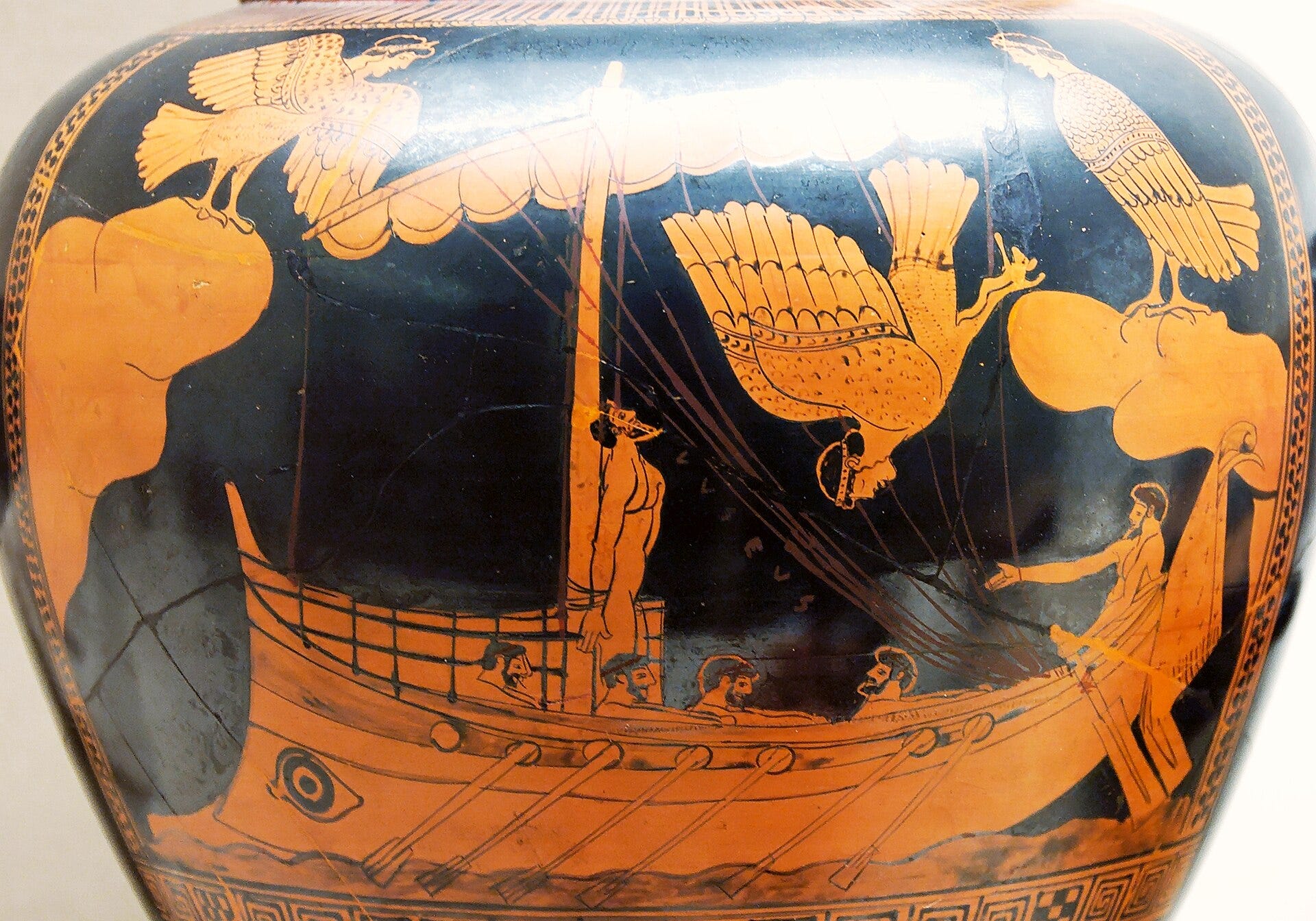
The Odyssey is everywhere right now. Christopher Nolan’s film is conquering the box office, spawning online memes, and dominating online discourse. If you rip your eyes away from your feeds, and turn your attention to another book or film, you might find Homer’s epic dwelling there, too. As the author and translator Daniel Mendelsohn has observed, the story of “the hero, separated from home and loved ones, who wanders among strange peoples and fantastical places during a difficult journey home” is The Wizard of Oz, Finding Nemo, Dante’s Inferno, Alice’s Adventures in Wonderland, Huckleberry Finn, and even Nolan’s own films Inception and Interstellar. The hero who uses disguise to test the loyalty of those around him has been recycled in Alexandre Dumas’s The Count of Monte Cristo and Ridley Scott’s Gladiator. The poem’s fascination with alien creatures—like Scylla, Charybdis, and the Cyclops Polyphemus—could even be seen as a kind of ancient recipe for Star Trek.
But in an equally true way, Homer’s Odyssey is not everywhere. It is nowhere. This is an alien story about alien values from an alien world. It is a 2,500-year-old poem about a 3,000-year-old story from a Bronze Age that is as dead and buried as the heights of Troy. The values of The Iliad and The Odyssey are blessedly passé, including their bloody warrior culture and their fixation with an antiquated vision of glory through brute strength, which was often purchased through the spilling of blood and the keeping of slaves.
For the last few weeks, there has been a ferocious debate about whether Christopher Nolan’s movie properly honors the original text. Is it okay that Helen of Troy is portrayed by a Black actress? Is it okay that Matt Damon’s Odysseus seems traumatized by the sacking of Troy, in a way that feels like he’d qualify for PTSD treatment from Veterans Affairs? The most interesting (and also, the dumbest) questions that people are asking about The Odyssey are fundamentally questions of translation. They are all versions of an underlying anxiety, which is something like: What is the duty of modern artists when translating ancient works for a modern audience?
Well, I thought, who better to answer that question than the famed classicist whose translation of The Odyssey reportedly inspired Nolan’s own screenplay and film. Today’s interview is with Emily Wilson, who has expanded on her celebrated translations of Homer with her new book Crossing the Wine-Dark Sea. We talk about the art of translation, her views on Nolan’s film, and the eternal struggle of modern artists to balance familiarity and estrangement when they take on the task of making the ancients modern.
The Odyssey Is Older and Weirder Than Most People Think
Derek Thompson: Many people today want Homer to sound ancient. “Ancient” to us sounds like elevated Shakespearean language. Shakespeare’s work is about 400 years old. But Shakespeare himself was born some 2,500 years after Homer. We are far closer to Shakespeare than Shakespeare was to Homer. So this idea that “old equals Shakespeare” makes no sense. Shakespeare was extremely modern compared to Homer. How do you think about making something for modern audiences that is so old that it makes what we consider old seem relatively young?
Emily Wilson: Homer is Bronze Age poetry. In fact, he’s archaic-era poetry that reflects a folk memory of the Bronze Age. It’s very important to realize that we need to constantly defamiliarize and be open to how very strange these poems are, and to the fact that they were always strange. They were always mythical. They evoked a world that never actually fully existed in the way it is represented in The Odyssey. I don’t believe that in archaic or Mycenaean Greece there were goddesses descending to talk to people. And the poem reflects multiple different eras in history, because it’s based on this long preexisting oral tradition.
In order to evoke that experience of going on a poetic time machine, I think it’s useful to constantly remind yourself that your job isn’t to pretend you’re taking the reader back in time 50 years. That’s not nearly far enough. I need to convey the vividness of the storytelling, the humanity of the characters, and then lull you into a false sense of security. And then you’ll be like, “wait, why is this character wailing and slapping his thighs and slaughtering 500 cattle?” If you come at the poem with the most boring kinds of strangeness up front, like putting the verb in the wrong place, that distracts the audience from what’s fundamentally strange in Homer.
Thompson: Has the definition of what is a good translation changed?
Wilson: The norms governing what counts as a good translation have definitely changed, especially in the case of translations from Latin and ancient Greek. The 18th century poet Alexander Pope, like me, wrote a big bestseller by managing to translate Homer at a time when his culture was very much ready for it. He uses wonderful, ornate rhyming couplets, and he is both responding to the existing Augustan norms and reshaping that culture. There’s always in translation, especially of an old text, this interaction between, “I’m going to familiarize it,” and “I’m going to domesticate it,” and “I’m also going to reshape the possibilities in the receiving culture by bringing something alien into our culture and making us able to respond to it.” Before the Pope translations, English readers were really suspicious of Homer. They assumed that of course, if you’re going to read a canonical classic, you go for Virgil. He was the ornate stately classical one. Homer has things like people falling over in the manure, and the whole structure of his narrative is really weird.
Thompson: Was The Odyssey always so central to our conceptualization of Western literature and storytelling, or is its fame a somewhat modern development?
Wilson: People sometimes think the canon means the great books that have absolutely always been read and always been interpreted in exactly the same way. That’s historically false. The Iliad and The Odyssey have only been translated into modern vernacular languages very, very recently in the big picture. It’s only been about 400 years in English. In the Middle Ages, people were not reading Homer. They were reading summaries of myths about the Trojan War, and they were reading Virgil’s Aeneid, but they were definitely not reading The Odyssey.
Dueling Translations of Homer’s First Sentence
Thompson: I think it’d be fun to go through one passage in The Odyssey and hear how different translators dealt with the opening lines. Let’s begin with Alexander Pope.
The man for wisdom’s various arts renowned
Long exercised in woes, O muse, resound
Who, when his arms had wrought the destined fall
Of sacred Troy and razed her heaven-built wall.
Now here is E.V. Rieu, revised by Peter Jones in 1991, which is the version most commonly read in the UK. It’s a sentence of prose. It’s not even poetry.
Tell me, Muse, the story of that resourceful man who was driven to wander far and wide after he had sacked the holy citadel of Troy.
We compare that with Robert Fitzgerald, from 1961, which you call a far more elegant version written in largely iambic rhythm.
Sing in me, Muse, and through me tell the story
of that man skilled in all ways of contending,
the wanderer, harried for years on end,
after he plundered the stronghold
on the proud height of Troy.
And now the version that I read as a freshman in high school in the year 2000, by Robert Fagles, in free verse.
Sing to me of the man, Muse, the man of twists and turns …
driven time and again off course once he had plundered
the hallowed heights of Troy.
How would you, almost as an English teacher, explain the differences among these treatments of the first sentence?
Wilson: We could easily spend the whole hour just on these lovely little case studies. One thing to consider is how each of them expands on the original. Pope’s translation, by modern norms, is more like a riff. If you tried to pass that off as a translation in the 21st century, people would be really disturbed. They might say, this is an amazing poem, but what does it have to do with Homer? You made most of that up. For instance, “the man for wisdom’s various arts renowned.” I love that. There is nothing in the original either about renown or about wisdom. That’s just not there. It’s wonderful, but it’s totally made up.
The 20th century translations have a closer relationship to the original. One way to narrow this down is to focus on that very marked and super interesting epithet in the first line, polytropon, which the Rieu translation renders as “resourceful.” In the original, it suggests a twisty-turny-ness in the protagonist.
Then I love the Fitzgerald use of, “Sing in me and through me tell the story,” which again is totally made up. It’s just moi, one word, to me. That’s it. Fitzgerald is extrapolating by claiming to be a vessel of divine inspiration. It’s lovely, but it makes you think you’re in the world of the Hebrew Psalms rather than the world of Homeric archaic poetry. I also really love the way he makes it more grand by saying “Sing!” But the original verb ennepe is related to epos, which means “word.” It doesn’t mean sing. And it really matters that The Odyssey begins with a verb meaning “to tell.” The Iliad has a verb meaning “sing.” These poems are always in dialogue with each other. The Iliad is going for a different kind of discourse right at the start. So the choice to make The Odyssey “sing” messes up the contrast between those two invocations.
Fagles is popular for a reason and was a bestseller for many years. There are ways that Fagles is constantly drawing on previous translators. It’s notable that Fitzgerald uses “sing,” so of course Fagles is going to use “sing” too, even though the Greek doesn’t say sing. Fagles also modernizes and Americanizes. To me, it’s a very domesticating translation. In what you just read, the introduction of “time and again” is a modern American cliché. There’s no corresponding Greek word equivalent to time, no word equivalent to again. There’s a sense of multiplicity, but it doesn’t say time and again. It’s poetic and chatty at the same time. It’s bombastic but also colloquial. That’s the sweet spot Fagles manages to achieve.
Thompson: And now, your own translation.
Tell me about a complicated man,
Muse, who was lost so long and fled so far,
When he had sacked the sacred citadel
Of Troy, and how he saw and understood
So many people and so many places
And suffered so much in his heart at sea
As he was struggling to save his life
And bring his men back home.
Two things occurred to me. One, there’s a vernacular to it. I am not reading an attempt to do Hebrew poetry for a 21st-century audience. I am reading someone who wants to speak to a 21st-century audience in the language a 21st century audience would understand. But there’s also meter and there’s alliteration. You are well known for having chosen this word, “complicated,” which is not the direct translation of polytropon, which would be something like “many-turny.”
Wilson: Nobody has gone with “many-turny,” because it would be pretty bad.
Thompson: Complicated is a word that someone in 2026 might hear every day.
Wilson: You’re absolutely right about what I’m going for. I want there to be very marked poetic qualities to the language, because there are such qualities in the original, which includes traditional meter and alliteration. I’m trying to echo this alliterative quality to the poetics of the original. But also there’s a straightforwardness to the syntax, and a straightforwardness to at least some of the word choices, like andra, man, or moi, me. Those are not difficult words in archaic or classical Greek. To make them more vocabulary-ish in English is to add a different kind of poetics, and a quite modern idea that poetic has to mean super fancy, which I don’t think is how the ancient Greeks thought about it.
Like so many translation choices, you are always wrestling with something fundamentally impossible. I think all the time about how democracy is the worst ever political system except for all the others. “Complicated” is the worst choice except for all the others. It’s not “of twists and turns.” I have no idea what that is. Or “a man of far journeys.” I have no idea what that is. It’s not really English.
Complicated, as you say, is an actual word. We have uses of it in later Greek writers, including a reference to Hermes as also polytropos. It’s used to apply to situations, to diseases. Plato has a really interesting discussion of how the truthfulness and straightforwardness of Achilles contrasts with the polytropia of Odysseus. Plato clearly has an idea that this could be a little bit negative, but maybe not entirely. So it shouldn’t be just, “Yay, our great guy,” because that doesn’t seem to be how ancient people read that word. And at the same time, it is a single four-syllable word that I want to fit into a meter, because the original is a single four-syllable word. I felt complicated covers a lot of the bases, because it hints at both, this is going to be a protagonist who will have many different layers and guises and turns, and will take many turns in his journey. And it doesn’t fully play all the cards, which the original also doesn’t.
On Christopher Nolan’s ‘The Odyssey’
Thompson: What did you think of Christopher Nolan’s The Odyssey?
Wilson: It is a big spectacle, and it is a fun time at the movies. My teenagers really loved it, and it was fun to go with my teenagers. It’s a fun summer action movie. And it’s also very much a Nolan movie. I personally really like Nolan. I very much liked his early work. I liked Following. I liked Memento. Since then, he’s received these huge budgets, and I am constantly wrestling with the feeling that he’s a very good short story writer who’s always writing a 400-page novel, because he’s got the budget for it. It’s got this quite small-scale clever gimmick about narrative, but then it’s blown up to an enormous IMAX scale. I don’t think it’s a complicated movie. And I don’t think it’s even about a complicated man. I think it’s a quite simple action hero movie about an action hero who feels bad about being an action hero.
Thompson: What is the biggest difference between the Odysseus you wrestled with on the page and the Matt Damon character you saw on the screen?
Wilson: Homer’s Odysseus is a complicated man, polytropos, whereas Matt Damon in the film is traumatized Jason Bourne. He’s an action hero who feels bad about being an action hero. The Odysseus of the Greek poem is complicated. He’s very smart, very good at problem-solving, very crafty, very good at being in multiple disguises, being a different person depending on who he’s talking to, coming up with clever schemes like telling the cyclops his name is “No Man,” such that when the Cyclops cries out that “No Man is hurting him,” the other Cyclopes will think, oh, if no man hurting you, you’re fine, no problem. All of that is erased from the Nolan movie. There’s no Cyclops trick. There’s no comedy. Matt Damon isn’t required to be be scheming. We don’t even see him building the Trojan Horse, which I thought was an interesting choice. We have this tech hero, but we don’t see him building his tech. We see him agonizing about the results of the tech.
Thompson: It was interesting to me because there is a role Matt Damon has very famously played which that polytropos and cunning. In 1999, in The Talented Mr. Ripley, Matt Damon lied and lied and lied his way to the upper class, even when it meant having to commit some atrocities on the high seas. This performance is not that. This is a Matt Damon performance of a mostly virtuous and ultimately guilt-laden warrior who is a classic leader of men from the first minute to the end.
Wilson: When the casting was announced, it was Ripley that gave me hope in terms of where this might go with Matt Damon as Odysseus. But you’re absolutely right that it’s a Nolan reinvention. And of course Nolan is completely within his rights to reinvent in whatever way he sees fit. It’s not easy to cram the whole Odyssey into three hours and make this ancient epic poem into a Hollywood spectacle. You’re inevitably going to leave things out. You’re inevitably going to make choices. And if we look at the longer tradition, Virgil’s version of cruel Ulysses is not the same as Homer’s heroically and gloriously scheming Odysseus. There have been reinventions of this character for many hundreds of years, and Nolan won’t be the last.
Thompson: Is it possible that the Homeric Odysseus is un-filmable, for one of two reasons? Number one, there’s a tolerance for ambiguity in the poem that doesn’t exist in the assumed audience for Hollywood blockbusters. And two, this was written 3,000 years ago, when attitudes toward women and slaves and warrior culture and glory and gods were so different. Perhaps it would be kind of insane for Christopher Nolan to accept $250 million from a studio and spend it on a man whose values are utterly unrecognizable to an American audience.
Wilson: I think they would be, but I would dispute the idea that all films, as opposed to a summer blockbuster, are incapable of conveying ambiguity. We already talked about Patricia Highsmith and the Mr. Ripley. Modern culture, including modern TV and modern cinema, has a great many ambiguous bad-guy heroes. We’ve all watched Breaking Bad.
Thompson: Or Tony Soprano.
Wilson: Tony Soprano. We’re in the age of these gangster con-man anti-hero representations in a lot of serious pop culture. So I don’t think it’s the case that we can’t tolerate representations of quote unquote heroes who might be very damaging to their communities, their families, through whatever their quest is. It’s something 21st century readers and viewers are very much interested in. That was part of why I felt a little disappointed that Nolan was going for the easy idealization narrative, as opposed to things that are very much available to a modern viewer if you trust the viewer to be open to just a tiny notch more complexity than this movie was allowing us to have.
And then on the question of the social changes, of course this is a poem that represents a society in which slavery is normalized, in which the dominance of the elite man over his household, including over his wife and his whole entourage of enslaved people, is completely normalized. And yet at the same time, the original Odyssey gives us real insight into the perspectives of those he subordinates, those he marries, those he has sex with. We get to understand how Penelope feels. How does it feel to be one of those slave women who get killed by Telemachus, which I suspect Tom Holland’s agent said, don’t put that one in.
One of the things I did find frustrating about the Nolan movie was that we are asked to pity the warrior, but we never get a sense that those he kills are also human beings. All of the Trojans wear masks as if they were robots. Homer never does that.
Thompson: Except for the Zendaya character, where the conflation of the girl who’s killed in Troy and the Athena sculpture that’s decapitated is maybe the most effective and brilliant reconceptualization of the film.
Wilson: She’s his conscience come to life. She’s the one moment when we might get at least a little glimpse of the perspective of the victims. But insofar as she seems to have a perspective, she’s influencing Matt Damon to go back home and kill some more people who are presented in a cartoonishly villainous way. There is an empathy that both the Odyssey and the Iliad have in understanding that the Trojans are just as human as the Greeks. Polyphemus, the Cyclops, yes, he’s a giant, and yes, he eats people, we don’t like that, but he also has a favorite sheep. He’s a big human being with some scary food ways, but he’s not completely dehumanized. He’s not a puppet. Whereas the Nolan film makes everyone who isn’t Matt Damon into a bit of a puppet.
Thompson: There are at least two ways I think Nolan’s Odyssey respected the Odyssey I read in your translation. One is the braided storytelling. You’ll have a dinner between Telemachus and Menelaus, and Telemachus will say, “tell me about dad!” and Menelaus will say, okay, sure. And then you have this vivid scene from Troy that unspools for so long you forget it’s a flashback from a dinner scene. That recapitulates a lot of the Odyssey, which is constantly stories within stories within stories.
The second is this quote from Nolan:
“I wanted the world of the Odyssey to feel like a world that a modern audience could relate to. We didn’t want it to look or sound like previous movies set during antiquity, as many of them take their cues from certain periods of art and music like neoclassical painting from 18th and 19th century Europe or romantic era orchestral compositions. We wanted an earthy, modern, relatable tone to ground the story.”
If you took that paragraph and put it in your introduction to the Odyssey, I could imagine you having a similar goal. How do you feel about the effectiveness of the film at narrative braiding and at trying to sound straightforward rather than gussied up and Shakespearean?
Wilson: I love that focus on the braided narrative. Nolan has said that he realized belatedly that he’d been making the Odyssey all his career. He’s always had these obsessions with narratives within narratives, and with stories that get reinterpreted later, where you understand later that’s what that meant. And the stories-within-stories mode comes directly from Homer within our tradition. I really thought he was in some ways the ideal director from that perspective, from his real affinity for stories about memory, stories about storytelling, stories about time.
In terms of the earthiness, I like the focus on trying to defamiliarize. There are ways this film is pushing back against the swords-and-sandals tradition of Spartacus or Cleopatra or even the Petersen movie Troy from 20 years ago. It’s trying to give us a different visual palette and a different audio palette, with the lack of the symphony. It’s a lot of very loud noises instead of the surging string section. In terms of whether it actually feels earthy, to me it seemed like, okay, we’re in House of the Dragon. It’s faux medieval. I wasn’t sure it felt earthy. It felt very Hollywood and very TV-ish on the big screen. I like that he’s trying something new. I’m just not 100% convinced that for me it totally worked aesthetically.
The Right-Wing Online Discourse About The Odyssey
Thompson: The discourse around the Odyssey has been … interesting. Complicated is another way to put it. From the right, there’s been a great fixation on the ethnicity of certain cast members, like Helen of Troy, and interest in the fact that the film is not a proper representation of the era when the Odyssey might have first been written down. There’s something interesting about that reaction, because it’s simultaneously reactionary and also somewhat modern, this idea that the Odyssey as a 2026 movie must be as close to a documentary of 900 BCE as possible, and anything that isn’t perfectly documentarian is therefore woke.
In Alexander Pope’s time, you didn’t have a lot of people affronted by the fact that Pope completely made up the first two sentences of his Odyssey, because it was beautiful poetry, and what is good is what is beautiful poetry. What have you made of the discourse of the right?
Wilson: It’s actually not that complicated. It’s people trying to come up with narratives to justify some knee-jerk desire to cast aspersions on or hate people of particular categories, and to come up with stories about why am I totally right to be consumed by online hatred, and why am I not an idiot to be wasting my life like this. For whatever reason, people seem to enjoy being angry sometimes. But I don’t think it’s particularly complicated.
And of course it’s also historically complete nonsense and a category mistake. The Homeric poems are not works of history with footnotes. They are complex epic poems composed in the archaic period but carrying this folk memory of much earlier periods. They’re a mishmash of different social periods in terms of their architecture, their armor, their social practices, the linguistic forms we find in the poems. So the idea of getting back to the real Homer, and the real Homer being Mycenaean, is wrong. Homer isn’t Mycenaean. There’s no poetry composed in Linear B, which is the writing of the Mycenaeans. All of that is historically nonsense in my opinion, as well as nonsense in literary scholarship terms, because Homer was a poet, not a historian.
The Odyssey is in many ways filtering preexisting myth to make it resonate with its own time, with the archaic period, with the seventh century BCE, which is a time of protoglobalization, of migration of Greek speakers, of colonization, of interactions between Greeks and non-Greeks. The whole question of can Greeks meld together, and what is it to be Greek versus to be a non-Greek. And these questions about new technology, with both iron and writing coming into being in the archaic period. New kinds of cleverness. The poem is wrestling with those questions, and wrestling with Odysseus as this culture hero who can straddle two time periods. He can use bronze, but then look what he’s going to do when he gets back home. I’m the master of iron as well. I can move from one time to another. I’m like the sun god who represents time. I can stop time. I can go back in time. I can also go forward in time. And the Odyssey itself is playing around with time and history.
So the idea that there’s one time we need to locate the Odyssey in and make it historically authentic? Homer did not do that. The famous boar’s tooth helmet described in Book 10 of the Iliad is a much older kind of helmet than the helmets they usually wear in the Homeric poems. If you’re going to be authentic, you need to make them all wear the same kind of helmet. So all of that fixation on “why are they dressed up like Batman?” … well, you don’t need to be authentic. You can do whatever you want. Homer was already taking huge creative liberties with time and with props and with language.
As much as Nolan can do whatever he wants with his films and his money, much of the criticism of the film is valid, for the sake of freedom of expression. Some of the other articles I have read have criticized the color pallet of the film for being too monochrome--Greeks of all periods valuing color in apparel and architecture. There is also the sense that the allegedly "woke" casting decisions were cynically made to appeal to the Academy for awards season.
Unexpected, but fun!
Also readers be advised: the video has it's own fun nuggets, eg how translator's job is novel and interesting.