

In Friday’s breaking news FAQ on Huang’s resignation, I went deep on the legal and political implications of the Nvidia scandal. Today, I want to spend some time looking at the economic fallout: AI bubble talk, Nvidia and the future of chips, and whether AGI could ironically hurt Nvidia, the company that made AGI possible.

1. Bubble Talk
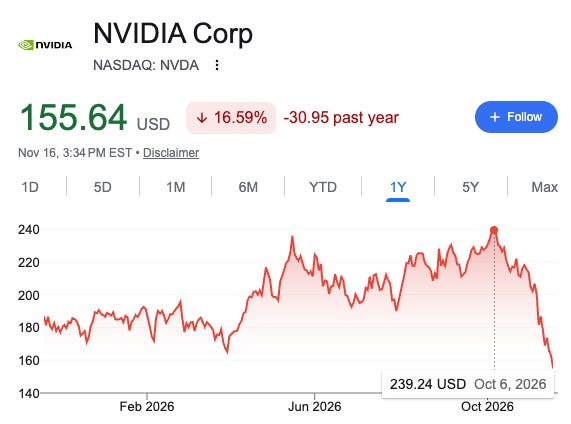
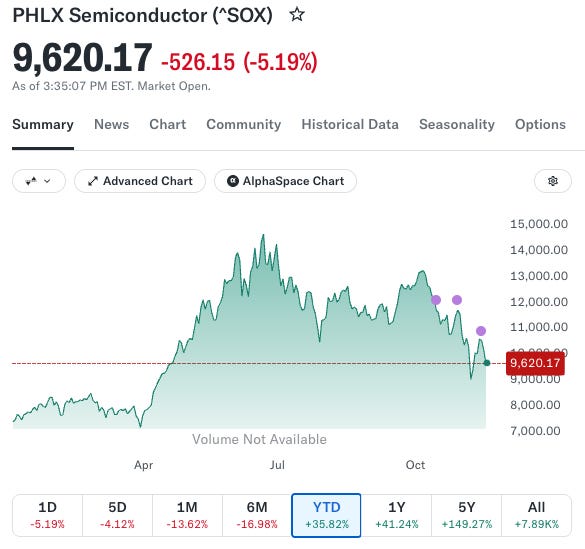
It’s not looking good out there. Nvidia’s market cap is down nearly 40 percent since October. The Philadelphia Semiconductor Index, which is a proxy for the overall chip industry, has suffered the same vertiginous fall. More commentators and analysts are asking: Did the AI bubble just pop?
Let’s begin with: No! I think it’s important to say that the AI buildout looks nothing like the dot-com bubble, right now. The stock market’s growth has reasonably traced the rise in corporate earnings. “Since the end of 2019, the S&P 500 has risen about 135 percent while its companies’ earnings have risen about 125 percent,” Jason Furman writes. No obvious bubble there.
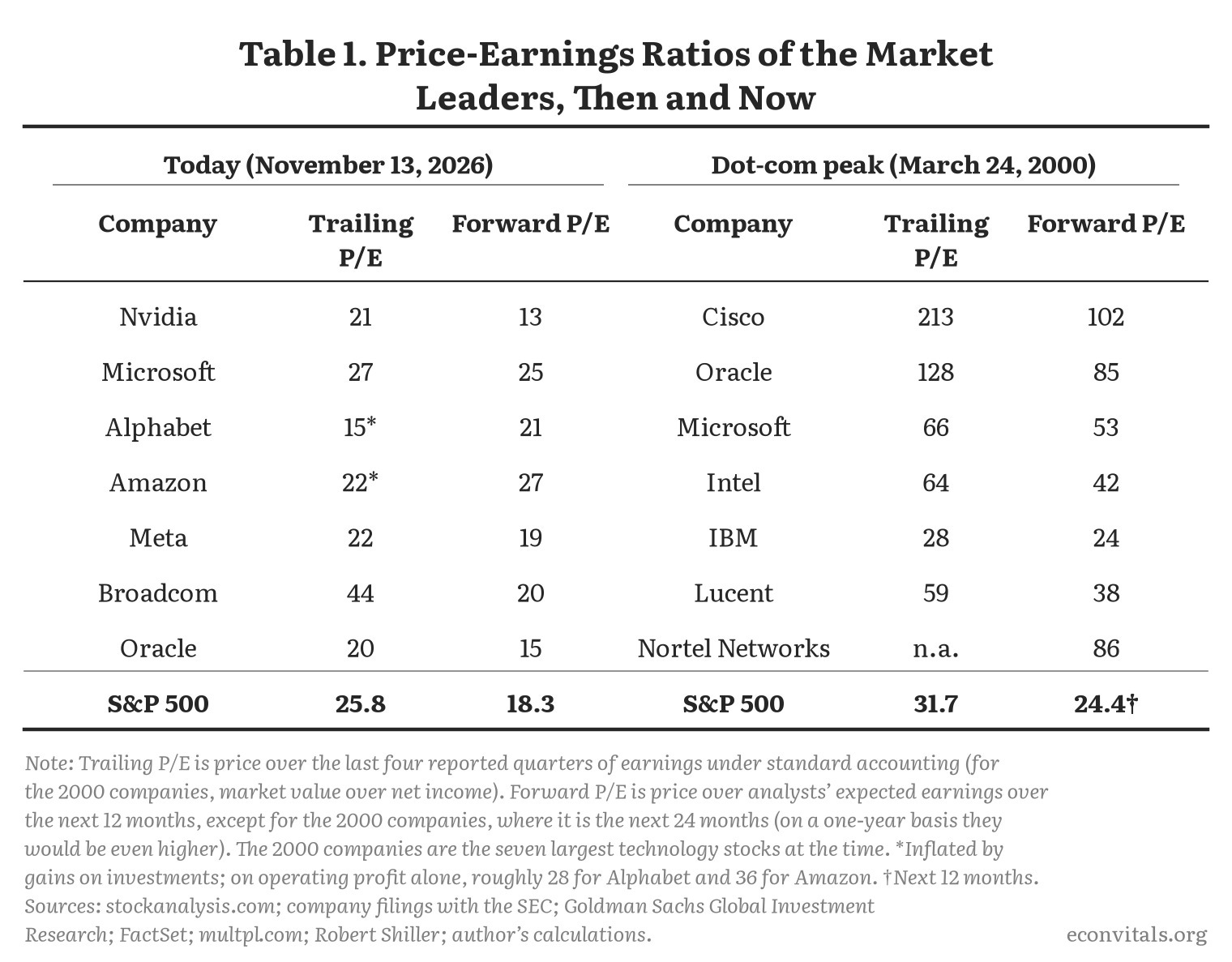
The dot-com bubble featured high-flying companies with little profit—and, sometimes, little revenue. Several dot-com darlings carried stock prices that were several hundred times their trailing earnings, which was an egregious sign of irrational exuberance. Nvidia, by contrast, trading at less than 13 times earnings. By this statistic alone, its stock price appears to be about as exuberantly bubbly as … uh, CVS.
Perhaps most importantly, the dot-com bubble burst because supply outran demand, as it so often does in commodity frenzies. By the early 2000s, more than 95 percent of deployed fiber-optic cable was unused by web companies, because telecommunications firms overbuilt in anticipation of demand that didn’t show up until several decades later. But AI is the opposite story. There is so much excess demand for chips that the price of renting an Nvidia H100 has “risen more than 50 percent since last December,” as Furman points out.
Even Paul Kedrosky—my go-to source for data-driven predictions of the AI bubble— concedes that not much should change in the short term for Nvidia after Jensen’s resignation:
Nvidia’s prospects change less than people think: While Huang was a force of nature, and he drove Nvidia single-mindedly and without a clear successor, the semiconductor industry is unusual. It has very long design/test/build cycles, so years of product are already in the works. His absence won’t stop that, nor will it be felt anywhere near as palpably as some starry-eyed tech types already argue.
And yet … for everything I just said, I don’t think the bubble case is hard to make. It’s not just Jensen Huang’s resignation, which is sending shudders through the AI-startup world. It’s not just rising borrowing costs across the economy, which could slow the data center buildout. It’s not just signs of slowing revenue growth for the frontier labs. And it’s not just fears that the 2026 election has empowered anti-AI politicians throughout the country. It’s all four of these things working together and compounding one another.
If we look back at November 2026 as the date of death for the AI bubble, I suspect that this will be the story, in one paragraph:
