

Perhaps you’ve heard the news: America is experiencing a religious revival and it’s concentrated among young people who are flocking back to the fold.
The Economist declared that “The West has stopped losing its religion.” The Washington Post noted that “Catholicism is drawing in Gen Z men.” The Wall Street Journal chronicled “A Church’s Campaign to Teach Lost Boys How to Be Men.”
If true, this would mean the abrupt end to the largest wand fastest period of secularization in American history. But Ryan Burge, the author of the Graphs About Religion Substack, says something weirder is going on. Yes, the share of Americans who say they have “no religious affiliation” has stopped rising—for now. But the religious revival among young people is more mirage than divine miracle.

There is a story that I thought I knew about the state of religion in America. On one side of the god divide, you had secular Americans who were anti-institutional, skeptical of traditional authorities, and struggling to build new systems of belief to organize their lives. On the other side, you had religious Americans who were fond of tradition and proud of centuries-old institutions of faith. But Burge told me that the fastest growing phenomena in American religion—the rise of the non-believers and the rise of new “non-denominational” Christian churches—are being powered by the same phenomenon, which he calls the “Substack-ification” of religion.
In today’s interview, which is luxuriously adorned with Burge’s graphs—we discuss the history of religion in America, the rise and pause of modern secularism, how America’s fastest growing churches are often personality cults, and why religious people seem to be happier, according to practically every measure.
Derek Thompson: Throughout the 20th century, America was, by all accounts, the most religious, rich country in the world by far. Four hundred years after the Scientific Revolution, 100 years after Nietzsche declared, “God is dead,” in America, God was not dead. What’s the deal with America and religion?
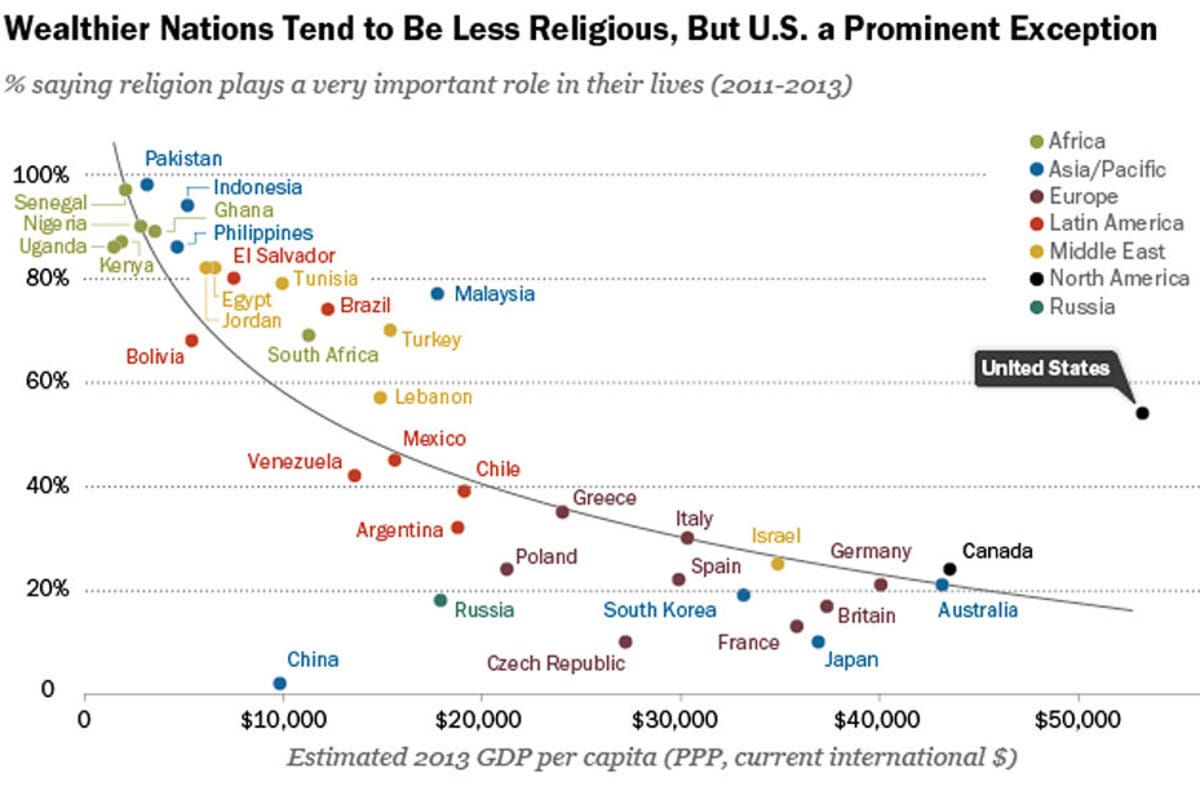
Ryan Burge: We are an insanely religious country and it becomes even more prominent when you do a scatterplot of GDP on one axis and religiosity on the other axis. All the other wealthy countries on earth—especially our Eastern and Western European neighbors, Scandinavian neighbors—are significantly less religious than we are. Our closest comparison is Switzerland in terms of GDP. But only 17% of the Swiss say religion is very important. In America, it’s about 50%. So we are three times more religious than we should be compared to our European neighbors. We’re more religious than basically any industrialized country on earth at this point.
Thompson: Why?
Burge: The Christian nationalists are going to hate this answer, but it’s because we did not have a state church at the founding. Really you can thank Thomas Jefferson for this. There’s a theory in religious economy—Finke and Stark wrote a book about it, called The Churching of America—that argues that, without a state church monopoly, competition between religious groups forces religions to compete to be the best, the most interesting, the most charismatic, the most attractive. We had the most robust religious market of any country in the Western part of the world. Add to that the fact that America was founded by deeply religious people. Religiosity is woven into the DNA of American culture. So I think that created the fertile soil, and then the fact that we had this marketplace just allowed that soil to be even more productive.
THE RISE—AND PAUSE—OF AMERICAN SECULARISM
Thompson: Between the 1940s and 1980s, the share of Americans saying, “I have no religious affiliation” is a flat line. And then, suddenly, the flat savannah becomes Mount Kilimanjaro. The lines starts going up linearly. What happened in 1990?
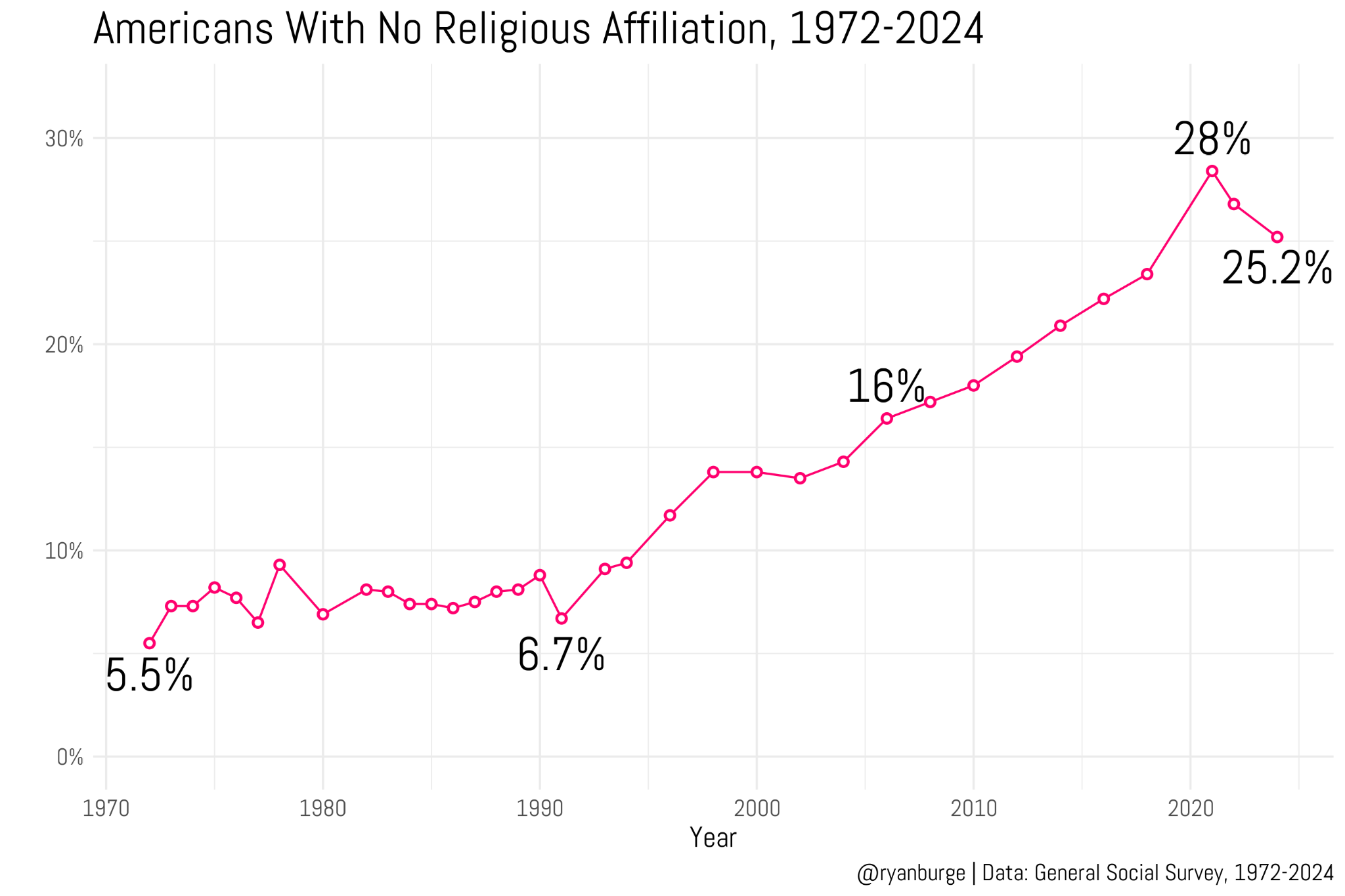
Burge: I call it the venture capitalist graph. Every VC wants to see that hockey stick. The nones were hanging around for a very long time. There was a paper written in 1968 by a sociologist called “The Nones: The Neglected Category of Analysis.” No one was even thinking about it.
The one factor that a lot of people in this field point to is the fall of the Berlin Wall. If you grew up in America in the 1950s, ‘60s, or ‘70s, you could not say you were an atheist because it meant you were a communist. When the Berlin Wall fell, the Cold War was over and atheism was no longer so toxic.
Second, the rise of the internet allowed people to say what they really believed online and find others who agreed with them. The example I give: Imagine you were a kid raised in Mississippi in the 1950s and you did not believe in God. You’re probably never going to tell another human being. But now you can go online and find the Atheists of Mississippi Facebook group or sub-reddit, and that emboldens you to say what you really are.
The last thing I’ll say is that it has to do with politics. I really do think Newt Gingrich is one of the worst politicians we’ve had in terms of the trajectory of America. He decided he’d rather win than be a good person, and dragging the Democrats through the mud was how he’d do it. Republicans won the House majority in 1994 for the first time in years. Then both sides started going in the mud. The Republican Party started calling Democrats evil because they’re not the party of evangelicals, and began courting evangelicals and conservative Catholics. That set off what we call the God gap — the idea that the Republican Party is the party of people of faith and the Democratic Party is largely becoming the party of the non-faithful. I think that might be the most important political-religious phenomenon in America right now.
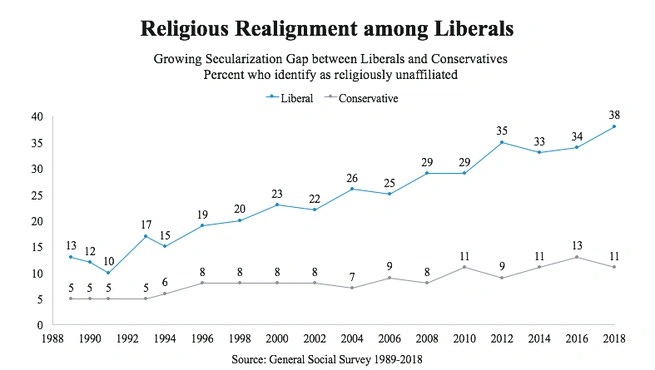
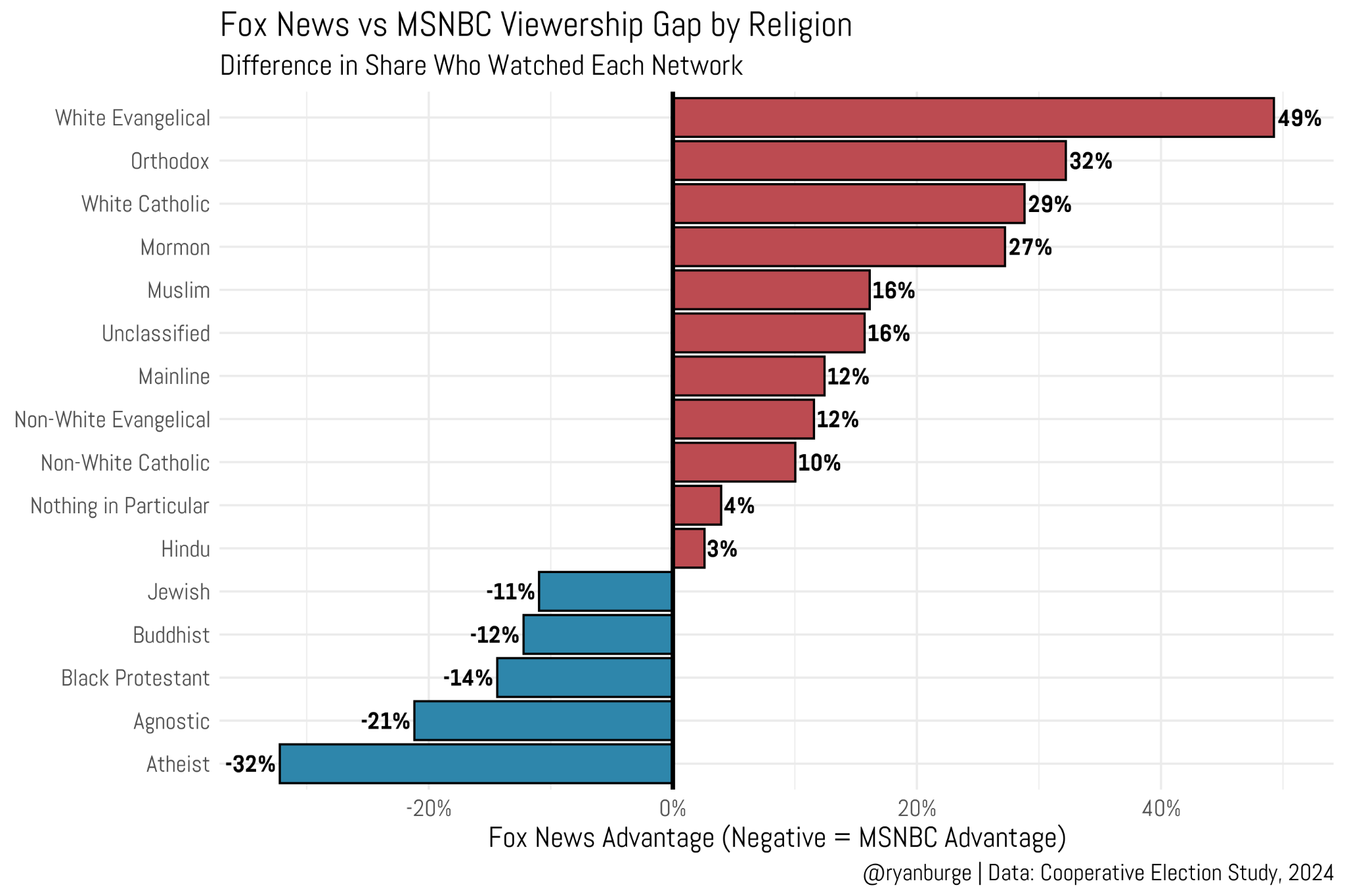
Thompson: So it was this dual connotation shift. Atheism went from a negative reputation during the Cold War to no reputation, or even a positive reputation, and Christianity became fused with Republican politics in a way that alienated liberal young people.You have a really compelling chart in one of your essays on the religion gap, looking at who watches Fox News versus MSNBC. According to your analysis, atheists are more liberal and more likely to watch MSNBC than white Catholics or Mormons are to be fviconservative.
I want to continue telling this story. We’ve explained why America is so religious and why the inflection point happened in the early 1990s. But at some point between 2019 and 2022, the share of Americans who said they have no religious affiliation, which had been rising for 30 years, just stopped. What happened in 2020?
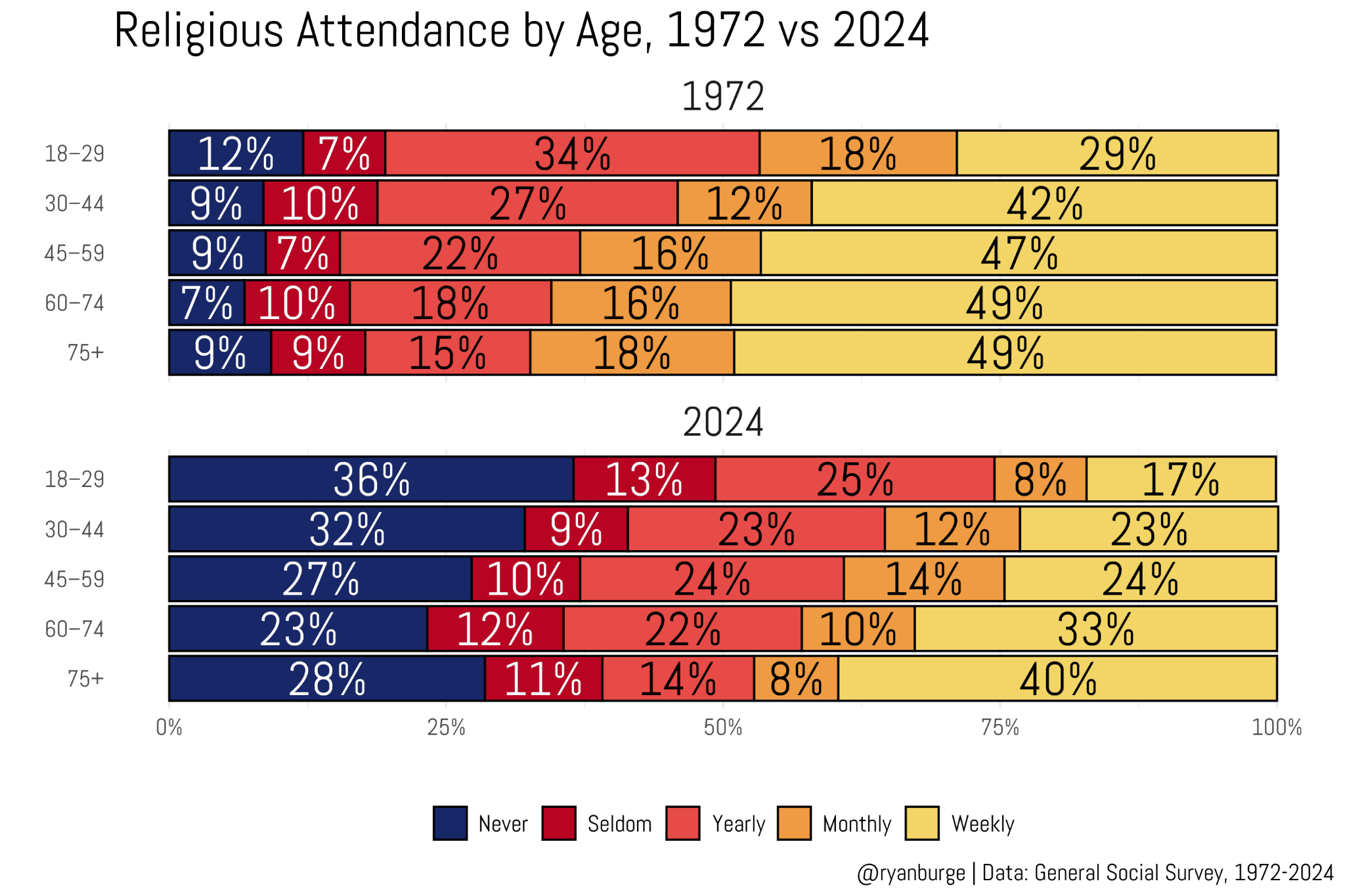
Burge: If you’ve watched Fox News, you’d know about what they call a massive religious revival. But no — it’s not a revival, it’s just a pause. What we’re seeing is that older Americans are more likely to say they’re religious today than they were even five years ago, and you’re seeing that with Gen X too. A slight return to religion among middle-aged and older Americans is driving the aggregate number to stay flat or maybe even tick down a little.
Thompson: Why?
Burge: We don’t know exactly why. I do think at some level it’s politics. A lot of older Americans are Republicans, especially white older Americans. Part of the return of religion is: “I’m a Republican, I’m a conservative, and that’s why I say I’m religious.” But they’re not actually going to church. They just say they’re religious because that’s what their tribe does.
The crucial point is that the share of Americans who are non-religious will go up in the future unless something dramatic changes—something we've never seen before in the history of modern polling. Millennials are about 40% non-religious. Among Gen Z, it's around 45%. Boomers are going to die eventually. For every boomer who dies and is replaced by a Gen Z, the aggregate number of nones rises through generational replacement.
Thompson: There’s one interpretation of what’s happening right now that says young Americans — and in particular young men with no clear political affiliation — are swarming back into the churches. Is that happening?
Burge: To parse out young people from a polling standpoint is really hard. They’re a hard group to poll, because they’re hard to contact and they don’t want to answer surveys. People don’t realize that even the gender gap thing among Gen Z is mathematically hard to parse. You’re cutting a sample from everyone down to just Gen Z, then cutting it in half again between men and women. You’re talking about a subgroup of a subgroup. Seeing a change there that’s statistically significant would take a sample size so large we can’t collect it.
All these anecdotes are interesting, but the idea that young people are coming back to church en masse is just not supported by any data I’ve ever looked at.
THE SUBSTACK-IFICATION OF AMERICAN RELIGION
Thompson: What religions and denominations are growing the fastest right now?
Burge: There’s a thing in American evangelicalism called non-denominationalism. For those who don’t live in that world, these are the churches you drive by that look like factories or office buildings. They’re called things like The Journey, The Ramp, The Bridge, Life Church. There’s one called I Heart Church; that’s literally their legal name. There’s one called Enjoy Church in St. Louis. Those non-denominationals were a rounding error in American Christianity 50 years ago: 3% of Americans were non-denominational then, and now it’s 14% of all Americans. That’s 35 to 40 million people.
For comparison, the largest denomination is the Southern Baptist Convention at 12.5 million. Non-denoms are probably three times that size. One-third of all Protestants are now non-denominational. The reason Evangelicalism is still 20% of America — the same size it was 50 years ago — is because of the rise of non-denominationalism.
Thompson: Talk to me like I’m a Reform Jew who knows nothing about non-denominational Evangelicalism — in part because that’s exactly who I am. What’s special about these non-denominational churches that explains their unique growth at a moment when so many other, more traditional faiths are declining?
Burge: It’s what I call the great reversal in American society. We used to be very top-down, very hierarchical. If you wanted to be a pastor, you had to go through an ordination process, get approval from a denomination, and then they would place you in a congregation. This is the absolute opposite of that. They don’t ask permission to start a church. A lot of them aren’t ordained. A lot have very little or no theological training. It’s almost like the social media internet model — you can build a following online and then that becomes the whole thing.
These churches are popping up by the thousands all across America. They’re the most grassroots form of religion you could possibly have. A lot of these churches were literally started by a guy in his basement having a Bible study with two or three couples. He might have been a real estate agent, an insurance broker, a construction company owner—and he just starts a Bible study. Then it grows from eight people to eighteen to eight hundred, and it just becomes this organic thing.
Some of those pastors are proud of the fact that they didn’t have to seek permission to start the church, that they had very little formal training. They say ”God did this.” And people like the accountability too. When you put $100 in the plate, that $100 is decided upon by people sitting in that room. The elders, the deacons, the pastor are all right in front of you and you can talk to them any Sunday. Whereas if you gave money to the Catholic Church, some of it goes to some diocese, to the Vatican, and it goes away and we don’t know where. Non-denoms have almost no bureaucracy. It feels renegade: “Screw what everyone else wants. We’re going to start a church because God wants us to.” And that has been incredibly successful and has really changed the trajectory of American religion.
Thompson: It’s interesting, because I would have thought that a resurgence of Christianity would be a counter-movement to the larger theme of declining institutions. I expected you to say, “Look, institutions are declining in media, but they’re strong in religion because of the religious revival.” And what you’re telling me is: No, the same thing that’s happening in media is happening in religion. You used to have to start as a beat reporter at a local paper, slowly work your way up to the New York Times; that has been demolished. Now you go online, start a Twitch, a YouTube, build an audience.
Some of these media startups are, if not personality cults, certainly personality businesses. Are these fast-growing non-denominational churches better understood as personality cults? Or are they better understood as tweaks of Protestantism that catch on because they feel grassroots rather than because they tapped into a 500-year-old tradition?
Burge: Many of them are personality-driven, without a doubt. And there’s an interesting problem coming in a couple of years, because a lot of these churches were started in the 1990s and 2000s, and those pastors are getting to the age where they don’t want to be pastor anymore. How do you hand that off to someone who is half as charismatic?
There are actually famous examples of this going wrong. There’s a church in Chicago called Willow Creek, which was one of the first non-denominational megachurches in America. Their pastor was Bill Hybels, and he had a five-year plan to retire and hand off to a new generation, including both a male and a female pastor. He had the whole thing planned out. Then it came out that he was involved in sexual harassment, and everything fell apart. Both new pastors resigned. Most of the elder board resigned, accused of covering it up. The church declined 30 to 40% in attendance. That is the weakness of this whole model.
Denominations will continue to endure because they have structure in place to carry you over the chasms of uncertainty. Non-denominationals have no structure. It’s all based on who the pastor is. It’s the Substackification of American religion. You start your own thing. You go outside the ecosystem, you don’t need all the structures. That’s almost exactly what these non-denominational churches are doing. You’re not here for Methodism or Lutheranism. You’re here for my flavor of American Christianity and the way I preach it. And people are drawn to that by the tens of thousands. It’s the only major segment of American religion that’s growing.
Thompson: You’ve really changed my mind in the last few minutes. I came into this conversation with the frame that the rise of secularism in America was all about the decline of institutions and the rise of individualism. But the story you’re telling is that many of the biggest success stories within Christianity right now are about anti-institutional individuals building a broadcast that is one-to-one-million audience. So the same underlying sociological phenomenon that one could use to describe the rise of the nones is the same thing powering the renaissance of Christianity in some parts of America. It just shows how unbelievably powerful some of these zeitgeists are — that they can explain and power movements that seem, in terms of their outcomes, to be entirely opposite. On one hand, people are becoming less religious. On the other, people are becoming more religious. But it’s the same anti-institutional zeitgeist powering both.
Burge: Think about Donald Trump too. He ran outside the party — “They don’t want me to be the candidate, they’re actively working against my candidacy.” He used that as a badge of honor, just like those pastors say, “Yeah, I don’t need to get ordained. I don’t need permission to start this church. God wants me to.” He was a bottom-up, grassroots president. That’s the great reversal.
All the power in society now comes from building a following on social media. If you build a big enough following, you can literally change the world, whether it be religion, politics, or culture. I don’t think we fully grasp what that means in terms of how we think about where power comes from. We destroyed all the gatekeepers. Is that necessarily a good thing? I would argue a little bit of gatekeeping is what kept us safe. Ivermectin is not the solution to all your problems, but when you destroy all the gatekeepers, it can seem like it. It’s almost like we’re living in a relativist world where no one has the truth. The destroying of hierarchy and leadership in all the structures we had are leading us into a new era, changing everything about what authority looks like, who we listen to, and what the truth is. And I think American religion, whether it realizes it or not, led that charge with the rise of these non-denominationals.
Thompson: The idea that anti-authority philosophy is powering the revitalization of Christianity as much as it’s powering the rise of secularism is a strange idea. I like it.
THE FOUR TYPES OF NON-BELIEVERS
Thompson: I want to talk a little bit about the “nones.” The same way that non-Christians see Christianity as one big monolith, people looking at non-believers think it’s just one big group of people who hate Christianity. But you’ve done a really good job explaining how there are four subcategories of non-believers. I’d love you to run through those four categories.
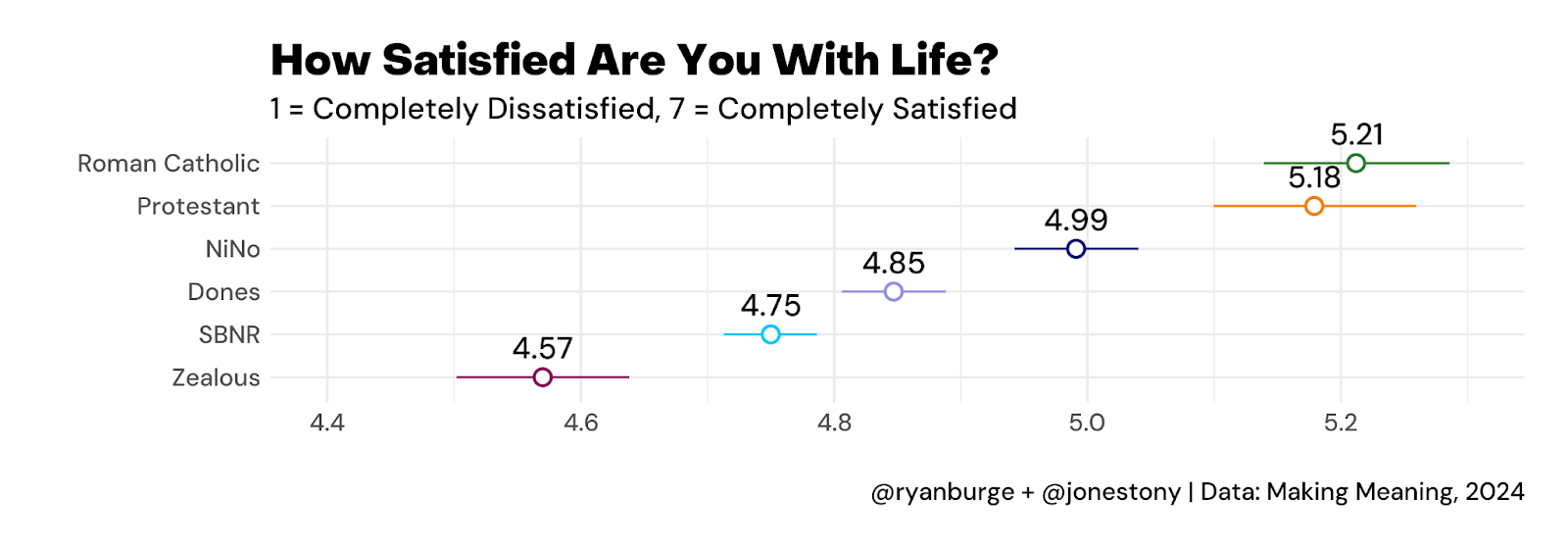
Burge: We got a Templeton grant and did a survey of 12,000 non-religious Americans. For a long time the nones were just one group. When you’re 5% of America, you can be a monolith. empirically speaking. But you can’t go from 5% to 30% and still call the whole group “the nones.” There have to be internal categories. So we did this 12,000-person survey and created a four-part typology, myself and my coauthor Tony Jones.
One is called SBNRs: spiritual but not religious. These are the woo-woos. They don’t believe in Jesus, Muhammad, or Buddha, but they want to know your astrological sign. They think believing in Jesus is absolute nonsense, but they believe the star sign you were born under changes your entire life trajectory. That makes more sense to them.
Thompson: To make fun of myself: In my 20s, I certainly wasn’t very religious. And when I was dating, I believed I had a lucky pair of socks. If I wore those socks, it would be a really good date. After months, maybe years, of believing quite fervently in the concept of lucky socks, I realized: My theology is that there is no God, except a god of socks. The Almighty has no control over anything in the world, except that after creating the heavens and the Earth and the animals and the humans, His only domain of care is the degree to which these striped socks lead to an enjoyable date. Individual theologies can sometimes make absolutely no sense when you look at them from 30,000 feet up. A lot of human belief comes from a place of instinct that isn’t exactly well-planned before it’s articulated.
So anyway — I interrupted your four-part breakdown. We’ve talked about the spiritual but not religious. Keep going. What are the other three subcategories?
Burge: The second is more methodological. I call them the NINOs, nones in name only. A quarter of the nones are NINOs. A lot of these people say they have no religious affiliation, but then you ask them questions about religious practices and they actually do a bunch of religious things. Those first two groups — SBNRs and NINOs — make up 60% of the nones. We think those groups are generally more open to religion based on our questions about religious openness.

The bottom two groups are not at all open to religion. One we call the “Dones,” because that’s exactly what they are. They’re as far from religion as you can be: 1% believe in God, less than 1% pray at all, 2% go to church once a year or more. And we asked them, “What happens when you die?”, 77% of them said say, “When I die, my existence ends.” They’re also the oldest of the four groups. The boomer atheists, in my mind, are the dones. They make up about a third of all nones.

And then the last category — only 10% — might be the most fascinating. We call them zealous atheists. If you go on Reddit’s r/Atheism subreddit, that’s who you’re seeing: people who are atheist and angry about it, and who want you to become an atheist too. We asked all the nones, “Have you tried to convince someone to leave religion in the last 12 months?” On average, 5% of nones have tried to de-convert someone. Among zealous atheists, it’s a majority.

So it’s much more nuanced than “all nones hate religion, all nones are atheists.” A significant number of nones do believe in God or a higher power at some level. A lot say they’re spiritual, a lot have quasi-religious practices whether they realize it or not. Very few people are completely aspiritual and areligious. It’s more of a gradient than an on-off switch.
Thompson: I want to circle back to the spiritual but not religious. You have a really good picture of how they differ from the rest of the none category. They’re more likely to do yoga, meditate, believe in astrology or horoscopes, use crystals or tarot cards, burn sage, use mind-altering substances. It’s interesting to me that there’s this category of Americans who have gone into religion as if it’s a foreign country, harvested certain souvenirs, and brought them back to the world of secularism. They practice yoga but have no interest in understanding its religious origins. They meditate but are not remotely interested in any Buddhist version of nirvana. Tell me about this group. Who are they? Are they growing? And what do we misunderstand about them?
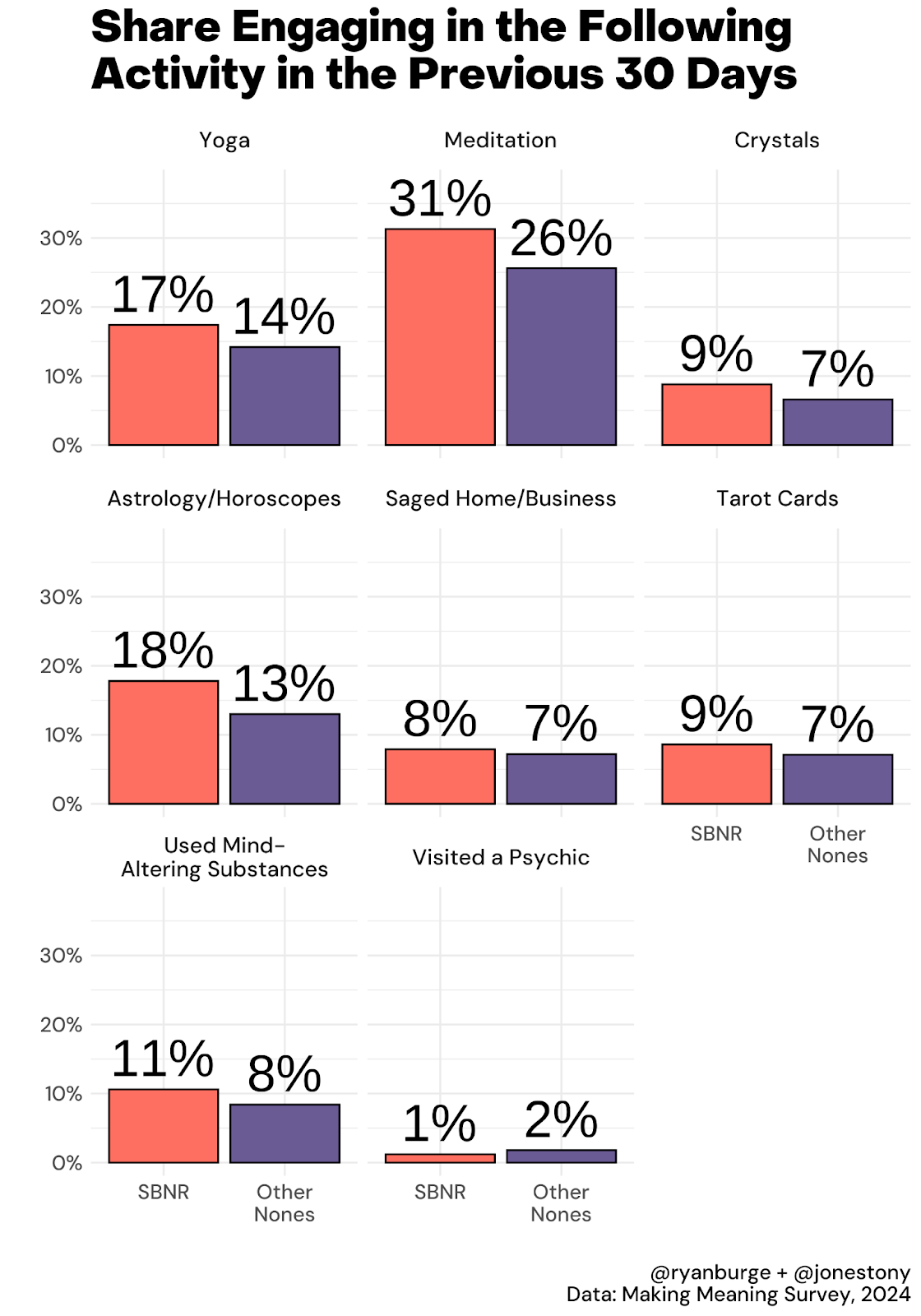
Burge: People think that a lot of people who aren’t religious are still very spiritual. That’s a big misconception. Among all nones, 25% said spirituality was very important to them. Among the religious, 61% said spirituality was very important. So the idea that lots of non-religious people are replacing religion with spirituality is actually not true. Most people who are non-religious are also non-spiritual at the same time. SBNRs are one manifestation of non-religion, but they’re not the dominant one.
What you were describing, Derek, is a concept that Christian Smith pioneered about 20 years ago called moralistic therapeutic deism. This was the idea that “God wants me to feel good about things.” You take your lucky socks, or astrology, or you go to mass once a year at Christmas. You pick and choose the theology that makes sense to you and push away whatever doesn’t make you feel good. I think that’s what SBNRs have done. They pluck out certain practices from major religious traditions—”I’ll take the parts I like and leave the rest”—not realizing that one of the reasons religion has been so successful throughout human history is that it requires doing everything together.
There was a big media story 10 or 15 years ago about something called Sunday Assembly. It was “Church Without God.” A bunch of atheists got together on Sunday morning, had coffee and donuts, sang pop songs, heard a TED-style talk, and built community. It was a huge story. But most of those Sunday assemblies folded. They only wanted the parts of religion they liked and left the others behind. They were afraid to ask for money because it felt scammy, so a lot of them didn’t have the money to pay the musicians, or pay for the rental hall.
You can’t just pick and choose. It’s like a three-legged stool. You need all three legs. If you pull one out, it falls apart. A lot of people are doing that with religion right now. They’re walking down the buffet line, picking one piece, putting it on their plate, and calling it a spiritual life. That doesn’t endure.
RELIGION, HAPPINESS, AND THE ‘MOST CONCERNING TREND’
Thompson: Some people say: “If you knock God off the pedestal, it creates a vacuum for spirituality that has to be filled with something.” But what you see in the data is that in many cases, that vacuum is filled with more vacuum. People who are least likely to go to church are most likely to feel somewhat empty in their lives. Dropping out begets dropping out.
Burge: This might be the most worrisome trend I see in all the data. Twenty percent of Americans tell Pew that their religion is “nothing in particular.” This group is struggling economically. They have the lowest socioeconomic status of any religious group. They’re also the least likely group to participate in politics: putting up a yard sign, going to a political meeting. They are struggling in every possible way, because in many ways they’ve dropped out of the social fabric that holds American society up.
Here’s what people don’t understand about how religion works in America. The people most likely to attend a house of worship this weekend are those with graduate degrees. The people least likely are those with a high school diploma or less. I have never seen a single data source where that relationship is reversed. More education leads to more participation in everything in American life—not just religion, but politics, culture, society. And if you think about what religion does that’s invisible to the average person, it gives you the opportunity to move up in life by building a network of people who run businesses, who are managers, who can get your foot in the door at a new company. Whereas if you’re a nothing-in-particular who dropped out of everything, you’re putting your resume in a stack with a thousand others and no one knows who you are.
This dropping-out phenomenon makes their lives demonstrably worse in ways they don’t see or feel. Religious people are doing well because they’ve built a social network that is not fully visible to them, but is there to support them through their darkest times — when they lose a job, when they lose a spouse, when they’re going through depression or anxiety. Those social organizations carry them through.
This is creating a bifurcation in American society between the haves and the have-nots. What’s even scarier: among young people 18 to 22, the most popular response to “What is your present religion?” is nothing in particular. One-third of 18-to-22-year-olds say that. You’re setting yourself up for failure as you move into adulthood because you don’t have the social networks that your parents and grandparents had. What are you going to rely on? For many of them, the answer is Twitch, YouTube, and TikTok. They’re not going to get out into the world and try to make it better, because they have no social connection.
Thompson: You had a really striking graph that showed that the happiness gap between the religious and non-religious has roughly doubled between the boomer generation and this generation of young people. Why do you think that is?
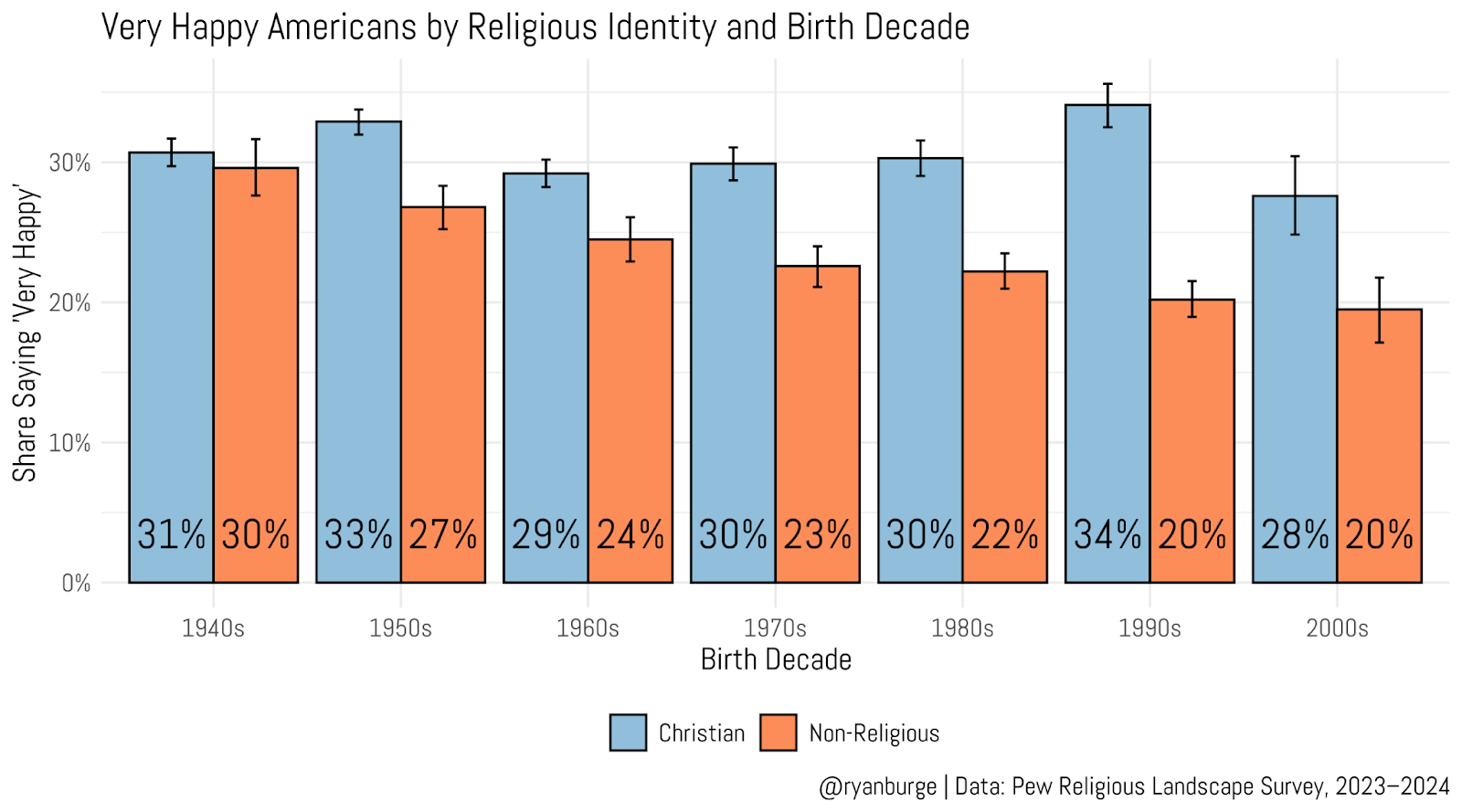
Burge: I think it’s about divide between liberalism and conservatism. No one wants to have this conversation, but liberals are not as happy as conservatives. You can cut the data however you want, control for whatever you want, run whatever math you want. Conservatives are happier than liberals. Part of it is this idea I hear constantly online: We live in the worst timeline possible, and everything is catastrophized. The polar ice caps are melting, Social Security is going bankrupt. You and I both came of age during the Obama ascendance, and Obama was a hopeful politician. He was good at instilling the idea that democracy could be good, that America could be a beacon for the world. Think about the politicians who have run for election since. How many are truly inspirational? Not very many.
You know where I hear the most inspirational stuff? At church. That’s where I get inspired to feel positive about things. It helps reorient me toward the positive. Whenever I give a talk, the last question I always get is, “Ryan, where’s your hope?” And for me it always comes back to faith.
This also connects to the fertility gap and the marriage gap. Married people are happier than unmarried people. People with children are happier than people without children. That’s not a conservative talking point, that’s just what the data says. And at some point we’ve got to say the true thing in the data: being religious, having kids, getting married, having an education—all those things tend to make people happier. And they’re all correlated with each other in this causal matrix. Being more religious means you’re more likely to be married, more likely to have kids, more likely to have social trust. If you’re more likely to have social trust, you’re more likely to be religious, more likely to go to college. All of these things are tangled up in a web that generates positivity. And if you’re not in that web, it feels like you’re going to struggle on metrics like happiness.
Thompson: I want to add one more ingredient: People who have more money are happier.
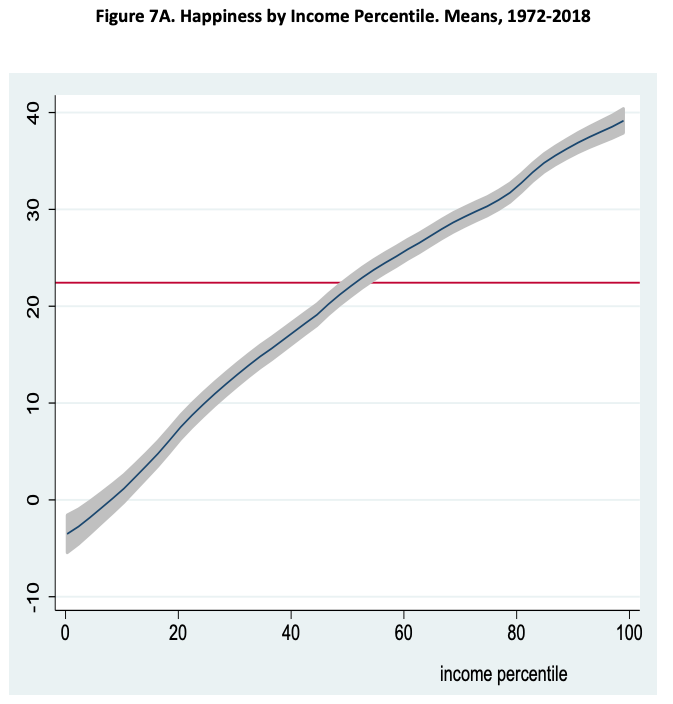
The cycle flows two ways. People who are educated, and therefore on the higher end of the income bracket, are more likely to get married. So not only do they have financial security, they also have relationship security, and that confers happiness or acts as a kind of vaccine against misery. There’s also research from the sociologist Kathryn Edin suggesting that men who were religious or went to church and then get divorced often lose their association with church, because it was the woman in the relationship managing the social calendar, including church on Sunday. Which meant that divorce precipitated disengagement with religion, rather than religion being the thing that dictated the relationship in the first place.
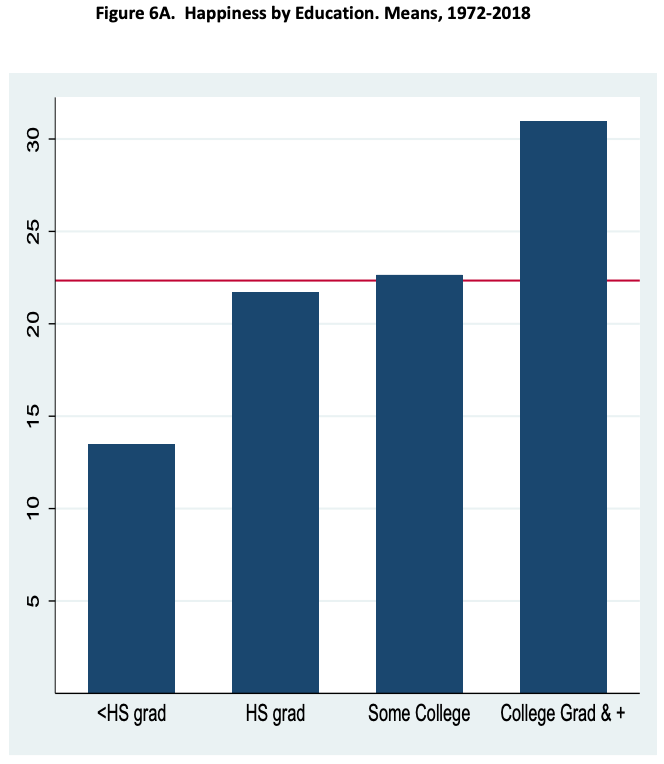
So rather than a clean domino effect—believe in God, then get married, then make money, thus be happy—I think about it as a complex cycle that keeps touching back on social connection. What is marriage? A social connection. What is a religious congregation? Social connections. What is one of the key differences between people with money and without? People with means can afford the experiences that protect social connections, rather than staying inside doing cheap things on their phone. To me, it all comes back to the fact that people need people, and we have a handful of institutions—marriage and religion—that are very good at keeping people attached to people. Folks who disengage from both aren’t doomed to misery. But there’s a lot you have to build on your own without institutions that are really, really good at keeping you connected to community. If you don’t have them, you have to build it yourself, and that’s just really damn hard to do.
Burge: There was a tweet a couple of years ago where someone wrote, “I wish there was a place to hang out that wasn’t expensive, with no alcohol, where we just make friends.” And I thought: “Oh, you’re going to hate my answer, but there’s probably one less than a mile from you right now that would absolutely love to have you show up.” All the comments were like, “No, not like that.” That’s the problem. People are waiting for some perfect social organization to fulfill all their loneliness needs and maybe find a partner. Your grandparents knew how to do this inherently, and we’ve forgotten how to just go and be social.
I speak to secular groups all the time, and they ask me, somewhat awkwardly, “Do you think our way of living is defective or inferior to yours?” I tell them: “I don’t want to speak about philosophical or theological things. I have my own theology and you have yours, and I’m not going to convince you I’m right. What I can tell you is: unless and until you create the social organizations that religion has provided for American society for the last 250 years, I’m going to think your way of living is not as good.” And by the way, that’s not just Christianity. That’s Judaism, Islam, Latter-day Saints. The community of people meeting together regularly to share their lives, create a mutual aid society for each other, and serve people in the community—that is an objectively good thing.
Religion always has a vertical component — you and God, your understanding of higher things — but it has a very strong horizontal component too: just hanging out with other people. Rodney Stark talked about this in the context of the Black Plague. A third of Europe died. But the death rate in Christian communities was lower, not because God was protecting Christians, but because Christians did not leave other Christians behind when they got sick. They tried to take care of them, feed them, nourish them. And by doing that, they actually lowered their own death rate. So it’s not magic, it’s science. Just taking care of other people is in some ways a miraculous thing, and that is how religion operates. You don’t have to believe in any woo-woo, any resurrection, any miracles to understand the miracle of what it means to hang out in community with people for a long period of time who want to help you and you want to help them. We’ve forgotten that part. There is a value in just showing up and being part and building a community. If you believe in none of it, it won’t matter, because those other people believe in you and you believe in them. I really do believe that if the average person goes to an average house of worship on a regular basis for a year or two, their lives will be demonstrably better in multiple dimensions—in ways they won’t even understand—because of being part of that community.
Thompson: I like the idea that “the strength of the vertical predicts the strength of the horizontal.” Strong beliefs in a higher purpose lead to strong connections with other people. That seems true outside of religion. Why does everyone make their best friends from school, or work, or their children’s school? Because they are obligated by law to attend school. That’s a very thick connection.
It might also explain the difficulty of forming a church without God. If the vertical is going to be weak, the horizontal is going to be weak. If you have a book club with people who don’t really love the same novels, it doesn’t last long. Whereas with church—if you have people who at least somewhat believe in a higher power and believe in the structures of Catholicism, or Protestantism, or some non-denominational thing—it’s the strength of the vertical that explains the strength of the horizontal.
As I’m working on ideas about the antisocial century, I want to hold onto this: if you don’t have that central spine of purpose, the community won’t last. If your only purpose is “let’s get together,” that’s not enough. You need that higher purpose—that vertical spine—in order to build a truly strong horizontal community.
One comment on the mental health discrepancies between conservatives and liberals. It looks as though this is based on self-reporting surveys, and if so, I believe that the culture of the religious vs non-religious relating to reporting any issues with mental health could very much skew the results. I do not believe that the vast majority of religious people would ever say that they struggle with mental health, even if they display the behavior of someone who might indeed fit that description to others outside of the group.
It's interesting that the benefits of religion described here all have nothing to do with theology, but are often downstream of education. In many ways, for a few years, college acts as the social space that churches used to.
It's also notable that the church abuse scandal didn't come up at all. Growing up in a majority Catholic area, there was probably nothing stronger pushing people away from religion than that.